

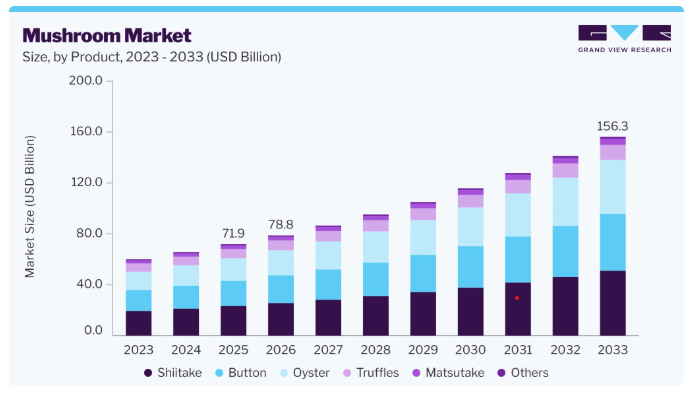

The global mushroom market is witnessing strong growth as consumers increasingly adopt plant-based diets, prioritize health-conscious food choices, and seek natural ingredients across food, wellness, and personal care products. The Mushroom Market was valued at USD 71.9 billion in 2025 and is projected to grow from USD 78.8 billion in 2026 to USD 156.3 billion by 2033, registering a CAGR of 10.2% from 2026 to 2033. Rising demand for protein-rich vegan alternatives, functional nutrition, and processed mushroom products is supporting industry expansion. Asia Pacific dominated the global market with a revenue share of 78.7% in 2025, supported by established mushroom consumption patterns and production across several regional economies.
Mushroom Market Trends and Key Insights
The market is evolving beyond traditional fresh mushroom consumption, with increasing demand for processed products, functional ingredients, and mushroom-based wellness formulations.
- Product: Shiitake mushrooms held the largest market share, accounting for 32.4% of revenue in 2025.
- Form: Processed mushrooms are expected to register the fastest CAGR of 10.7% over the forecast period.
- Distribution: Supermarkets and hypermarkets accounted for 38.27% of market revenue in 2024, while online stores are projected to grow at the fastest CAGR of 10.7%.
- Application: Food applications represented approximately 86.71% of global revenue in 2024.
- Regional Performance: Asia Pacific led the market with a 78.7% revenue share in 2025.
Growing Demand for Plant-Based and Functional Nutrition Drives Market Expansion
The increasing shift toward plant-based diets is a major factor supporting mushroom market growth. Consumers are reducing meat consumption and seeking nutritious alternatives that provide protein, texture, and savory flavor. Mushrooms offer approximately 3.3 grams of protein per 100 grams of serving, making them a suitable ingredient in vegan and vegetarian diets.
Health consciousness is further strengthening demand. Mushrooms contain vitamins B2, B3, and B5, zinc, and antioxidants, while being low in calories and nearly 99% fat-free. Their nutritional properties are attracting consumers interested in healthier food choices and wellness-oriented lifestyles.
Want to Understand What’s Driving Market Growth? Ask Prism AI for research-backed insights into market size, evolving opportunities
Functional varieties such as reishi, lion’s mane, cordyceps, and chaga are also gaining popularity in supplements, nutraceuticals, and fortified foods. Their perceived benefits in immunity support, cognitive health, stress management, and energy enhancement are expanding mushroom applications beyond conventional food consumption.
Product Insights: Shiitake Maintains the Leading Position
The shiitake segment accounted for the largest product share, representing 32.4% of global mushroom market revenue in 2025. Shiitake mushrooms are widely consumed because of their savory taste, umami flavor, and diverse health benefits. They are available in fresh and processed forms, with dried shiitake particularly popular due to its concentrated flavor.
Oyster mushrooms are projected to grow at a significant CAGR of 11.5% from 2025 to 2033. Their delicate texture and mild savory flavor support their use across different cuisines, particularly Chinese, Japanese, and Korean cooking.
Processed Mushrooms Gain Momentum Through Convenience and Longer Shelf Life
Processed mushrooms are expected to register the fastest growth among form segments, with a projected CAGR of 10.7%. These products include dried, frozen, canned, pickled, and powdered mushrooms.
Fresh mushrooms continue to attract consumers seeking organic and minimally processed food. However, their limited shelf life creates supply and distribution challenges. Technologies such as modified atmosphere packaging help maintain controlled storage conditions and extend product freshness.
Growing demand for convenient food products is encouraging manufacturers to introduce packaged mushroom products. Processing methods such as drying, freezing, and canning improve shelf life and expand availability across retail and foodservice channels.
Download a free sample report or claim your copy of this full market intelligence report
Distribution and Application Trends Strengthen Market Reach
Supermarkets and hypermarkets accounted for the largest distribution share, representing 38.27% of market revenue in 2024. These outlets provide consumers with access to multiple mushroom varieties and packaged products through established retail networks.
Online stores are expected to register the fastest distribution-channel growth, with a projected CAGR of 10.7% from 2025 to 2033. Convenience and price benefits are encouraging consumers to purchase fresh produce through digital retail platforms.
Food applications dominated the market, accounting for approximately 86.71% of global revenue in 2024. Mushrooms are widely used in household meals, foodservice preparations, and processed food products. Meanwhile, cosmetics applications are projected to grow at a significant CAGR of 10.5% from 2025 to 2033. Mushroom-derived compounds, including phenolics, terpenoids, selenium, polysaccharides, and vitamins, are attracting interest in skincare formulations for their antioxidant, moisturizing, and anti-aging properties.
Regional Insights: Asia Pacific Dominates the Mushroom Market
Asia Pacific held the largest market share of 78.7% in 2025 and is supported by established mushroom production and consumption across China, Japan, Indonesia, India, South Korea, and Vietnam. Traditional medicine systems, including Ayurveda and Traditional Chinese Medicine, also contribute to the use of different mushroom varieties. Their nutritional value and perceived immunity-supporting properties are further supporting regional demand.
North America accounted for a significant market share in 2024. The U.S. held 77.27% of North America's mushroom market revenue in 2025. Demand is supported by established retail networks, restaurant and foodservice consumption, and increasing interest in shiitake and oyster mushrooms. Mexico also contributes to regional consumption, with mushrooms used in food and religious practices.
Europe represents another important market, supported by developed retail infrastructure, higher per capita income, and demand for organic and exotic mushroom varieties. The UK held the largest share of the European market in 2025 and is an important producer and importer of cultivated and dried mushrooms.
Mushroom Market Future Outlook
The mushroom market is expected to maintain strong growth as demand for plant-based nutrition, functional foods, and natural ingredients continues to expand. Shiitake remains the leading product segment, while processed mushrooms and online distribution channels offer significant growth opportunities. Food applications will continue to represent the largest area of consumption, while cosmetics and wellness products are creating additional avenues for market expansion. Improvements in controlled cultivation, packaging, and supply chain efficiency are also supporting product availability and quality consistency. With growing consumer interest in health-conscious diets and value-added mushroom products, the global market is projected to reach USD 156.3 billion by 2033.


