

Bulk Recruitment for Real Estate Developers in India: Past, Present, and Future Workforce Trends

5 min read
0
Comments
65
Views
India's property landscape is undergoing an unprecedented expansion. According to industry reports by ETRealty and KPMG , employment in the Indian real estate sector is projected to touch 100 million by 2030 , propelled by rapid urbanization, GCC-led commercial office demand, data centers, and Tier-2/Tier-3 residential growth. Meanwhile, recent hiring trackers show real estate white-collar hiring surging by over 16% year-on-year .
For builders and developers, launching multi-tower townships or Grade-A commercial parks means onboarding hundreds of engineers, site supervisors, sales executives, and skilled trades people within tight RERA deadlines. As a result, bulk recruitment for real estate developers in India has transformed dramatically over the last decade.
Below is an in-depth look at how volume hiring in Indian real estate worked in the past, how top developers execute it today, and what the future holds for 2027 and beyond.
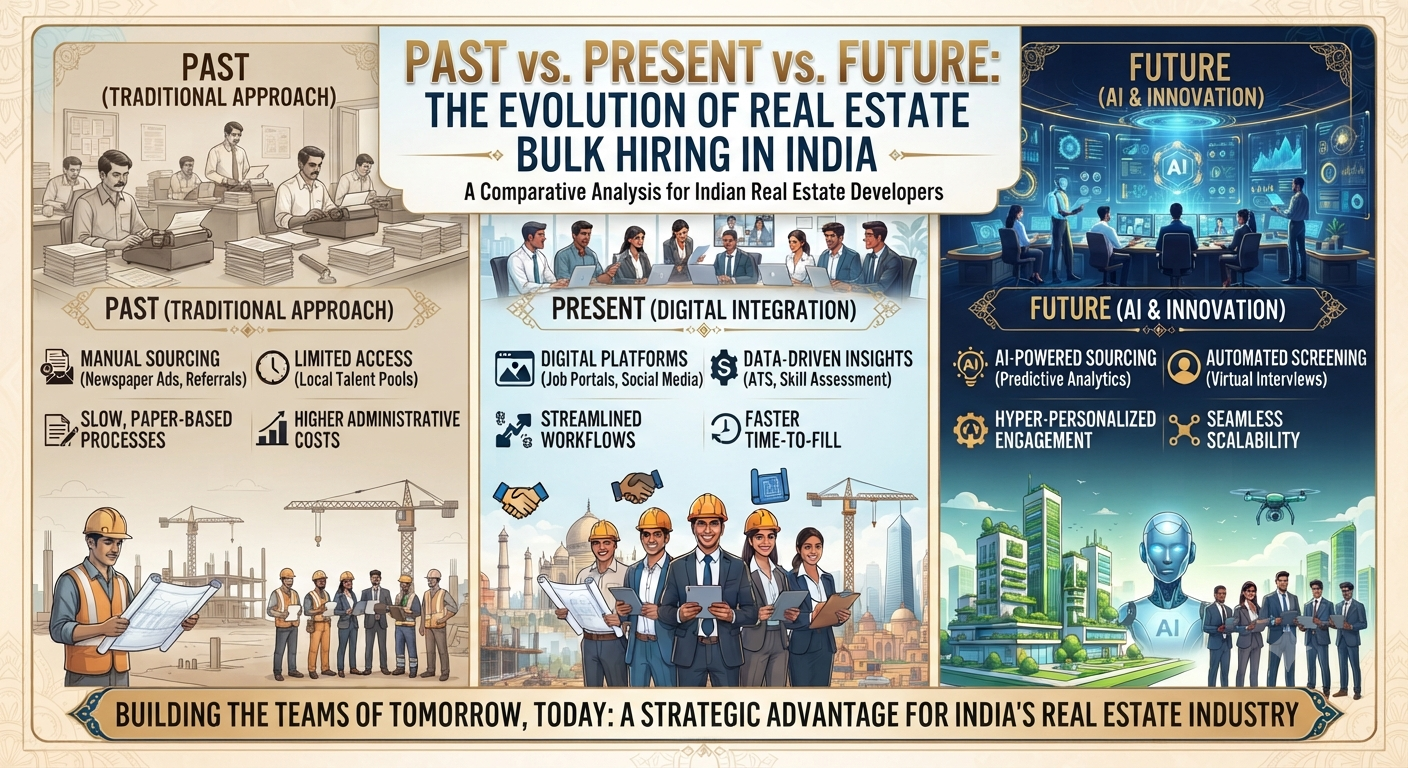
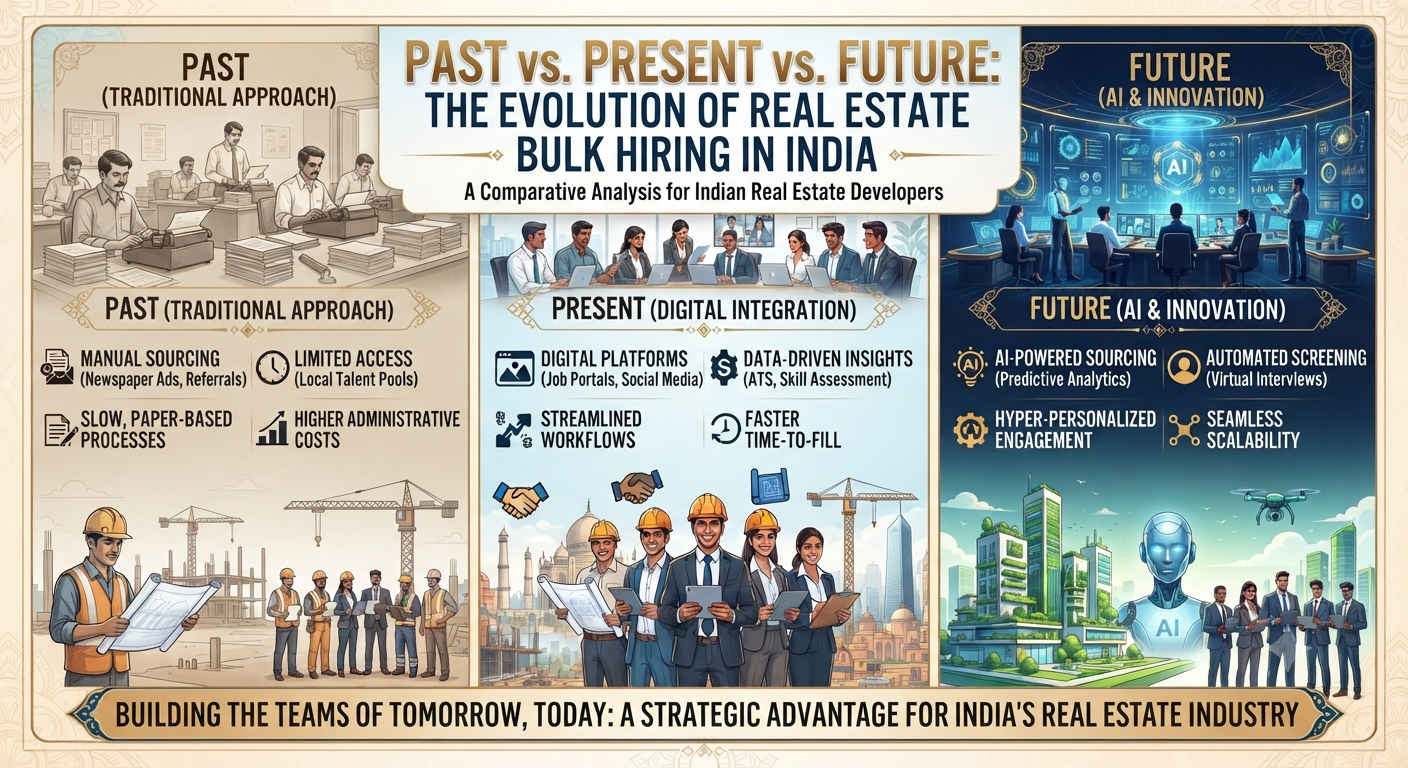
Past vs. Present vs. Future: The Evolution of Real Estate Bulk Hiring
To build a resilient workforce strategy, developers must understand how talent acquisition in the property sector has shifted across three distinct eras:
| Hiring Dimension | The Past (Pre-2020 Era) | The Present (2025–2026 Era) | The Future (2027–2030 & Beyond) |
|---|---|---|---|
| Primary Sourcing Channels | Unorganized local labor contractors, newspaper classifieds, and word-of-mouth referrals. | AI-assisted ATS screening, WhatsApp-first candidate funnels, regional job drives, and specialized RPO agencies. | Predictive workforce analytics, automated video trade-testing, and pan-India digital talent marketplaces. |
| Core Role Demand | Traditional civil engineers, basic site brokers, and general unskilled site laborers. | BIM-certified engineers, RERA compliance officers, CRM/channel sales managers, and certified safety stewards. | PropTech architects, AI/VR property experience designers, green-building (LEED/IGBC) auditors, and data center/logistics specialists. |
| Hiring Speed & Funnel | Slow, reactive hiring triggered only after project delays occurred (60–90+ days). | Milestone-backed backward planning with 48-to-72-hour batch mobilization and buffer pools. | Zero-lag “on-demand” talent benches integrated directly with project ERP and BIM timelines. |
| Compliance & Payroll | Informal cash payouts, fragmented documentation, and high statutory risk. | Strict adherence to India's consolidated Labor Codes, mandatory appointment letters, EPF/ESIC, and CLRA/BOCW digital logs. | Real-time automated compliance auditing, portable worker social security IDs, and ESG workforce reporting. |
| Geographic Focus | Concentrated heavily in top metros (Mumbai, Delhi NCR, Bengaluru). | Simultaneous hiring across Tier-1 hubs and booming Tier-2 corridors (Hyderabad, Pune, Lucknow, Jaipur, Indore). | Decentralized hybrid corporate teams paired with hyper-local Tier-3/Tier-4 micro-market sales and execution hubs. |
Key Takeaways from Each Era for Today's Developers
1. Why the "Past" Approach Causes Project Bottlenecks
In earlier years, developers relied heavily on local sub-contractors for blue-collar manpower and sporadic lateral poaching for engineers. While simple on paper, this reactive approach led to massive offer-to-joining drop-offs, inconsistent construction quality, and sudden site walkouts during peak festive or harvest seasons.
2. What Defines Successful Bulk Recruitment Today
Modern real estate leaders treat volume hiring as a structured supply chain rather than an ad-hoc HR task:
- Multi-Vertical Simultaneous Hiring: When a new project breaks ground, specialized bulk recruitment partners deploy three distinct talent tracks simultaneously—White-Collar Technical (Civil, MEP, Billing, QA/QC), Blue-Collar Skilled Trades (Shuttering carpenters, bar benders, masons, welders), and Revenue/Sales Teams (Pre-sales telecallers, channel partner managers, site closers).
- Practical Trade & Domain Vetting: Instead of relying solely on resumes, top agencies run hands-on trade tests for site workers and technical/BIM assessments for engineers before deployment.
- 100% Statutory Shield: By leveraging Contractual / Third-Party Staffing or Recruitment Process Outsourcing (RPO), developers offload payroll, EPF/ESIC filings, and labour code compliance onto the staffing partner—eliminating legal friction. [1, 2]
3. Preparing for the Future of Real Estate Talent (2027 & Beyond)
According to Colliers India, 80% to 90% of new commercial supply is moving toward green certification, while specialized asset classes like data centers, warehousing, and senior living are expanding rapidly. Future bulk hiring drives will prioritize:
- Sustainability & Green Tech Fluency: Bulk onboarding of engineers trained in IGBC/LEED standards, low-carbon materials, and energy-efficient MEP systems.
- Campus-to-Site Talent Pipelines: Leading developers are increasingly combining experienced lateral hiring with large-scale campus recruitment drives to build tech-savvy, digital-first sales and engineering cohorts.
- Attrition-Proof Batch Onboarding: Pairing new volume hires with structured 30-60-90 day integration programs and 60-to-90-day replacement guarantees to protect site momentum.
3 Proven Bulk Hiring Models for Indian Builders
- Contractual / Third-Party Staffing: Best for seasonal site surges, finishing phases, and large blue-collar crews. The recruitment agency acts as the Employer of Record, managing monthly payroll and statutory compliance.
- Recruitment Process Outsourcing (RPO): Ideal for developers launching multiple townships or commercial parks across cities. Dedicated recruiters embed into your organization to manage end-to-end volume hiring at a significantly lower cost-per-hire.
- Turnkey Bulk Permanent Placement: Designed for building core project management, architecture, and leadership sales teams on your direct payroll with strict replacement warranties.
Frequently Asked Questions (FAQs)
How has bulk recruitment for real estate developers in India changed recently?
It has shifted from slow, unorganized contractor hiring to tech-enabled, compliant volume staffing. Today's bulk recruitment uses WhatsApp-first candidate funnels, AI resume screening, mandatory trade testing, and full Labor Code compliance to mobilize teams within 48 to 72 hours.
Which roles see the highest bulk hiring demand in Indian real estate?
Demand is highest across three verticals: Civil/MEP site engineers and BIM specialists (technical), shuttering carpenters, masons, and electricians (blue-collar), and channel sales executives, pre-sales telecallers, and CRM managers (revenue).
What future skills will real estate developers hire for in bulk over the next few years?
Between 2027 and 2030, developers will increasingly hire in volume for green building compliance (LEED/IGBC), PropTech and CRM automation, VR/AR digital sales experiences, and specialized asset classes such as industrial logistics parks and data centers.


