

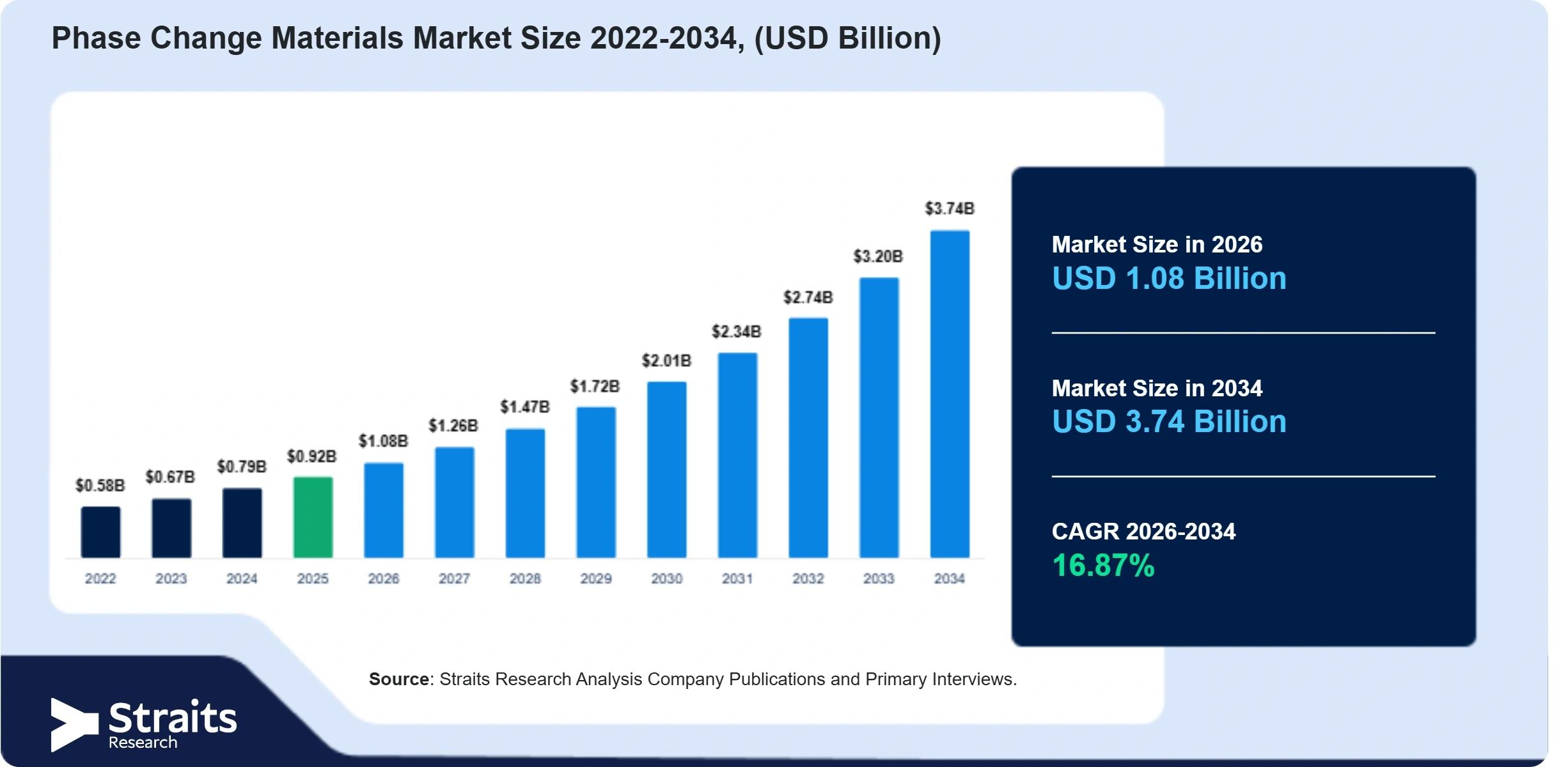

According to Straits Research, the global phase change materials market size was valued at USD 0.92 billion in 2025 and is projected to grow from USD 1.08 billion in 2026 to USD 3.74 billion by 2034, registering a CAGR of 16.87% during the forecast period (2026–2034). Europe dominated the phase change materials market with a share of 38.4% in 2025.
Phase change materials (PCMs) are substances that absorb, store, and release thermal energy during transitions between physical states, such as solid and liquid. These materials help regulate temperature by storing heat during warming and releasing it when temperatures decrease. PCMs are used in building materials, cold chain logistics, electronics cooling, textiles, energy storage systems, and temperature-sensitive packaging. Increasing demand for energy-efficient buildings, thermal management technologies, renewable energy storage, and temperature-controlled transportation is driving market growth.
Get Full Report: https://straitsresearch.com/report/phase-change-materials-market
Growth Drivers of the Phase Change Materials Market
Increasing Demand for Energy-Efficient Buildings
Growing emphasis on energy efficiency in residential, commercial, and industrial buildings is driving the adoption of phase change materials. PCMs integrated into walls, ceilings, insulation, and building envelopes help regulate indoor temperatures by storing excess heat and releasing it when needed, reducing heating and cooling demand.
Rising Adoption of Thermal Energy Storage
Phase change materials are increasingly used in thermal energy storage systems because they can store large amounts of energy during phase transitions. Their ability to manage heat loads supports applications in heating, cooling, and energy management systems.
Growth in Cold Chain Logistics
The expansion of pharmaceutical, food, and healthcare supply chains is increasing demand for reliable temperature control. PCMs are used in insulated packaging, refrigerated transportation, and temperature-controlled containers to maintain stable conditions for sensitive products.
Increasing Demand for Electronics Thermal Management
Electronic devices and computing systems generate heat during operation, requiring effective thermal management solutions. PCMs help absorb heat spikes and regulate temperatures in electronic components, batteries, and specialized equipment.
Expansion of Renewable Energy Systems
The growing deployment of renewable energy technologies is creating demand for thermal storage solutions that improve energy utilization. PCMs can store thermal energy generated by solar systems and support more efficient energy consumption during periods when energy generation is limited.
Technological Advancements in PCM Formulations
Research into organic, inorganic, and composite phase change materials is improving thermal conductivity, durability, stability, and compatibility with different applications. Material innovations are helping expand PCM use across industrial and commercial environments.
Applications of the Phase Change Materials Market
Building and Construction
PCMs are incorporated into building materials such as wallboards, ceiling panels, insulation systems, and concrete structures. They help reduce indoor temperature fluctuations and improve thermal comfort while supporting energy-efficient building design.
Cold Chain and Temperature-Controlled Packaging
Phase change materials are used in packaging solutions for food, pharmaceuticals, vaccines, and biological products. Their thermal storage properties help maintain required temperature ranges during transportation and storage.
Electronics and Battery Thermal Management
PCMs are applied in electronic equipment, battery packs, and thermal management systems to absorb excess heat and minimize temperature fluctuations. These applications are particularly relevant for electric vehicles, energy storage systems, and high-performance electronics.
Heating, Ventilation, and Air Conditioning Systems
PCMs are used in HVAC systems to store thermal energy and support heating and cooling operations. They help manage peak thermal loads and improve energy efficiency in buildings and facilities.
Textiles and Wearable Products
Phase change materials are incorporated into textiles, clothing, bedding, and wearable products to improve temperature regulation. These materials absorb and release heat in response to changing thermal conditions, supporting thermal comfort.
Solar and Thermal Energy Storage
PCMs are used in solar thermal systems and other energy storage applications to capture heat and release it when required. Their integration supports improved energy utilization and thermal energy management.
Emerging Trends in the Phase Change Materials Market
Development of Advanced Composite Phase Change Materials
Manufacturers are developing composite PCMs that combine phase change materials with supporting structures, conductive additives, or encapsulation systems. These formulations aim to improve thermal conductivity, prevent leakage, and enhance durability.
Increasing Adoption of Microencapsulation Technology
Microencapsulation is gaining attention because it allows phase change materials to be enclosed within protective shells. This improves handling, reduces leakage risks, and enables integration into building materials, textiles, coatings, and other products.
Growing Focus on Sustainable Thermal Management
The increasing emphasis on reducing energy consumption and carbon emissions is encouraging the use of PCM-based thermal storage solutions. These materials are being explored for applications that reduce cooling demand, improve energy utilization, and support more sustainable infrastructure.
Integration with Smart Buildings and Energy Systems
Phase change materials are increasingly being considered alongside smart building technologies, automated HVAC systems, and energy management platforms. Combining thermal storage with intelligent energy controls can help improve building energy performance.
Expansion of Electric Vehicle Thermal Management
The growing adoption of electric vehicles is creating opportunities for PCMs in battery temperature management, cabin thermal regulation, and heat control systems. Maintaining suitable operating temperatures can support battery performance and thermal stability.


