

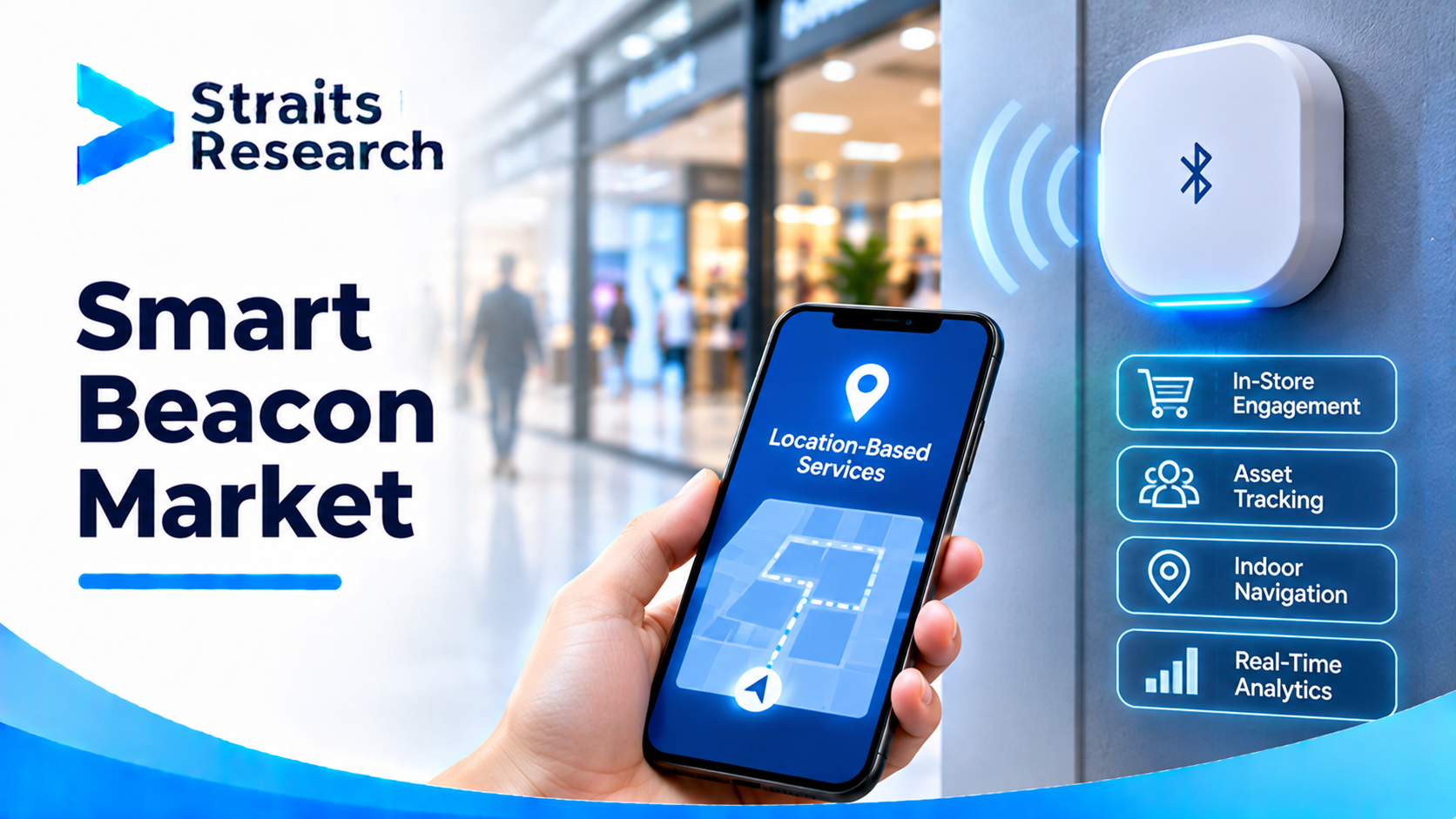

According to Straits Research, the global smart beacon market size was valued at USD 4.24 billion in 2025 and is projected to grow from USD 5.11 billion in 2026 to USD 22.92 billion by 2034, registering a CAGR of 20.62% during the forecast period (2026–2034). Europe held the largest market share of 35.4% in 2025, while North America is set to record the fastest growth at a CAGR of 31.4%.
-
Market Size 2025: USD 4.24 Billion
-
Market Size 2026: USD 5.11 Billion
-
CAGR (Forecast Period): 20.62%
-
Forecast Year: 2034
-
Projected Market Size: USD 22.92 Billion
-
Dominant Region: Europe
-
Fastest Growing Region: North America
Market Overview
Smart beacons are small wireless devices that use Bluetooth Low Energy and related technologies to transmit signals to nearby smartphones, tablets, and IoT devices. These devices support location-based services, indoor navigation, asset tracking, proximity marketing, and real-time communication. Smart beacon solutions include hardware, software, and services used across retail, healthcare, transportation, hospitality, and commercial buildings. Adoption of connected devices and location-based applications continues to shape the market.
Growth Drivers
Retailers use smart beacons to deliver location-based promotions, improve customer engagement, and provide product information to nearby shoppers. Hospitals and other healthcare facilities deploy beacon-based systems to locate medical equipment, monitor assets, and improve staff workflows. Transportation hubs and logistics operators also use indoor positioning solutions to support navigation and asset visibility. Wider use of Bluetooth-enabled devices further supports deployment across commercial and industrial environments.
Market Challenges
Battery replacement and device maintenance can increase operating costs across large beacon installations. Businesses that deploy hundreds or thousands of devices must manage battery life, hardware condition, and network performance across multiple locations. Indoor positioning accuracy can also vary due to walls, metal structures, machinery, and signal interference, which may require additional gateways, calibration, and software support.
Market Opportunities
Smart building applications offer opportunities for beacon suppliers that provide occupancy data, workplace analytics, and space utilization tools. Healthcare providers can also use beacon systems to monitor medical equipment, improve patient navigation, and coordinate staff activity. Companies such as Kontakt.io and HID can expand their offerings through integrated location services, analytics platforms, and enterprise asset management solutions.
Segment Analysis
By beacon standard, iBeacon is set to record a CAGR of 27.9% during the forecast period, supported by its established use in retail, proximity marketing, indoor navigation, and location-based services. Eddystone also serves applications that require Bluetooth-based identification and communication across compatible devices.
By connectivity type, hybrid connectivity is set to record a CAGR of 30.4%, supported by the combination of Bluetooth Low Energy with Wi-Fi, GPS, and other wireless technologies. This approach can improve coverage and positioning accuracy across complex indoor and outdoor environments.
By offering, hardware held a market share of 48.6% in 2025 due to the deployment of beacon devices across retail stores, healthcare facilities, transportation hubs, and commercial buildings. Services are set to record a CAGR of 28.5%, supported by demand for installation, integration, maintenance, and location data management.
By end use, retail held a market share of 28.4% in 2025, supported by proximity marketing and personalized customer engagement. Healthcare is set to record a CAGR of 31.5%, driven by the use of beacons for patient tracking, asset management, staff monitoring, and indoor navigation.
Regional Analysis
Europe held the largest share of the smart beacon market in 2025, accounting for 35.4% of global revenue. Proximity marketing, smart retail initiatives, and the use of location-based services across transportation, healthcare, and hospitality support the region's position. North America is set to record the fastest growth at a CAGR of 31.4%, supported by IoT adoption, connected infrastructure projects, and beacon deployment across healthcare facilities, airports, and commercial buildings.
Competitive Landscape
The smart beacon market includes wireless technology providers, location platform developers, and IoT hardware manufacturers. Key players include Estimote, Bluvision, Onyx Beacon, Leantegra, and Aruba. Other participants include Kontakt.io, Cisco, Gimbal, Accent Systems, Sensoro, and JAALEE Technology. Companies compete through device range, battery life, positioning accuracy, cloud connectivity, analytics, and integration with enterprise systems.
Recent Developments
-
June 2026: Japan-based Braveridge launched its +Beacon product series, with the first products comprising a button beacon and an environmental sensor beacon. The devices add event notification and environmental data capture functions to conventional Bluetooth beacon applications.
-
April 2026: Minew's MBM04 location relay beacon was highlighted in a Nordic Semiconductor announcement covering its use of the nRF54L15 system-on-chip. The device supports Bluetooth location relay applications in healthcare facilities, warehouses, smart factories, retail spaces, and commercial campuses.
Click to Read the Complete Insights & Report: https://straitsresearch.com/report/smart-beacon-market
Future Outlook
The smart beacon market is likely to benefit from wider use of location-based services across retail, healthcare, transportation, and commercial buildings. Hybrid connectivity, cloud-managed devices, and sensor-enabled beacons can expand applications beyond proximity marketing into asset monitoring and workplace management. Improvements in battery life and positioning accuracy may also support larger deployments across enterprise environments.
About Straits Research
Straits Research is a market intelligence company that provides global business information and consulting services. The company offers market reports, industry analysis, and strategic insights to help organizations understand market trends, assess opportunities, and make informed business decisions.


