English
 Arabic
 Français
 Spanish
 Portuguese
 Deutsch
 Turkish
 Dutch
Dutch
 Italiano
 Russian
 Romaian
 Portuguese (Brazil)
 Greek
Greek
 Réunionnais
 India
India
Market Dynamics and Competitive Landscape: Insights into the Brewer’s Yeast Industry
Autres |
2024-04-03 10:58:44
 Entreprises locales
 Runsound music
 La silver économie
 Affiliation Matrice 3x9
 Récompenses
 Babarun (BBRN)
 Calculez vos calories
 Collab Influenceurs
 Événementiels
 Procaly
 Affiliation
 Prêts Immobiliers

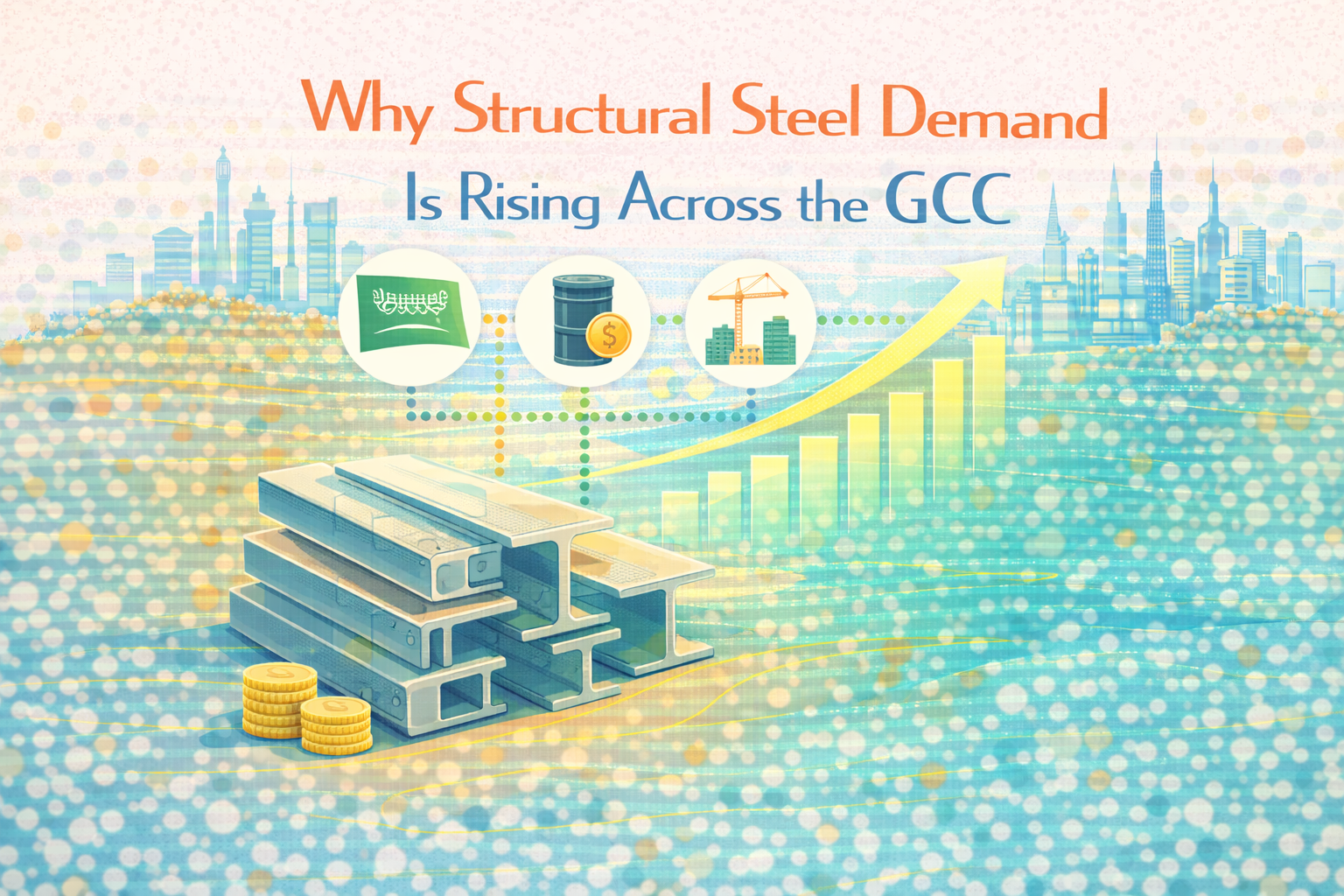
Structural steel is one of the most essential materials that have influenced the Gulf Cooperation Council's construction industry. With the Gulf Cooperation Council making rapid advancements through economic diversification, urbanization, and industrialization, high strength steel products have gained increasing demand. Starting from megacities and transport corridors to logistics and energy projects, structural steel is at the heart of fast, tall, and smart constructions made by the Gulf Cooperation Council.
In contrast to the cyclical patterns of booms and busts of the previous century, this time around the expansion is centered on national agendas for the future. The governments of the region are investing substantially in sectors other than oil, and this provides a pipeline of projects that depend on steel-intensive construction. That is why it is no exaggeration to say that the future of the global steel industry will be shaped by this region.
The most powerful driver of rising steel demand in the GCC is the scale and continuity of government-backed development programs. Saudi Arabia alone has more than USD 1 trillion worth of projects under execution or planning, spanning residential cities, tourism destinations, industrial zones, airports, and rail networks.
Projects such as New Murabba, NEOM, Qiddiya, and the Red Sea developments require massive quantities of rebars, beams, and fabricated steel sections. High-rise mixed-use buildings, long-span structures, and transport infrastructure all depend on structural steel for load-bearing capacity and design flexibility.
The UAE follows closely, with strong activity in logistics parks, industrial estates, ports, and urban redevelopment. Rail expansions, airport terminals, and warehousing facilities continue to push steel demand upward, particularly for long products and pre-engineered components.
This project-led environment has positioned the GCC Structural Steel Market for sustained growth rather than short-term spikes, supported by predictable public-sector spending and private-sector co-investment.
Beyond traditional construction, the GCC is witnessing a shift toward industrialized and modular building methods. Pre-engineered buildings (PEBs) and off-site fabrication are increasingly favored for factories, warehouses, data centers, and logistics hubs due to their speed, cost efficiency, and quality control.
Saudi Arabia’s rapid expansion of industrial land and logistics infrastructure has accelerated adoption of factory-built steel structures. Large-scale manufacturing facilities and storage complexes rely on standardized steel frames, roof systems, and portal structures that are produced off-site and assembled quickly on location.
This trend does not always increase total tonnage dramatically, but it raises demand for higher-precision fabricated steel products. Mills and fabricators capable of delivering engineered components, tight tolerances, and faster turnaround times are capturing a larger share of orders.
As a result, the market is evolving from commodity steel supply toward integrated fabrication and solution-based offerings.
Rebars continue to drive demand because they represent over half of overall demand. The high demand for rebars arises from the fact that this region relies largely on reinforced concrete construction of skyscrapers, offices, bridges, and public amenities such as stands. Massive foundations, slabs, columns, and transportation infrastructure rely heavily on rebar consumption.
The GCC region is dominated by demands from Saudi Arabia, which accounts for about half of the GCC's total demand. The sheer scale of construction activity in Saudi Arabia, coupled with expanding domestic capacities and a supportive government and environment for manufacturing steel locally, makes it a leading market in the GCC Structural Steel Market.
Transport and energy infrastructure provide another durable pillar for steel demand. Rail networks, metro systems, airports, and ports require extensive use of structural steel for stations, terminals, elevated tracks, and ancillary facilities.
Saudi Arabia’s airport expansion programs and regional rail connectivity projects across the UAE and Oman illustrate how transport investments translate into multi-year steel procurement cycles. These projects are less sensitive to short-term economic fluctuations, making them a stabilizing force for the steel industry.
In parallel, energy-related construction—such as power plants, transmission infrastructure, and industrial utilities—adds to demand for heavy sections and specialty steel products. As GCC countries invest in renewable energy and grid modernization, steel remains essential for structural support, equipment housing, and transmission frameworks.
The GCC structural steel industry is supported by a mix of large integrated producers, regional champions, and specialized fabricators. Saudi-based players such as Al Rajhi Steel, Saudi National Steel, Watania Steel, and Hadeed benefit from scale, domestic demand, and government-backed industrial strategies.
In the UAE, companies like EMSTEEL, Conares, and Union Iron & Steel play a significant role in supplying both domestic projects and export markets. Qatar Steel and QSTEEL support Qatar’s infrastructure and industrial needs, while Oman’s Jindal Shadeed and Hadid Majan contribute to regional supply diversity.
These companies are increasingly investing in product upgrades, higher-strength grades, and fabrication capabilities to align with evolving project requirements. Strategic expansions, asset enhancement programs, and partnerships signal confidence in long-term demand.
Despite strong fundamentals, the market faces notable challenges. Raw material price volatility remains a key risk, as the region depends heavily on imported iron ore, scrap, and semi-finished steel. Fluctuations in global commodity markets can quickly affect production costs and project budgets.
Freight disruptions and trade policy changes add another layer of uncertainty. Delays in raw material supply can disrupt fabrication schedules, while sudden cost increases complicate fixed-price infrastructure contracts.
To manage these risks, developers increasingly incorporate escalation clauses, and producers focus on inventory optimization and long-term supply agreements. Companies with diversified sourcing and operational efficiency are better positioned to navigate these pressures.
Structural steel demand in the GCC is not simply rising—it is becoming more strategic. As governments pursue urbanization, industrial self-sufficiency, and global competitiveness, steel will remain foundational to how the region builds its future.
The shift toward modular construction, advanced fabrication, and large-scale infrastructure ensures that demand will persist across economic cycles. Producers and fabricators that align with these trends will benefit most from the region’s transformation.