

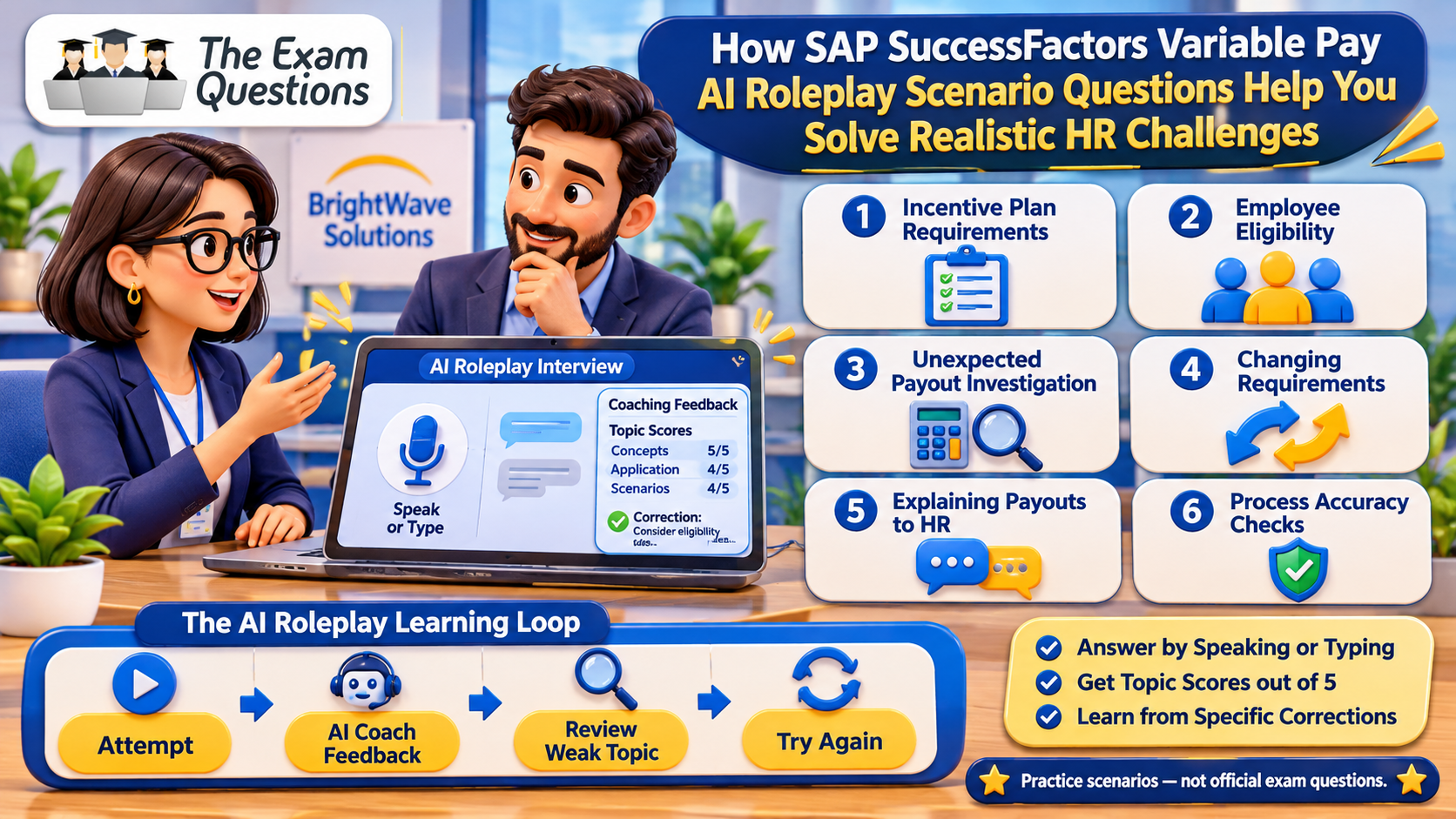
How SAP SuccessFactors Variable Pay AI Roleplay Scenario Questions Help You Solve Realistic HR Challenges

Knowing a definition and explaining it to a worried HR manager are two different skills. SAP SuccessFactors Variable Pay AI Roleplay Scenario Questions close that gap by asking you to think aloud, in business language, under gentle pressure. In this article you play the SAP consultant. Your client is a fictional company, and your job is to help its HR department through six realistic challenges.
Meet BrightWave Solutions
BrightWave Solutions is a mid-sized services firm with sales, delivery and support teams. Leadership wants to review how employee incentives are planned, calculated and explained. HR has called you in because staff have been asking questions the team cannot answer quickly.
An AI interviewer will pose one question per scenario. For each, you will see a typical first answer, a stronger answer and the reasoning behind it. Cover the improved response and try your own version first. There is no single perfect wording; what matters is that your answer is structured, specific and tied to a business need.
Scenario 1: Understanding Incentive Plan Requirements
Background: BrightWave pays annual incentives to sales and delivery staff, but each department describes its plan differently.
Issue: nobody has a single written summary of what the plans must achieve.
AI interviewer: "How would you start gathering the requirements for BrightWave's incentive plans?"
Possible student response: "I would open the system and configure a plan."
Improved response: "I would first interview HR and department leaders to capture who participates, what is measured, how payout is calculated and who approves it. Then I would confirm these against the system's capabilities."
Why it works: configuration follows requirements. Jumping to the tool risks building the wrong plan.
Concept: an incentive plan translates business goals into rules covering participants, targets, measures and payout logic. Requirements gathering is the foundation, because every later question about fairness or accuracy traces back to what was agreed at the start.
Follow-up: which requirement would you clarify first if two departments disagreed?
Scenario 2: Reviewing Employee Eligibility
Background: new hires, transfers and part-year employees join BrightWave throughout the year.
Issue: HR is unsure who should be included in this year's plan.
AI interviewer: "How would you review eligibility information?"
Possible student response: "I would include everyone with a job title in the plan."
Improved response: "I would compare the written eligibility criteria with employee data such as employment dates, role and status, then list exceptions for HR to decide."
Why it works: it uses documented rules and flags edge cases instead of guessing.
Concept: eligibility determines who participates and, often, for what period. Weak data produces weak results, and a stated rule that cannot be checked against employee records is not yet a usable rule.
Follow-up: how would you treat someone who changed roles halfway through the year, and who should approve the decision?
Scenario 3: Investigating Unexpected Outcomes
Background: a support team's payouts came in far below expectations.
Issue: managers suspect a calculation error.
AI interviewer: "What would you check when payouts look wrong?"
Possible student response: "I would change the formula until the numbers look right."
Improved response: "I would trace one affected employee from target amount through goals, weights, performance inputs and eligibility dates, comparing each step with the approved plan design."
Why it works: it isolates the cause before changing anything.
Concept: payout results depend on both logic and inputs. Most surprises originate in data, timing or misunderstood rules. Tracing a single case end to end is slower than guessing, yet it is the fastest route to a reliable explanation.
Follow-up: what evidence would convince you the formula itself is at fault?
Where the Course Experience Comes In
These scenarios mirror how the C_THR87 AI Roleplay Interview works. Learners choose an interviewer, then answer by microphone or by typing. A timed mock interview gives an examination-like feel, while Practice Mode shows model answers after questions so you can compare your thinking at once.
After an attempt, AI Coach feedback produces a scored coaching report. Syllabus topics are scored individually out of five. Performance analytics show topic-wise results, questions answered or skipped, interview duration and words per answer. The report can quote your own responses, point out factual errors and explain how to improve. The camera is never recorded.
The sample interface used in our materials demonstrates the platform experience only. The C_THR87 course has its own interviewers and syllabus topics, and no topics from other courses should be assumed. Confirm current objectives on the Official SAP certificate page.
Scenario 4: Handling Changing Requirements
Background: BrightWave acquires a small firm and leadership wants new teams added mid-cycle.
Issue: the plan was designed for the original workforce.
AI interviewer: "How do you respond when business requirements change mid-year?"
Possible student response: "I would just add the new people."
Improved response: "I would assess how the change affects eligibility, goals and budget, test it with sample records, document the decision and tell stakeholders what changes and when."
Why it works: it treats change as a managed process, not a quick edit.
Concept: plans must stay consistent and explainable even as the business moves. Every change touches eligibility, goals, budgets or communication, so a short impact review protects both the company and its employees.
Follow-up: what could go wrong if existing participants were not informed?
Scenario 5: Communicating with HR Stakeholders
Background: the HR director must explain payouts to a skeptical leadership team.
Issue: technical explanations confuse non-technical listeners.
AI interviewer: "How would you explain a payout result to HR stakeholders?"
Possible student response: "The system calculated it according to the configuration."
Improved response: "I would describe the result in plain terms: the target amount, how company and individual results were weighted, and how those produced the final figure, using one example employee."
Why it works: it is transparent, specific and avoids jargon.
Concept: compensation information is sensitive, so clarity and consistency build trust. A consultant who can translate technical logic into plain language becomes far more useful to HR than one who only knows the settings.
Follow-up: how would you handle a question you cannot answer yet?
Scenario 6: Reviewing Process Accuracy
Background: BrightWave runs its incentive cycle once a year, and errors surface only at payout time.
Issue: HR wants earlier warning signs.
AI interviewer: "How would you review the accuracy of the incentive process?"
Possible student response: "I would check the final payout list."
Improved response: "I would add checkpoints before calculation, such as validating source data, reviewing eligibility lists and sampling results against expectations, then record findings for the next cycle."
Why it works: it prevents errors instead of detecting them late.
Concept: accuracy is built into the whole process, from input data to communication. Reviewing only the final list treats symptoms, whereas checkpoints along the way address causes.
Follow-up: which checkpoint would catch the most errors for the least effort?
From Uncertain to Better Informed: A Student Journey
Meera, a fictional learner, attempts a timed mock interview and skips two questions. Her report shows low scores on eligibility, with a correction quoting her own sentence that "everyone with a job title qualifies." The coach explains that eligibility rests on defined criteria, not titles alone.
Meera switches to Practice Mode, studies the model answers, and rewrites her response with dates and criteria. In her second attempt she answers every question, uses more specific language and improves her topic scores. The report did not give her new facts so much as show her exactly where her reasoning was thin.
If you prefer a simpler routine, run the same loop each week: attempt, read the report, study the weakest topic, then try again with fresh wording.
How These Features Build Real Skill
Scores out of five reveal which topics need work, so revision stops being guesswork. Quoted corrections turn vague doubt into a precise fix. Speaking or typing answers practises structured responses, a habit that helps both exams and workplace conversations. Words-per-answer and duration data show whether you are too brief or too slow.
Why Roleplay Beats Rereading
Passive revision creates a comfortable feeling of familiarity. Roleplay removes that comfort. When an interviewer asks a question and the clock is running, you discover immediately whether your knowledge can be spoken in an organised way. That discovery, even when uncomfortable, is the most valuable output of practice.
Five Challenges to Try on Your Own
- Explain to a manager why a new hire was excluded from the plan.
- Describe how you would validate data before a payout run.
- Respond to an employee who says their bonus is too low.
- Outline how you would document a mid-cycle plan change.
- Summarise the incentive process for a leadership meeting in two minutes.
Record yourself, compare against your notes and repeat, adding one concrete example from your own work each time. Practice like this is most useful when paired with study of the official objectives, and you can explore the roleplay interview and related resources at The Exam Questions.


