

Asia Pacific Air Fryer Market Forecast: Urbanization and Changing Cooking Habits Drive Growth

The air fryer market is gaining momentum as households look for convenient cooking appliances that use less oil than conventional deep frying. Air fryers circulate heated air around food to create a crisp texture while supporting the preparation of vegetables, meat, seafood, snacks, and baked foods. Their versatility, compact design, and relatively quick cooking process are strengthening their position in modern kitchens.
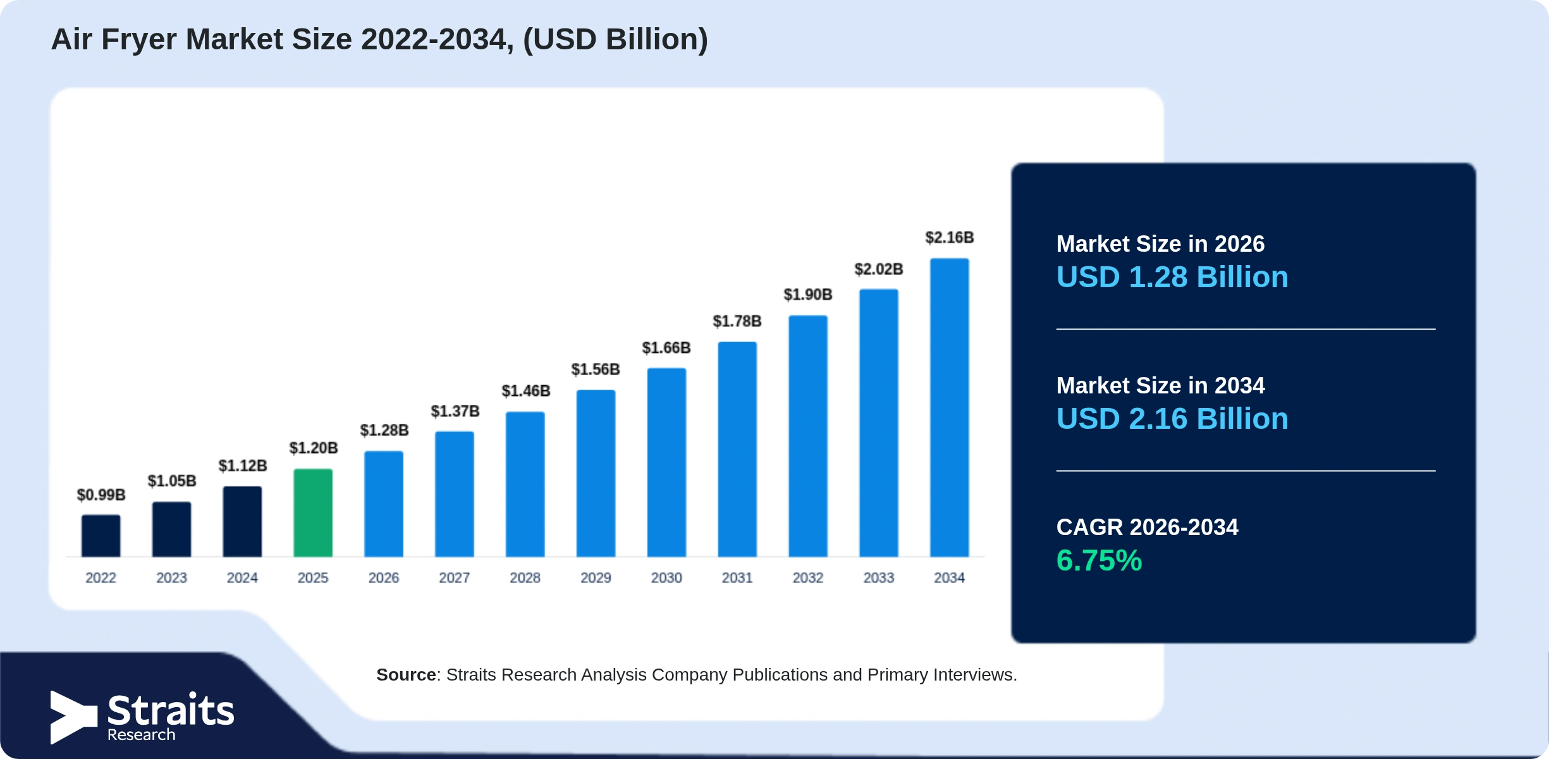
According to Straits Research, the air fryer market was valued at USD 1.2 billion in 2025 and is projected to increase from USD 1.28 billion in 2026 to USD 2.16 billion by 2034, registering a CAGR of 6.75% during the forecast period (2026–2034). North America dominated the market with a 38.5% share in 2025.
Health-Conscious Cooking Supports Air Fryer Adoption
Consumer interest in reduced-oil meal preparation is encouraging households to explore alternatives to traditional frying. Air fryers allow users to prepare crispy foods with little or no added oil, making them attractive for everyday cooking. Their ability to prepare different dishes in one appliance also supports demand among households seeking practical kitchen solutions.
Busy schedules and changing meal preparation habits are further strengthening adoption. Air fryers can prepare snacks, side dishes, and complete meals with limited supervision, reducing the time required for routine cooking. These advantages are encouraging consumers to incorporate air fryers into their daily kitchen routines.
Steam Technology and Dual-Basket Designs Expand Cooking Capabilities
Manufacturers are introducing new designs that combine hot-air circulation with steam technology to improve cooking versatility. Steam-assisted air fryers help retain moisture while producing crisp surfaces, expanding their suitability for vegetables, fish, dumplings, and baked foods.
Dual-basket configurations are also gaining attention because they allow different foods to cook simultaneously. Independent cooking zones and synchronized cooking times enable households to prepare main dishes and side dishes together, improving convenience and supporting demand for advanced appliances.
Air Fryer Market Segmentation
The air fryer market is segmented by product type, design, end user, and distribution channel. By product type, the digital segment accounted for a 68.7% share in 2025, supported by preset cooking programs, temperature controls, and convenient operation. Manual air fryers are expected to grow at a CAGR of 31.3% during 2026–2034, reflecting demand for affordable and easy-to-use appliances.
By design, basket air fryers held a 73.8% share in 2025, owing to their compact structure, easy cleaning, and efficient air circulation. Paddle-designed models offer automated stirring capabilities and are projected to grow at a CAGR of 6.8% during 2026–2034.
By end user, residential applications accounted for an 84.6% share in 2025, supported by widespread household use. Commercial applications, including restaurants, cafés, and catering operations, are expected to grow at a CAGR of 6.4% during 2026–2034.
By distribution channel, e-commerce represented a 35.9% share in 2025. Online platforms enable consumers to compare models, prices, features, and reviews, while specialty stores and supermarkets provide additional opportunities for product discovery.
Regional Outlook: North America Leads, Asia Pacific Records Fastest Growth
The North America air fryer market accounted for a dominant 38.5% share in 2025. Consumer interest in convenient cooking appliances and healthier meal preparation supports regional demand. The availability of multifunctional models and established retail channels further strengthens adoption.
Asia Pacific is the fastest-growing region in the air fryer market with a CAGR of 9.4%. Urbanization, household formation, and changing cooking preferences are creating opportunities for appliance manufacturers. China, India, Japan, and South Korea represent important markets for compact and multifunctional kitchen appliances.
Europe accounted for a 27.4% share in 2025, supported by consumer demand for convenient cooking equipment. France recorded nearly 3.4 million air fryer sales in 2025, highlighting the category's growing presence in household kitchens.
Competitive Landscape and Industry Developments
The competitive landscape includes Philips, BLACK+DECKER, Conair, Avalon Bay, Breville, SharkNinja, and other appliance manufacturers. Competition centers on cooking performance, product design, capacity, pricing, and distribution reach. Manufacturers are also exploring connected cooking functions and advanced controls to differentiate their offerings.
In May 2026, SharkNinja expanded its Ninja air fryer portfolio with additional AI-assisted cooking features and larger-capacity options. In March 2026, Philips introduced next-generation Airfryer models featuring AI-powered cooking guidance and connected app integration. These developments reflect the industry's focus on improving convenience and cooking performance.
Future Outlook
The air fryer market is expected to benefit from continued interest in reduced-oil cooking, multifunctional appliances, and convenient meal preparation. Innovations in steam-assisted cooking, digital controls, and multi-zone designs are likely to expand the range of applications across residential and commercial kitchens.
Manufacturers that combine affordability, cooking versatility, and reliable performance may find new opportunities as consumer demand for efficient kitchen appliances continues to evolve.
About Straits Research
Straits Research provides market intelligence and consulting services covering industry sizing, competitive landscapes, and growth opportunities across multiple sectors. Explore the full Air Fryer Market report for further information.


