

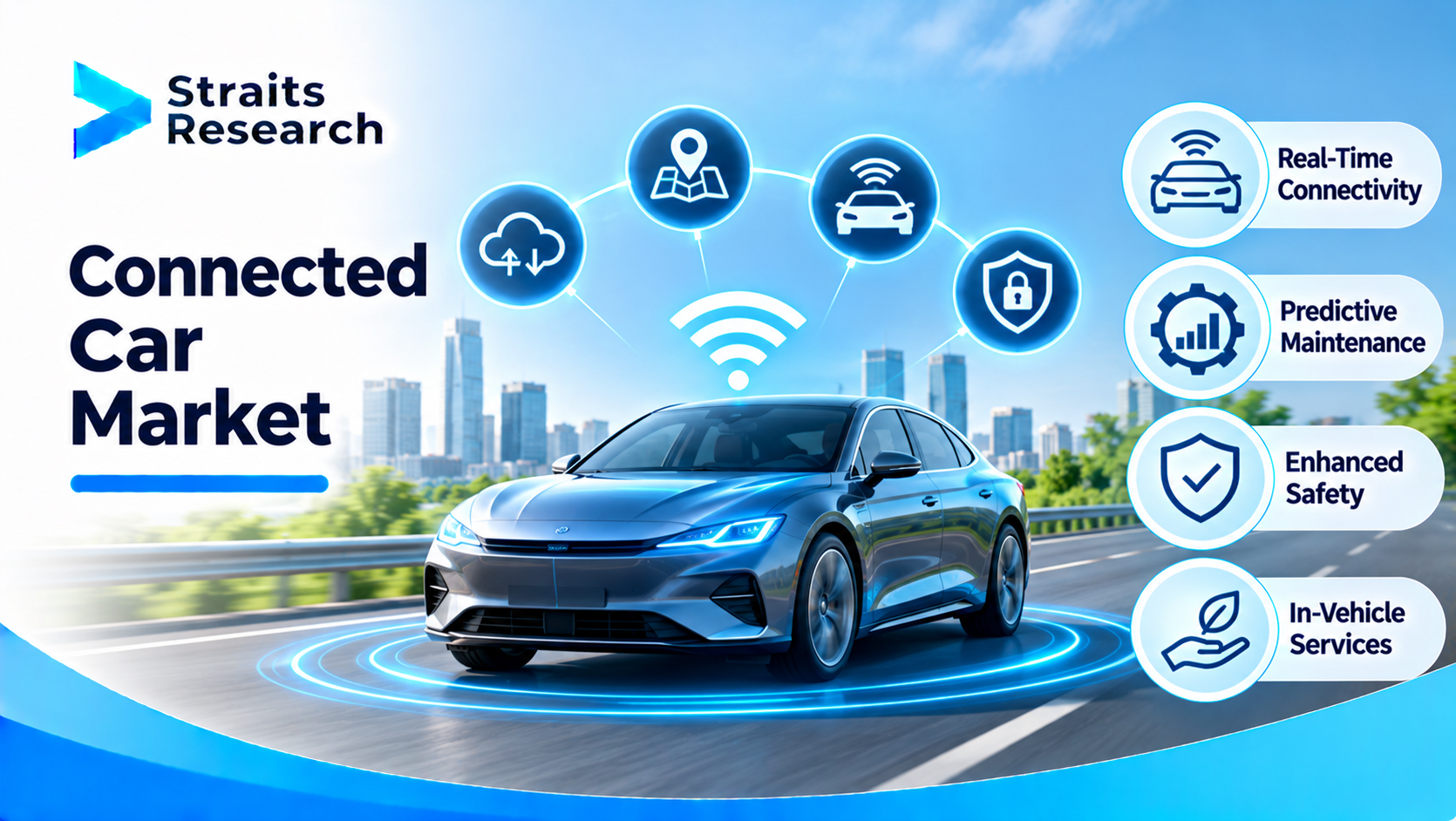

According to Straits Research , the global connected car market size was valued at USD 60.67 billion in 2025 and is projected to grow from USD 70.43 billion in 2026 to USD 232.16 billion by 2034, at a CAGR of 16.08% during the forecast period. North America dominated the market with a 37.4% share in 2025, while Europe is expected to record the fastest growth at a CAGR of 17.9%.
-
Market Size 2025: USD 60.67 billion
-
Market Size 2026: USD 70.43 billion
-
CAGR (Forecast Period): 16.08%
-
Forecast Year: 2034
-
Projected Market Size: USD 232.16 billion
-
Dominant Region: North America
-
Fastest Growing Region: Europe
Market Overview
Connected cars use internet access and communication technologies to exchange data with external networks, nearby vehicles, road infrastructure, and connected devices. These vehicles integrate telematics, GPS, cellular networks, vehicle-to-everything communication, and onboard sensors to support navigation, remote diagnostics, infotainment, safety alerts, and vehicle monitoring. Automakers use connected technologies to improve vehicle management, driver convenience, road safety, and access to digital mobility services.
Growth Drivers
Adoption of advanced driver assistance systems supports the connected car market as automakers integrate collision alerts, lane departure warnings, and driver monitoring functions into vehicle models. These systems use real-time road and vehicle data to improve driver awareness and safety. Consumer preference for connected infotainment also supports market growth, as drivers seek online navigation, media access, smartphone connectivity, and voice-based controls. The use of remote diagnostics and vehicle-to-everything communication further increases the need for connected vehicle platforms.
Market Challenges
High costs of telematics units, sensors, embedded software, and connectivity hardware increase vehicle production expenses. These costs can restrict the availability of advanced connected features in entry-level models and price-sensitive markets. Data privacy and cybersecurity risks also create challenges for automakers and technology providers. Secure data storage, regulatory compliance, and protection against unauthorized access require additional investment and can affect consumer confidence.
Market Opportunities
Automotive software providers can develop subscription-based connected services for navigation, vehicle diagnostics, predictive maintenance, and in-car entertainment. These services create recurring revenue through monthly subscriptions, data packages, and software upgrades while giving automakers new post-sale revenue channels.
The shift toward software-defined vehicles also creates opportunities for telecom operators and connectivity providers. Partnerships that combine eSIM technology, 5G networks, and vehicle software can support global connectivity and remote service delivery. IDEMIA Secure Transactions' February 2026 partnership with Hyundai Motor Group to provide eSIM and connectivity management solutions illustrates this opportunity.
Segment Analysis
By technology, 4G/LTE held the leading position with a 58.7% share in 2025, supported by its established use in telematics, infotainment, and vehicle connectivity. By car type, SUVs contributed a 44.2% share due to their broad consumer adoption and integration of advanced digital features. Embedded connectivity solutions are projected to grow at a CAGR of 17.5%, while OEM sales are expected to record a CAGR of 16.8% as automakers integrate connectivity features directly into new vehicles. Vehicle-to-infrastructure communication is also projected to grow at a CAGR of 16.9%.
Regional Analysis
North America led the connected car market with a 37.4% share in 2025. The region benefits from established automotive manufacturers, advanced telecom infrastructure, and widespread use of vehicle connectivity and telematics services. The U.S. remains a key market due to its connected vehicle ecosystem and investment in automotive software and digital mobility.
Europe is expected to record the fastest regional growth at a CAGR of 17.9%. Automaker investment in software-defined vehicles, vehicle safety systems, and 5G telematics supports adoption across Germany, the U.K., France, and other markets. Asia Pacific also offers growth opportunities through vehicle production, smartphone integration, and the expansion of connected mobility services in China, Japan, South Korea, and India.
Competitive Landscape
The connected car market is highly fragmented, with competition among automotive manufacturers, telematics technology providers, and connected vehicle software developers. Established players compete on connectivity infrastructure, advanced telematics, and automotive technology integration. Specialized providers focus on AI-enabled vehicle services, customized connectivity solutions, and software-based mobility platforms. Key companies include Bosch, Continental, Qualcomm, AT&T, and Samsung Electronics.
Recent Developments
-
February 2026: IDEMIA Secure Transactions partnered with Hyundai Motor Group to provide eSIM and connectivity management solutions for vehicles from Hyundai, Kia, and Genesis across strategic global markets.
-
April 2026: Qualcomm Technologies expanded its Snapdragon Digital Chassis platform with connected vehicle solutions for advanced connectivity, telematics, and software-defined vehicle capabilities.
-
August 2026: Tata Communications and Tata Motors Passenger Vehicles announced a partnership to equip the Sierra.ev with built-in 5G connectivity, supporting in-car services, over-the-air updates, remote diagnostics, and personalized digital experiences.
Click to Read the Complete Insights & Report: https://straitsresearch.com/report/connected-car-market
Future Outlook
The connected car market is expected to advance as automakers integrate 5G connectivity, telematics, and software-based functions into vehicle platforms. Growth in over-the-air updates, remote diagnostics, and vehicle-to-everything communication will create new opportunities for automotive software and telecom providers. Partnerships between automakers, network operators, and technology companies are likely to shape the next phase of connected mobility.
About Straits Research
Straits Research is a market intelligence and consulting firm that provides comprehensive industry reports, data-driven insights, and strategic research solutions. The company helps businesses understand market trends, assess competitive environments, and identify growth opportunities across global industries.


