

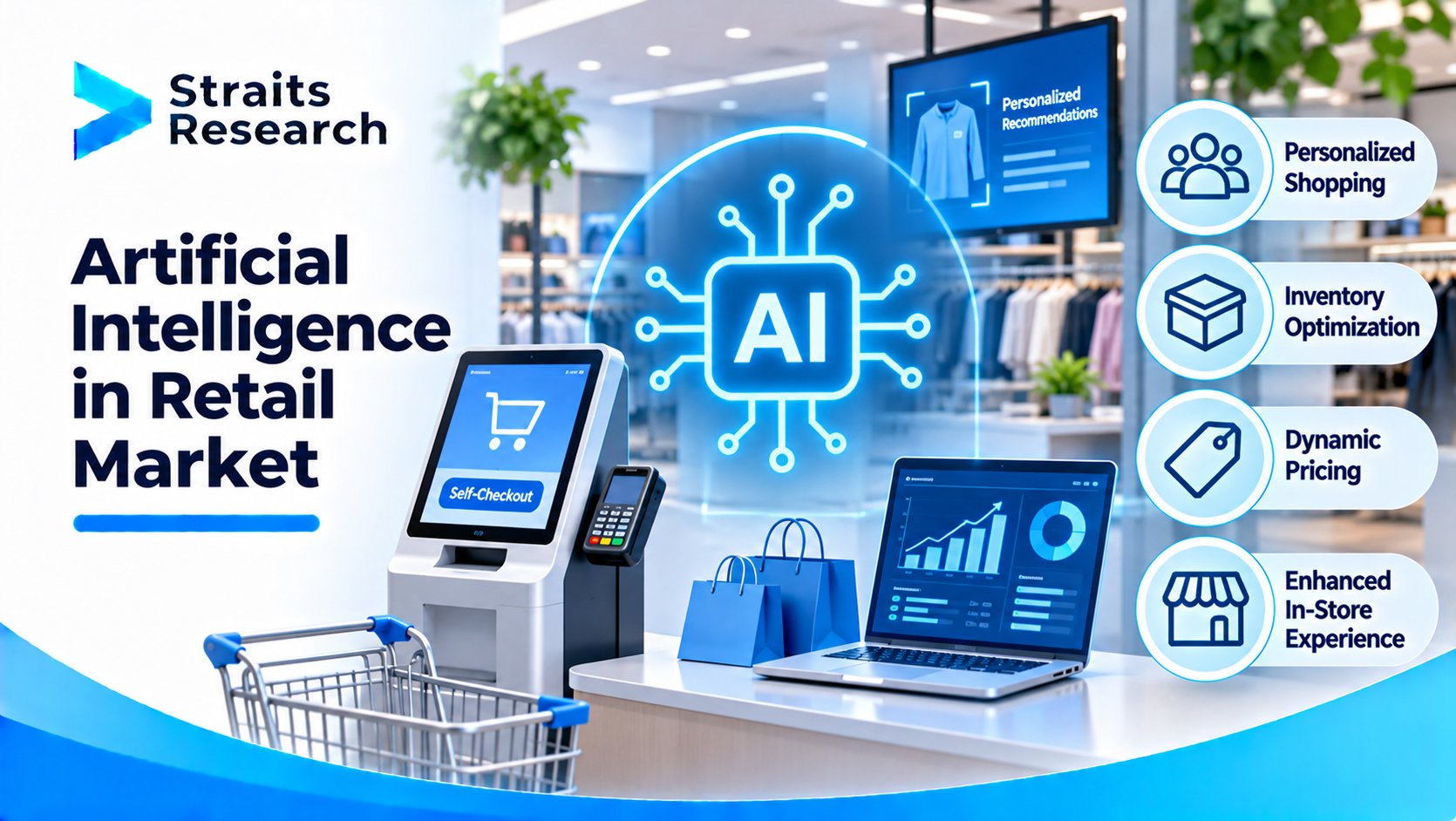
Artificial Intelligence in Retail Market Forecast Reaches USD 190.31 Billion by 2034

According to Straits Research, the global artificial intelligence in retail market size was valued at USD 13.39 billion in 2025 and is projected to grow from USD 17.98 billion in 2026 to USD 190.31 billion by 2034, at a CAGR of 34.3% during the forecast period. North America dominated the market with a 38.4% share in 2025, while Europe is expected to record the fastest growth at a CAGR of 31.8%.
-
Market Size 2025: USD 13.39 billion
-
Market Size 2026: USD 17.98 billion
-
CAGR (Forecast Period): 34.3%
-
Forecast Year: 2034
-
Projected Market Size: USD 190.31 billion
-
Dominant Region: North America
-
Fastest Growing Region: Europe
Market Overview
Artificial intelligence in retail refers to the use of machine learning, natural language processing, computer vision, and other AI technologies to improve retail operations and customer experiences. Retailers use these systems for personalized product recommendations, inventory management, demand forecasts, automated checkout, dynamic pricing, and customer service. AI tools also help businesses assess consumer behavior, optimize operational processes, and improve product discovery across physical and digital sales channels.
Growth Drivers
Demand for personalized shopping experiences is a major factor that supports market growth. Retailers use AI to assess purchase histories, browsing patterns, and customer preferences to deliver relevant product recommendations and targeted promotions. E-commerce adoption also creates opportunities for AI chatbots, visual search tools, and automated customer support systems that improve digital shopping experiences. In addition, advances in natural language processing and customer analytics help retailers improve engagement and strengthen customer retention.
Market Challenges
High software deployment costs create a barrier for small and mid-sized retailers. AI implementation requires investment in data infrastructure, software licenses, system integration, and technical support, which can place pressure on limited budgets. A shortage of skilled AI professionals also affects adoption, as retailers need specialists to manage data systems, maintain AI models, and integrate new tools with existing platforms. Data quality and privacy concerns further increase implementation complexity.
Market Opportunities
Retail technology providers can develop subscription-based AI platforms for small retailers that need personalization, customer analytics, and inventory tools without major infrastructure costs. These solutions can create recurring revenue through software licenses, usage-based pricing, and technical support services.
Agentic commerce also creates opportunities for technology companies that offer AI shopping assistants, automated product discovery, and conversational checkout tools. Accenture's investment in Profitmind and its strategic partnership with the company in January 2026 highlight the commercial potential of AI systems that automate retail pricing, inventory, and planning decisions.
Segment Analysis
By application, predictive merchandising led the market with a 24.6% share in 2025. Retailers use these tools to assess customer preferences, forecast product performance, and optimize product assortments across sales channels. By offerings, services are projected to grow at a CAGR of 30.4%, supported by the need for AI integration, system customization, technical support, and model maintenance. Online retail is also a key area of adoption, with a projected CAGR of 31.2% as retailers strengthen digital shopping experiences.
Regional Analysis
North America held the leading regional position in 2025, supported by the presence of major technology providers, established retail chains, and advanced digital infrastructure. Retailers across the U.S. and Canada use AI for customer analytics, inventory optimization, personalized marketing, and automated service platforms.
Europe is projected to record the fastest regional growth at a CAGR of 31.8%. Retail digitalization, wider use of AI-based customer engagement tools, and investment in intelligent commerce platforms support adoption across the U.K., Germany, France, and other European markets. Asia Pacific also offers opportunities as e-commerce platforms and large retail networks adopt AI for product recommendations, logistics, and customer service.
Competitive Landscape
The artificial intelligence in retail market is highly fragmented, with competition among AI technology providers, cloud computing companies, and retail software developers. Established players compete on AI infrastructure, advanced analytics, and enterprise software integration, while specialized providers focus on personalization, customer engagement, and retail analytics. Microsoft, Amazon Web Services, Google, IBM, and NVIDIA are among the key companies in the market.
Recent Developments
-
January 2026: Accenture invested in Profitmind through Accenture Ventures and formed a strategic partnership to expand agentic AI capabilities for retail pricing, inventory, and planning operations.
-
January 2026: Algonomy partnered with Databricks to advance RetailAI, an AI platform for retail forecasting, replenishment, pricing, allocation, and logistics.
-
May 2026: Tata Consultancy Services and Rezolve Ai announced a global partnership to help retailers integrate agentic AI into commerce workflows, including conversational commerce, product discovery, and automated checkout.
Click to Read the Complete Insights & Report: https://straitsresearch.com/report/artificial-intelligence-in-retail-market
Future Outlook
The artificial intelligence in retail market is expected to expand as retailers integrate AI into customer engagement, inventory planning, pricing, and digital commerce. Agentic AI, conversational shopping, and predictive analytics are likely to create new opportunities for software vendors and retail technology providers. Companies that offer scalable platforms, reliable data integration, and measurable operational value are positioned to strengthen their presence in the market.
About Straits Research
Straits Research is a market intelligence and consulting firm that provides comprehensive industry reports, data-driven insights, and strategic research solutions. The company helps businesses understand market trends, assess competitive environments, and identify growth opportunities across global industries.


