

Laser Cutting Machine Demand Forecast: Advanced Metal Fabrication Supports Industry Growth

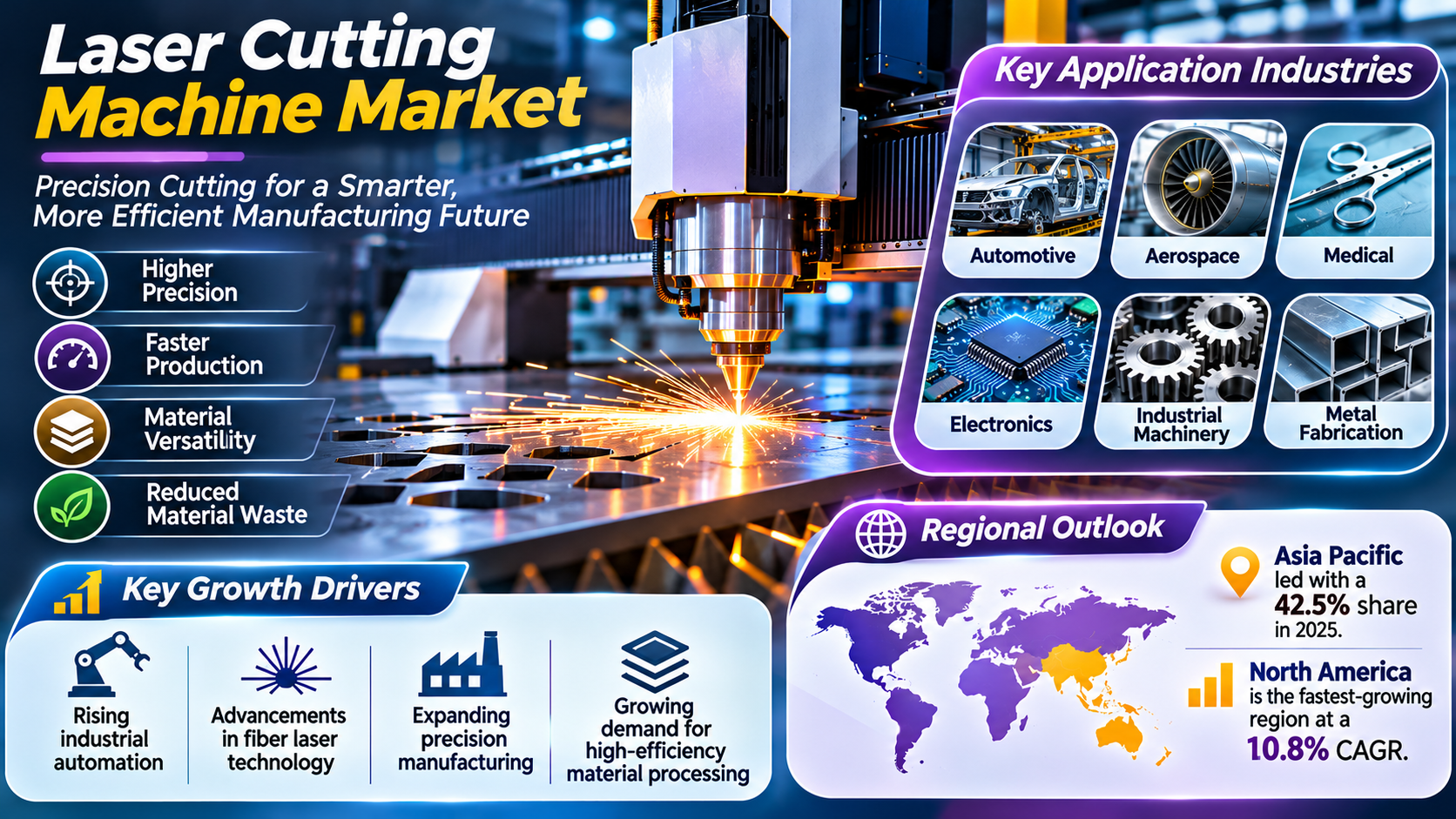
Laser cutting machines are becoming essential equipment across modern manufacturing industries as businesses prioritize precision, production speed, and material efficiency. These systems use concentrated laser beams to cut metals, plastics, wood, textiles, and other engineered materials with high accuracy. Their ability to process complex designs, minimize material waste, and integrate with automated production lines is strengthening adoption across automotive, aerospace, electronics, medical devices, and industrial machinery manufacturing.
According to Straits Research, the global laser cutting machine market was valued at USD 7.46 billion in 2025 and is projected to grow from USD 8.15 billion in 2026 to USD 16.49 billion by 2034, registering a CAGR of 9.21% during the forecast period (2026–2034). Asia Pacific dominated the market with a 42.5% share in 2025, supported by its extensive manufacturing base, industrial automation, and expanding automotive and electronics production.
Fiber Laser Technology Strengthens Manufacturing Efficiency
Fiber laser technology is gaining importance because of its cutting speed, beam quality, energy efficiency, and relatively low maintenance requirements. These systems are widely used to process steel, stainless steel, aluminum, brass, and other industrial metals. Their compatibility with high-power applications and automated production environments is encouraging manufacturers to adopt fiber laser equipment for precision metal fabrication. The development of advanced laser sources is also expanding the range of material thicknesses and industrial applications that can be processed.
Automation Transforms Precision Manufacturing
The integration of robotics, computer numerical control (CNC) systems, machine vision, and automated material handling is transforming laser cutting operations. Mechanized systems improve cutting consistency, reduce manual intervention, and support higher production volumes. Automotive and aerospace manufacturers benefit from accurate processing of complex components, while electronics producers use laser cutting for increasingly miniaturized parts. These developments are strengthening demand for automated laser cutting equipment across manufacturing facilities.
Medical Manufacturing Creates New Growth Opportunities
Medical device manufacturing is emerging as an important application area for laser cutting technology. The medical segment is projected to register the fastest growth at a CAGR of 10.4% during 2026–2034. Precision laser processing supports the production of surgical instruments, implants, and specialized medical components that require accurate geometries and clean edges. Growing demand for miniaturized medical devices and minimally invasive technologies is creating additional opportunities for equipment manufacturers.
Market Segmentation Highlights
The laser cutting machine market is segmented by product type, end-user, sales channel, mode of operation, and process.
By product type, fiber lasers dominated the market with a 55.3% share in 2025. Their precision, speed, and energy efficiency support adoption across metalworking and industrial manufacturing. Gas lasers and crystal lasers also serve applications requiring different material-processing capabilities.
By end-user, the market includes automotive, aerospace, medical, industrial machinery, electronics, and other industries. The medical segment is projected to grow at a CAGR of 10.4% during the forecast period.
By sales channel, direct sales held the leading position with a 64.2% share in 2025. Direct relationships enable manufacturers to offer customized equipment, installation, training, maintenance, and technical support.
By mode of operation, mechanized systems are projected to record the fastest growth at a CAGR of 10.2% during 2026–2034, supported by increasing automation and demand for consistent production quality.
By process, fusion cutting accounted for the largest share of 48.7% in 2025. Its ability to produce accurate cuts and clean edges makes it suitable for automotive, aerospace, electronics, machinery, and metal fabrication applications.
Regional Outlook: Asia Pacific Leads as North America Accelerates
Asia Pacific accounted for the largest regional share of 42.5% in 2025, reaching a market value of USD 3.17 billion. Industrialization, automotive and electronics manufacturing, metal fabrication, and factory automation are supporting regional demand. China represented a major country-level market, valued at approximately USD 1.65 billion in 2025, while Japan reached approximately USD 0.48 billion.
North America is the fastest-growing regional market, with a projected CAGR of 10.8% during 2026–2034. Investment in advanced manufacturing, production reshoring, aerospace and defense manufacturing, and automated processing systems is supporting expansion. The United States accounted for approximately USD 1.88 billion of the regional market in 2025.
Europe accounted for 22.4% of the market in 2025, supported by its established automotive, aerospace, engineering, and machinery industries. Increasing adoption of robotics, CNC systems, and energy-efficient production technologies is contributing to regional demand.
Competitive Landscape and Industry Developments
The competitive landscape includes manufacturers specializing in industrial laser sources, automated cutting equipment, and precision manufacturing systems. Key companies identified by Straits Research include TRUMPF, Hans Laser Technology, Bystronic, Yamazaki Mazak, Wuhan HGLaser Engineering, DMG MORI, LVD, Cincinnati Incorporated, Universal Laser Systems, Nissan Tanaka, IPG Photonics, and Epilog Laser.
Recent industry developments reflect the growing focus on high-power fiber lasers and automated production. In May 2026, TRUMPF expanded its laser cutting machine portfolio with next-generation fiber laser systems featuring AI-powered process optimization and automated material handling. In March 2026, Bystronic introduced advanced cutting solutions integrating automation, intelligent production software, and high-speed fiber laser technology. Earlier, in October 2025, AMADA launched high-power fiber laser cutting machines featuring adaptive beam control and smart monitoring capabilities.
Future Outlook
The laser cutting machine market is expected to expand as manufacturers invest in precision processing, automated production, and advanced fiber laser technologies. Medical device manufacturing, mechanized cutting systems, and high-efficiency metal processing will create additional opportunities for equipment suppliers. Asia Pacific is expected to retain its leading regional position, while North America offers strong growth potential through advanced manufacturing investments. Continued innovation in laser power, robotics, machine vision, and intelligent process control will shape the industry's development through 2034.
For detailed market estimates, segmentation, regional forecasts, and competitive analysis, explore the Laser Cutting Machine Market Report by Straits Research.
About Straits Research
Straits Research is a market intelligence and consulting organization that provides industry analysis, market forecasts, and strategic insights across diverse sectors. Its research supports businesses, investors, and decision-makers in understanding market developments, evaluating opportunities, and making informed strategic decisions.


