

Electric Highway Market Size, Share, and Forecast 2026–2034: Emerging Growth Opportunities

The transition toward low-emission transportation is creating new opportunities for electric highway infrastructure. Electric highways, also known as e-Highways, enable electric trucks and other heavy-duty vehicles to receive power while travelling through electrified road systems. By reducing dependence on conventional charging stops and supporting longer-distance transportation, these systems offer a potential solution for improving the efficiency of electric freight operations. Government decarbonization targets and investments in sustainable mobility are increasing interest in electrified highway networks.
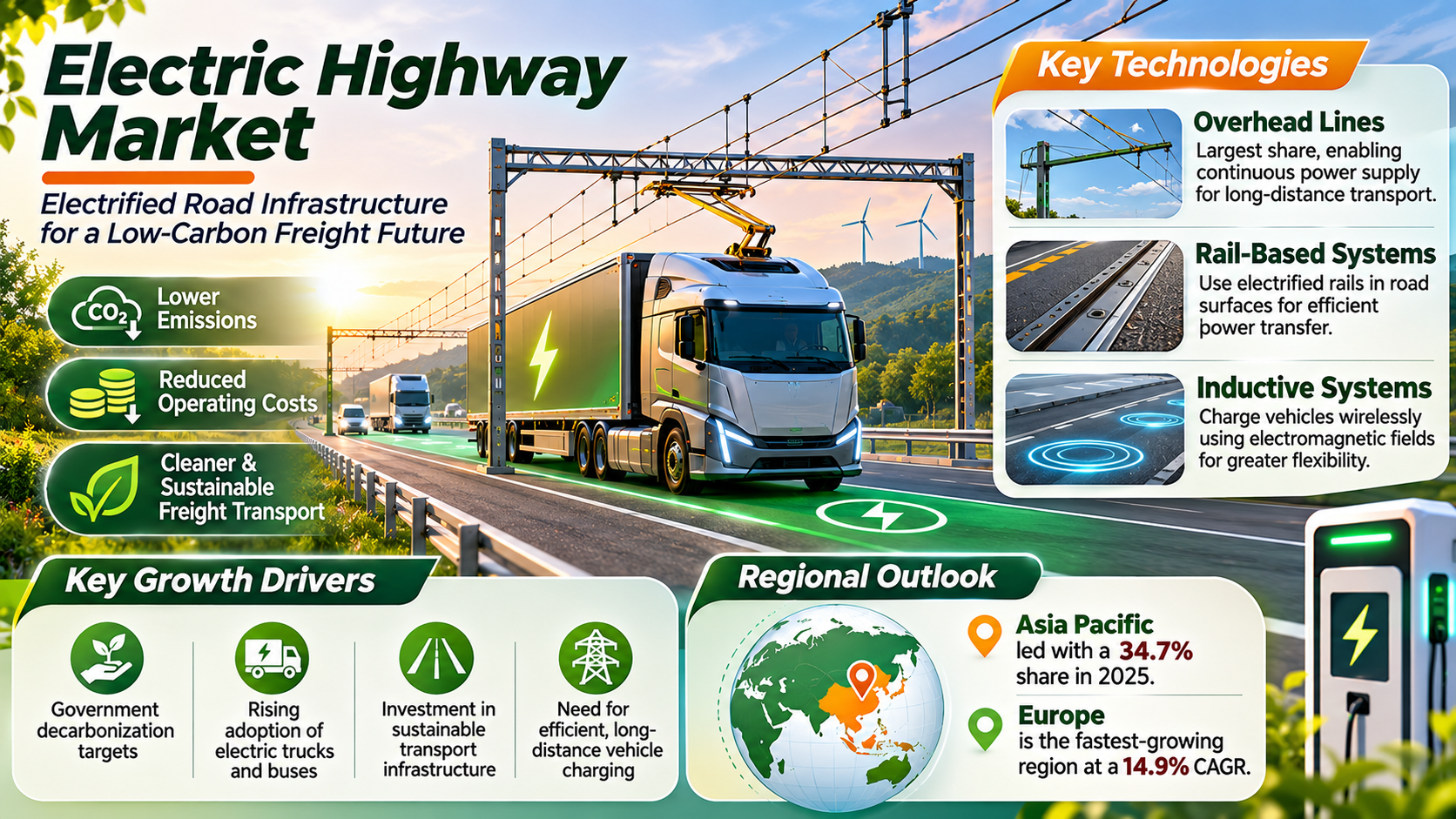
According to Straits Research, the global electric highway market was valued at USD 52.6 billion in 2025 and is projected to grow from USD 60.07 billion in 2026 to USD 173.77 billion by 2034, registering a CAGR of 14.2% during the forecast period (2026–2034). Asia Pacific dominated the market with a 34.7% share in 2025, supported by electric vehicle adoption, transportation electrification initiatives, and infrastructure development.
Emission Reduction Targets Strengthen Electric Highway Investment
Governments are increasingly prioritizing transportation decarbonization as part of broader climate and environmental policies. Electric highways support these objectives by allowing heavy-duty electric vehicles to receive power while moving, potentially reducing reliance on diesel-powered freight transportation. The European Union's target of reducing greenhouse gas emissions by 55% by 2030 has encouraged investment in electrified transportation corridors, particularly in countries such as Germany. India's emissions-reduction commitments and long-term net-zero target are also creating opportunities for sustainable road infrastructure development.
Electric Truck Adoption Creates New Infrastructure Opportunities
The growing adoption of electric trucks and buses is increasing demand for charging infrastructure capable of supporting long-distance transportation. Conventional charging systems can require vehicles to stop for extended periods, creating operational challenges for freight operators. Electric highways offer an alternative through continuous power supply using overhead lines, electrified rails, or wireless charging systems. As vehicle manufacturers and logistics companies expand their electric mobility strategies, investment in compatible road infrastructure is expected to gain importance.
Market Segmentation Highlights
The electric highway market is segmented by technology into overhead lines, rail, and inductive systems.
By technology, overhead lines account for the largest market share. These systems use electrified cables installed above roadways to transfer power to compatible electric trucks and buses through pantographs or similar connection mechanisms. Their ability to provide continuous electricity during vehicle operation makes them an important technology for long-distance freight corridors. However, installation requires supporting infrastructure, including power lines, monitoring equipment, and grid connections.
Rail-based systems use electrified rails embedded in road surfaces to transfer electricity to compatible vehicles through conductive components. This technology offers precise power transfer but requires modifications to existing road infrastructure. Inductive systems use electromagnetic fields to charge vehicles wirelessly, eliminating the need for physical connections between vehicles and road infrastructure. Their flexibility creates opportunities for future electric road applications, although charging efficiency and alignment requirements remain important considerations.
Regional Outlook: Asia Pacific Leads as Europe Accelerates
Asia Pacific dominated the electric highway market with a 34.7% share in 2025. The region's expanding electric vehicle ecosystem, investment in electric buses, and transportation electrification initiatives are supporting demand. China plays an important role through its established electric bus market, while India's proposed electric highway initiatives are creating opportunities for electrified freight corridors and supporting infrastructure.
Europe is the fastest-growing regional market, with a projected CAGR of 14.9% during 2026–2034. Supportive electric vehicle policies, emissions-reduction targets, and investments in sustainable freight transportation are encouraging the development of electric road systems. Germany, France, and Sweden are among the countries pursuing electrified road infrastructure initiatives to support long-distance transportation and reduce emissions.
North America is also investing in electric highway technologies through research, demonstration projects, and infrastructure development. The region's focus on electric freight transportation and high-power charging networks is creating opportunities for technology providers and infrastructure operators.
Competitive Landscape and Industry Developments
The electric highway market includes technology companies, power infrastructure providers, telecommunications firms, and industrial automation specialists. Key companies identified by Straits Research include ALE International, Cisco Systems, Huawei Technologies, Honeywell, Siemens, ABB, AT&T, IBM, LG CSN, and Schneider Electric.
Recent developments highlight growing investment in electrified freight infrastructure and intelligent energy management. In May 2026, Siemens Mobility expanded its electric highway solutions through advanced overhead catenary systems and smart energy management technologies. In March 2026, ABB E-mobility launched next-generation high-power charging solutions for electric highway corridors. Earlier, in October 2025, Alstom expanded its sustainable mobility portfolio through electric road infrastructure projects, while Hitachi Energy introduced grid integration solutions for high-power charging networks in June 2025.
Future Outlook
The electric highway market is positioned for significant growth as governments and transportation companies seek practical solutions for reducing freight emissions and supporting electric heavy-duty vehicles. Overhead line systems currently lead technology adoption, while rail-based and inductive charging offer alternative approaches for future infrastructure development. Asia Pacific's established electric mobility ecosystem and Europe's strong decarbonization policies will remain important regional growth factors. Infrastructure investment, grid integration, and collaboration between vehicle manufacturers and technology providers will shape the industry's development through 2034.
For detailed market estimates, technology segmentation, regional forecasts, and competitive analysis, explore the Electric Highway (e-Highway) Market Report by Straits Research.
About Straits Research
Straits Research is a market intelligence and consulting organization that provides industry analysis, market forecasts, and strategic insights across diverse sectors. Its research supports businesses, investors, and decision-makers in understanding market developments, evaluating opportunities, and making informed strategic decisions.


