

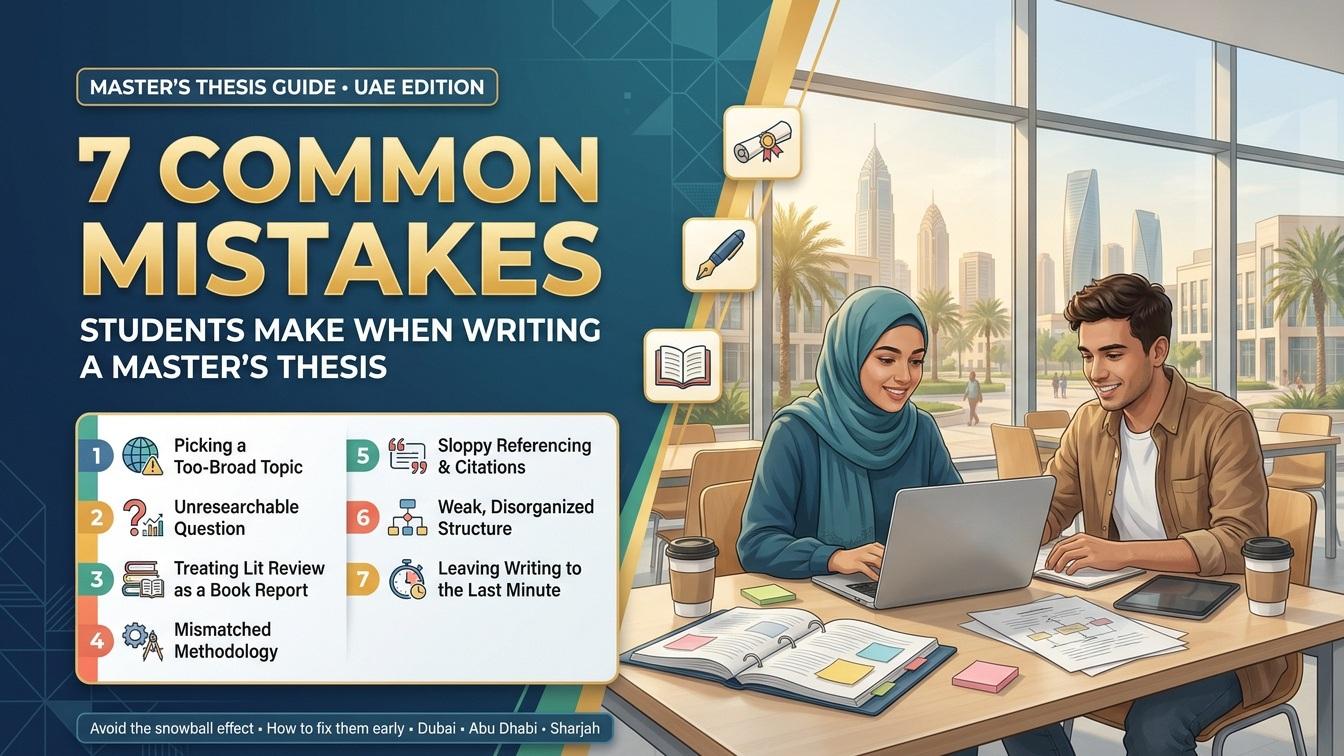

Ask any supervisor what makes a thesis struggle, and they rarely say "the student wasn't smart enough." Usually it's a handful of avoidable slips made in the first few weeks that snowball by month six.
If you're a postgraduate student in Dubai, Abu Dhabi, Sharjah or anywhere else in the UAE, you're probably juggling a job, a family or a visa timeline alongside your research. That makes every wasted week count. Here are seven mistakes worth dodging, and how to do it. If you're searching for master thesis help , start here.
The Seven Mistakes (and Their Fixes)
1. Picking a Topic Because It Sounds Impressive
“The Impact of Artificial Intelligence on the Global Economy” sounds ambitious. It's also unmanageable. Big topics lead to shallow chapters and vague conclusions.
The fix: Narrow it until it feels almost uncomfortably specific. "How AI-based hiring tools affect recruitment in Dubai's banking sector" is something you can finish. Also check that you can actually reach your data. Access to UAE companies, government bodies or survey participants can take weeks, so confirm it before you commit.
2. Writing a Research Question That Can’t Be Answered
A good question is clear, focused and researchable. “Why is social media bad?” fails all three tests. “Does Instagram use affect academic performance among first-year university students in the UAE?” passes.
The fix: Write your question, then ask: what data would answer this, and could I realistically collect it? If you can't say, rewrite it. Show the draft to your supervisor early. Ten minutes of feedback now can save you a month of rewriting.
3. Treating the Literature Review as a Book Report
Many students list what each author said, one paragraph after another. That's a summary, not a review. Examiners want to see you compare sources, spot disagreements and find the gap your study fills.
The fix: Organize by theme, not by author. For each theme, ask what researchers agree on, where they clash and what's still missing. Where relevant, include regional studies, including Gulf-based research, rather than relying only on Western sources. It strengthens your argument and shows you understand your own context.
4. Choosing a Methodology That Doesn’t Match the Question
This one catches people late. A student plans interviews but needs statistical proof, or sends a survey to 40 people and claims the results represent an entire industry.
The fix: Let the question choose the method, not the other way around. Be honest about sample size, limitations and ethics approval. Many UAE universities require ethical clearance before you collect any data, so check your handbook early. A modest, well-justified method beats an impressive one you can't defend in your viva.
5. Sloppy Referencing
Mixed citation styles, missing page numbers and references that appear in the text but not the bibliography all cost marks. They also raise plagiarism flags, even when you didn't mean to copy anything.
The fix: Confirm your required style (APA, Harvard, etc.) in week one, then use a reference manager such as Zotero or Mendeley from the first source you read. Retrofitting 120 references the night before submission is miserable and error-prone.
6. A Weak Structure That Makes Readers Work Too Hard
Some theses contain good ideas buried in the wrong places. The introduction promises one thing, the findings deliver another and the conclusion introduces new material.
The fix: Build a one-page outline before you write. Each chapter should answer one clear job: introduce, review, explain method, present findings, discuss, conclude. Then reverse-check. Does your conclusion answer the exact question from your introduction? If not, something needs to move.
7. Leaving the Writing Until the Last Minute
Writing a thesis in the final three weeks is a bit like cramming for a marathon. You may technically finish, but the quality shows. Rushed work tends to have thin analysis, careless errors and no time for revision.
The fix: Write as you go. Draft the methodology while it's fresh, and put rough findings on paper before they feel "ready." Set small weekly targets, such as 500 words a day. And plan for the unexpected: Ramadan schedules, university holidays and work deadlines all eat into your calendar.
Small Habits That Prevent Most of These Problems
You don't need a perfect system. A few steady habits help a lot:
- Meet your supervisor regularly, even briefly, and bring specific questions.
- Keep a research log of what you read, what you decided and why.
- Get a fresh pair of eyes on your draft before the final week.
- Ask for help early. Struggling quietly rarely improves anything.
Support can take many forms, including peer groups, university writing centres, and academic guidance from assignment writing services that offer feedback and structure rather than shortcuts. Whatever you choose, use it to build your own understanding. Your name goes on the thesis, and you'll be the one explaining it to your examiners.
Final Thoughts
Most thesis problems come from decisions made early and rarely revisited. Pick a focused topic, ask a researchable question, review the literature critically, match your method to your aims, reference as you go, plan your structure and start writing sooner than feels necessary.


