

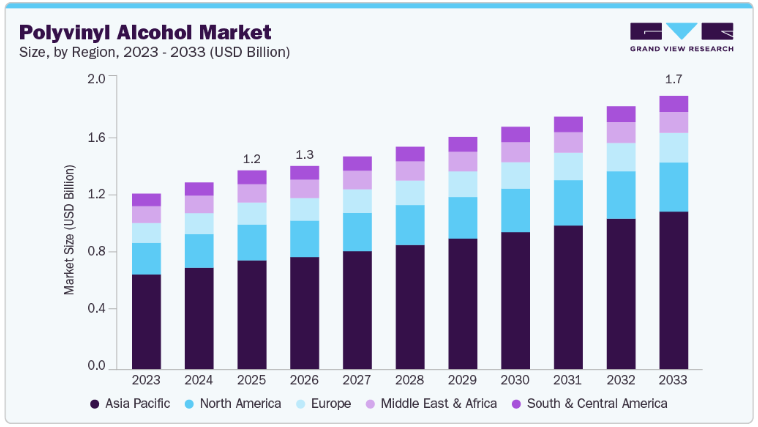

The global polyvinyl alcohol market is witnessing steady growth, driven by increasing demand for biodegradable packaging materials, expanding textile processing activities, and rising applications in construction chemicals, paper coatings, and specialty films. Polyvinyl alcohol (PVA) is valued for its water solubility, film-forming properties, binding strength, and biodegradability, making it suitable for a wide range of industrial and commercial applications. Growing infrastructure investments and the shift toward sustainable packaging solutions are further supporting its adoption across end-use industries. The global Polyvinyl Alcohol Market was estimated at USD 1.21 billion in 2025 and is projected to grow from USD 1.24 billion in 2026 to USD 1.66 billion by 2033, registering a CAGR of 4.3% from 2026 to 2033.
Polyvinyl Alcohol Market Key Highlights
- Asia Pacific dominated the global market with a revenue share of 54.81% in 2025.
- China is expected to register a CAGR of 5.3% from 2026 to 2033.
- Food packaging accounted for 31.95% of market revenue in 2025.
- Construction is projected to be the fastest-growing end-use segment, with a CAGR of 5.8%.
- Asia Pacific is anticipated to record the fastest regional growth at a CAGR of 5.0% during the forecast period.
Market Trends Driving Industry Development
The polyvinyl alcohol industry is gradually moving beyond traditional applications toward specialty and high-performance uses. Demand for water-soluble films in packaging, medical device consumables, and additive manufacturing is creating new opportunities for manufacturers. High-purity and partially hydrolyzed PVA grades are increasingly being developed to meet specific performance requirements across electronics, pharmaceuticals, and eco-friendly packaging applications.
Innovation in PVA films is also expanding their functional capabilities. Ultra-thin water-soluble films with improved barrier properties and antimicrobial additives are gaining attention in healthcare and detergent applications. Nanotechnology integration is being explored to enhance mechanical strength, moisture resistance, and thermal stability. These developments are opening additional opportunities in electronics, medical packaging, and precision agriculture.
Want to Understand What’s Driving Market Growth? Ask Prism AI for research-backed insights into market size, evolving opportunities
Growth Drivers, Opportunities, and Market Restraints
The expansion of sustainable packaging and textile processing is a major factor supporting market growth. PVA's biodegradability and water solubility make it an attractive material for applications seeking alternatives to conventional plastics. Increasing textile output across major manufacturing hubs is also sustaining demand for PVA in textile sizing.
Infrastructure development and rising paper packaging demand are contributing to consumption across construction chemicals, coatings, and paper-related applications. In construction, PVA improves bonding, flexibility, and water resistance in adhesives, coatings, and cement additives.
Specialty applications represent another important growth opportunity. Medical-grade PVA and advanced water-soluble films used in controlled-release pharmaceuticals and single-use industrial systems are expanding beyond conventional commodity applications. Multilayer film development and functional additives can also support products requiring enhanced barrier properties or specific dissolution characteristics.
However, fluctuations in vinyl acetate monomer prices remain a major restraint. Changes in crude oil and petrochemical feedstock prices affect production costs and profit margins, creating uncertainty for manufacturers. Competition from lower-cost conventional polymers and alternative biodegradable materials can also limit PVA adoption in price-sensitive applications.
Download a free sample report or claim your copy of this full market intelligence report
End-Use Market Analysis
Food packaging held the largest share of the polyvinyl alcohol market by end use, accounting for 31.95% of revenue in 2025. The segment is projected to grow at a CAGR of 3.8% from 2026 to 2033. Increasing demand for biodegradable and water-soluble films is supporting PVA adoption among food brands seeking packaging materials aligned with sustainability objectives. Food-grade PVA films offer moisture resistance and suitability for contact with consumables, supporting their use in packaging applications. Adoption is particularly strong in Asia Pacific and North America, where regulatory incentives and expanding fast-moving consumer goods volumes are supporting demand.
The construction segment is expected to register the fastest growth, with a CAGR of 5.8% during the forecast period. PVA is increasingly incorporated into adhesives, coatings, and cement additives to improve bonding, flexibility, water resistance, and durability. Urbanization, infrastructure investment, and government-led construction projects, particularly in China and India, are supporting demand for high-performance PVA grades.
Download a free sample report or claim your copy of this full market intelligence report
Regional Market Outlook
Asia Pacific: Asia Pacific dominated the global polyvinyl alcohol market with a 54.81% revenue share in 2025 and is expected to record the fastest regional CAGR of 5.0% through the forecast period. Growth is supported by expanding textile, packaging, and construction industries across China, India, and Southeast Asia. Large-scale manufacturing infrastructure and cost-efficient production have strengthened the region's position in global PVA demand. Increasing industrialization and policies encouraging biodegradable materials are further supporting the use of PVA in water-soluble films and specialty applications.
China remains an important market because of its large textile manufacturing base and established packaging industry. Domestic capacity expansion and industrial modernization are supporting PVA consumption in adhesives, coatings, and water-soluble films. Demand from detergent pod and agrochemical packaging applications is also contributing to market development. The country's chemical industry initiatives and infrastructure investments are supporting production and application expansion.
North America: The North American market is driven by increasing demand for sustainable packaging and advanced industrial applications. Growing interest in biodegradable films and adhesives is supporting PVA adoption. Pharmaceutical and medical device manufacturers also utilize high-purity PVA grades in coatings and formulations. In the U.S., environmental policies, demand for biodegradable packaging, pharmaceutical applications, personal care products, and specialty adhesives are contributing to market growth.
Europe: Europe's market development is influenced by environmental sustainability regulations and circular economy initiatives. Restrictions on conventional plastics are encouraging the adoption of biodegradable PVA materials, particularly in packaging and specialty films. Automotive and construction manufacturers are also incorporating PVA into high-performance adhesives and coatings. Industrial conversion capabilities and investment in innovation continue to support regional demand.
Future Outlook of the Polyvinyl Alcohol Market
The polyvinyl alcohol market is expected to maintain steady expansion through 2033 as demand increases across sustainable packaging, construction, textiles, and specialty industrial applications. Food packaging will remain an important end-use segment, while construction is positioned for faster growth. The development of high-purity grades, advanced water-soluble films, and functional additives is expected to create additional opportunities for manufacturers. At the same time, raw material price volatility and competition from substitute polymers will continue to influence market dynamics.
Explore Our Research & Intelligence Solutions
Grand View Signal: Understand the Factors Shaping Commodity Prices – Explore the Platform


