

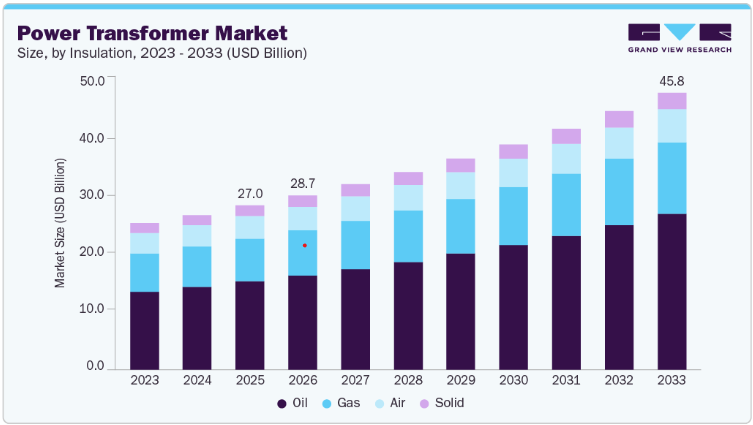

The global power transformer market is witnessing significant growth as electricity consumption increases across residential, commercial, and industrial sectors. Rapid urbanization, industrial expansion, renewable energy integration, and investments in transmission and distribution infrastructure are strengthening demand for advanced power transformers. Utilities and governments are increasingly focusing on grid modernization, energy efficiency, and reliable electricity transmission, creating opportunities for conventional as well as smart transformer technologies. The global Power Transformer Market was valued at USD 27.0 billion in 2025 and is projected to grow from USD 28.7 billion in 2026 to USD 45.8 billion by 2033, registering a CAGR of 6.9% from 2026 to 2033.
Power Transformer Market Key Highlights
- Asia Pacific dominated the global market with a revenue share of 41.1% in 2025.
- Shell core transformers accounted for the largest core segment share of 42.1% in 2025.
- Oil insulation held the leading share of 59.3% in 2025.
- Three-phase transformers dominated the phase segment with a 66.1% revenue share in 2025.
- Transformers rated between 100 MVA and 500 MVA accounted for 60.3% of market revenue in 2025.
- Industrial applications represented the largest application share at 50.1% in 2025.
Market Trends and Growth Drivers
Increasing electricity demand is one of the primary factors supporting the expansion of the power transformer market. Industrialization, urban development, and infrastructure investments are creating the need for stronger transmission networks capable of delivering reliable electricity across different regions. Both developed and emerging economies are investing in grid expansion and modernization to accommodate rising consumption.
The growing adoption of renewable energy is also influencing transformer requirements. Solar and wind power installations introduce variable electricity generation and changing power flows, increasing the need for advanced transformers that can support grid stability and efficient transmission. Investments in high-voltage transmission technologies and renewable energy integration are consequently creating additional demand.
Want to Understand What’s Driving Market Growth? Ask Prism AI for research-backed insights into market size, evolving opportunities
Smart grid development is another important market trend. Governments and utilities are modernizing existing electricity networks through technologically advanced transformers, smart meters, remote monitoring, and digital diagnostic systems. These technologies help utilities monitor grid conditions, respond to changes in electricity demand, improve operational efficiency, and reduce transmission losses.
Environmental considerations are encouraging manufacturers to develop green transformers with reduced noise, lower energy losses, and more sustainable insulation materials. The transition toward eco-friendly transformer technologies is becoming increasingly relevant as countries strengthen their focus on energy efficiency and greenhouse gas reduction.
Market Opportunities and Industry Restraints
Grid modernization and replacement of aging infrastructure offer substantial opportunities for market participants. Older electricity networks require upgrades to improve reliability and accommodate renewable energy sources. Short circuits and other operational challenges associated with aging infrastructure are also creating demand for replacement and modernization programs.
Government-backed electrification initiatives, particularly across Asia Pacific and Africa, are supporting investments in conventional and green transformer technologies. Digitalization is creating further opportunities through remote monitoring, smart diagnostics, and predictive maintenance solutions that improve equipment reliability.
However, the market faces challenges related to high initial investment and manufacturing lead times. Power transformers require significant capital expenditure, while installation and supporting infrastructure development can involve complex processes. Shortages of quality steel, lengthy manufacturing cycles, and regulatory approvals can also delay projects.
Raw material price volatility remains another important restraint. Steel, aluminum, and copper are essential materials used in transformer production. Fluctuations in their prices and supply chain disruptions can increase manufacturing costs, affecting affordability and market expansion, particularly in middle- and low-income countries.
Download a free sample report or claim your copy of this full market intelligence report
Segment Analysis: Core, Insulation, and Phase
The power transformer market is segmented by core, insulation, phase, rating, and application. Each category reflects different operational requirements and equipment specifications.
Core Type: The shell core segment dominated the market with a 42.1% revenue share in 2025 and is projected to register the fastest CAGR of 7.4% during the forecast period. Shell core transformers are commonly used in low-voltage and high-output applications, including electronic circuits and low-voltage power circuits. Their advantages include efficient cooling, design flexibility, high seismic resistance, control of leakage magnetic flux, and strong short-circuit performance.
Insulation Type: Oil insulation accounted for the largest share of 59.3% in 2025 and is expected to grow at a CAGR of 7.4% from 2026 to 2033. Oil provides electrical insulation and thermal stability, helping protect transformer components from high-voltage damage and overheating. Mineral oil, silicone oil, and bio-based oils are used in transformer insulation. Growing environmental awareness is also encouraging manufacturers to explore alternatives such as ester oil.
In April 2025, Baoding Tianwei Baobian Electric Co. Ltd. announced advancements in natural ester oil-based transformer technology, highlighting its 110kV transformer using natural ester insulating oil.
Phase Type: Three-phase transformers held the largest market share of 66.1% in 2025 and are expected to register a CAGR of 6.9% through 2033. These transformers are widely used in manufacturing, mining, petrochemicals, telecommunications, automation equipment, and precision machine tools. Their suitability for higher power ratings, along with their compact size and cost advantages, supports their extensive industrial use.
Regional Market Outlook
Asia Pacific: Asia Pacific dominated the global power transformer market with a 41.1% revenue share in 2025. Rapid industrialization, urbanization, population growth, and increasing electricity consumption are driving investments in transmission and distribution infrastructure. China, India, and Indonesia are among the countries contributing to regional demand through grid expansion and modernization. Renewable energy integration and efforts to reduce transmission losses are also supporting the adoption of advanced transformers.
North America: The North American market is supported by investments in grid modernization, renewable energy integration, and replacement of aging infrastructure. Utilities across the U.S. and Canada are upgrading transmission networks to improve reliability and support long-distance electricity transmission. The expansion of solar and wind projects, electric vehicle charging infrastructure, and industrial electrification is further strengthening demand. The U.S. held the largest revenue share in the regional market in 2025.
Europe: Europe's market is influenced by renewable energy adoption, cross-border electricity integration, and modernization of existing power grids. Germany, France, and the UK are investing in transmission networks to accommodate increasing wind and solar power generation. Decarbonization initiatives and electrification across transportation and industrial sectors are also supporting demand for high-performance transformers and digital substations.
Latin America: Brazil, Mexico, and Argentina are investing in electricity infrastructure upgrades and grid expansion. Renewable energy integration, rural electrification, and efforts to reduce transmission losses are creating opportunities for power transformer manufacturers. Industrial development and regional interconnection projects are also contributing to market potential.
Middle East and Africa: Large-scale infrastructure projects, energy diversification, and increasing electricity demand are supporting market development. Saudi Arabia and the UAE are investing in transmission infrastructure for industrial expansion and smart city initiatives. African countries are focusing on electrification and grid reliability, particularly in underserved areas, creating demand for efficient and durable transformer technologies.
Future Outlook
The power transformer market is expected to maintain steady growth through 2033 as electricity demand, renewable energy integration, and infrastructure modernization continue to influence investment decisions. Smart grid technologies, high-voltage transmission systems, and environmentally friendly transformer designs are likely to remain important areas of development.
Although raw material costs, manufacturing lead times, and high capital requirements may create challenges, continued investments in electricity networks and industrial infrastructure are expected to support long-term market expansion.
Explore Our Research & Intelligence Solutions
Grand View Signal: Understand the Factors Shaping Commodity Prices – Explore the Platform


