

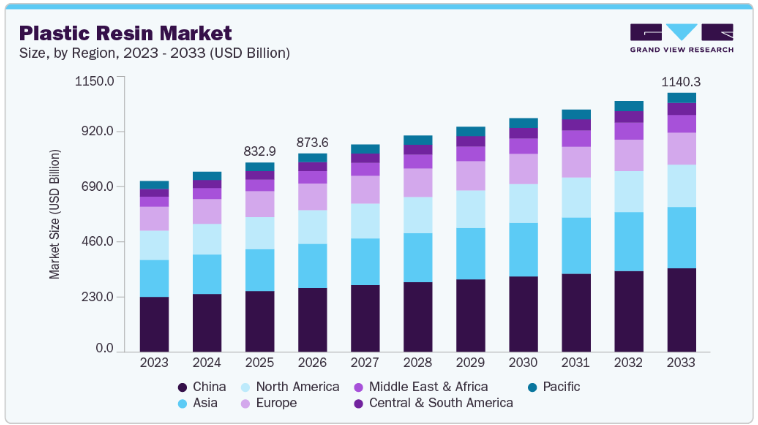

The global plastic resin market plays a fundamental role in modern manufacturing, supplying materials used across packaging, automotive, construction, electronics, agriculture, and consumer goods industries. Demand for plastic resins is influenced by production capacity, feedstock availability, polymer innovation, and the evolving performance requirements of end-use sectors. Manufacturers are increasingly focusing on advanced resin formulations, recyclable materials, and bio-based alternatives to improve product functionality while addressing sustainability expectations. The global Plastic Resin Market was valued at USD 832.9 billion in 2025 and is projected to grow from USD 873.6 billion in 2026 to USD 1,140.3 billion by 2033, registering a CAGR of 3.9% from 2026 to 2033.
Understanding the Market's Growth Structaure
Plastic resin demand is closely connected to the availability and economics of raw materials. Feedstocks such as ethane, LPG, and naphtha influence production costs, manufacturing decisions, and regional competitiveness. Producers continuously evaluate their feedstock combinations to optimize cracker operations and maintain cost efficiency.
North America benefits from ethane-advantaged production, which supports lower-cost ethylene manufacturing. In contrast, Europe and parts of Asia rely more heavily on naphtha-based feedstocks, making production economics more sensitive to fluctuations in oil prices.
Capacity additions also influence the industry's supply structure. Large-scale investments in upstream petrochemical infrastructure can strengthen domestic production capabilities, change trade flows, and affect the availability of different resin grades across markets.
Major Factors Influencing Plastic Resin Demand
Polymer innovation and material performance
Technological advancements in polymer chemistry and manufacturing processes are expanding the application potential of plastic resins. Improvements at the monomer and polymerization stages allow producers to develop materials with enhanced mechanical strength, thermal resistance, clarity, and process efficiency.
Advanced catalysts and tailored polymer structures help manufacturers create specialized resin grades without significantly increasing production costs. These improvements are particularly relevant to packaging, automotive, and electronics applications, where material performance and manufacturing efficiency are important considerations.
Want to Understand What’s Driving Market Growth? Ask Prism AI for research-backed insights into market size, evolving opportunities
Growing emphasis on sustainable materials
Sustainability is becoming an important area of product development. Bio-based resins derived from renewable feedstocks, including sugarcane and agricultural waste, are gaining attention as alternatives to conventional fossil-based materials. Chemical recycling technologies are also creating opportunities to regenerate plastic resins closer to virgin-material quality.
These developments support the industry's efforts to reduce dependence on traditional feedstocks while responding to changing environmental expectations.
Feedstock price volatility
Fluctuations in feedstock prices remain a significant market restraint. Differences in regional access to natural gas liquids, naphtha, and other raw materials influence production economics. When input costs rise, manufacturers may face pressure on operating margins and product pricing.
Product Segmentation: Crystalline Resins Maintain Market Leadership
The plastic resin market is segmented by product, with crystalline resins holding the leading position. The segment accounted for 58.2% of global market revenue in 2025 and is projected to expand at a CAGR of 3.8% from 2026 to 2033.
Crystalline plastic resins are widely used because of their processing flexibility, predictable mechanical properties, and broad industrial applicability. Materials such as polyethylene, polypropylene, PET, and epoxy are utilized in packaging, containers, films, fibers, coatings, and structural products. Their molecular structure supports consistent mechanical behavior and efficient large-scale manufacturing.
Demand for these materials is closely associated with consumer goods production, packaging requirements, construction activity, and infrastructure development. As a result, capacity additions and economic conditions across major manufacturing regions influence the segment's performance.
Engineering plastics represent another important product category and are expected to register a faster CAGR of 5.0% during the forecast period. These materials include nylon, PBT, PC, PU, PPO, and related polyamides. Their higher strength, heat resistance, and long-term reliability make them suitable for automotive systems, electrical components, industrial equipment, and durable consumer products.
Increasing vehicle electrification, automation, and demand for compact, high-performance designs are supporting the adoption of engineering plastic resins.
Application Analysis: Packaging Leads, Agriculture Gains Momentum
Packaging represented the largest application segment, accounting for 41.3% of market revenue in 2025. It is projected to grow at a CAGR of 4.0% from 2026 to 2033.
Plastic resins are extensively used in primary food packaging, transportation packaging, and protective packaging. Manufacturers and converters require consistent volumes of processable materials that deliver suitable barrier properties, sealability, and stiffness. This sustained demand influences production capacity allocation and the development of application-specific resin grades.
Agriculture is projected to record a CAGR of 5.4% through the forecast period. The segment benefits from increasing demand for solutions that improve agricultural productivity and water efficiency. Plastic resins are used in protective films, irrigation systems, greenhouse covers, mulching applications, silage wraps, and durable agricultural containers.
LDPE and LLDPE films are particularly relevant because of their film-forming capabilities and UV resistance. Their applications support crop protection and agricultural resource management.
Download a free sample report or claim your copy of this full market intelligence report
Regional Market Landscape
The Asia Pacific region accounted for 22.1% of global plastic resin market revenue in 2025. Regional development is increasingly influenced by upstream capacity additions, feedstock economics, and expanding domestic petrochemical infrastructure.
India is emerging as an important center for upstream growth. Government-led initiatives, including Petroleum, Chemicals and Petrochemicals Investment Regions (PCPIRs), plastic parks, and incentive schemes, are supporting investments in cracker and monomer projects. These developments are expected to expand domestic ethylene, propylene, and PVC production capacity while gradually reducing structural import dependence.
China held the largest country-level market share, accounting for 44.7% of revenue in 2025. Its market is supported by refinery investments, petrochemical integration, and state-backed capacity expansions. Large-scale production of ethylene and propylene strengthens the country's position in the global resin supply chain.
North America benefits from abundant natural gas liquids, particularly ethane from shale production. The U.S. Gulf Coast remains an important petrochemical manufacturing center, supporting ethylene and downstream polyethylene production. Competitive feedstock economics also contribute to capacity additions and export-oriented resin supply.
Europe faces a different operating environment, shaped by higher energy and feedstock costs, regulatory requirements, and capacity rationalization. Greater reliance on naphtha and imported intermediates increases exposure to oil price fluctuations and production costs. These conditions have contributed to plant shutdowns and deferred capacity investments.
Competitive Landscape and Industry Innovation
The plastic resin market is fragmented and competitive, with major producers investing in research and development to improve product performance, cost efficiency, and sustainability. Competition is influenced by manufacturing scale, access to feedstocks, technological capabilities, and the ability to develop specialized materials.
Key companies operating in the market include:
- BASF SE
- SABIC
- Dow Inc.
- DuPont de Nemours, Inc.
Future Outlook
The plastic resin market is expected to maintain steady growth through 2033, supported by demand from packaging, agriculture, automotive, electronics, and construction. However, its development will remain closely tied to feedstock availability, production capacity, and regional cost advantages.
The industry's future competitiveness will depend on balancing material performance with cost efficiency and sustainability requirements. Investments in polymer innovation, recycling technologies, bio-based materials, and upstream production infrastructure are likely to remain important in shaping the next phase of market development.
Explore Our Research & Intelligence Solutions
Grand View Signal: Understand the Factors Shaping Commodity Prices – Explore the Platform