

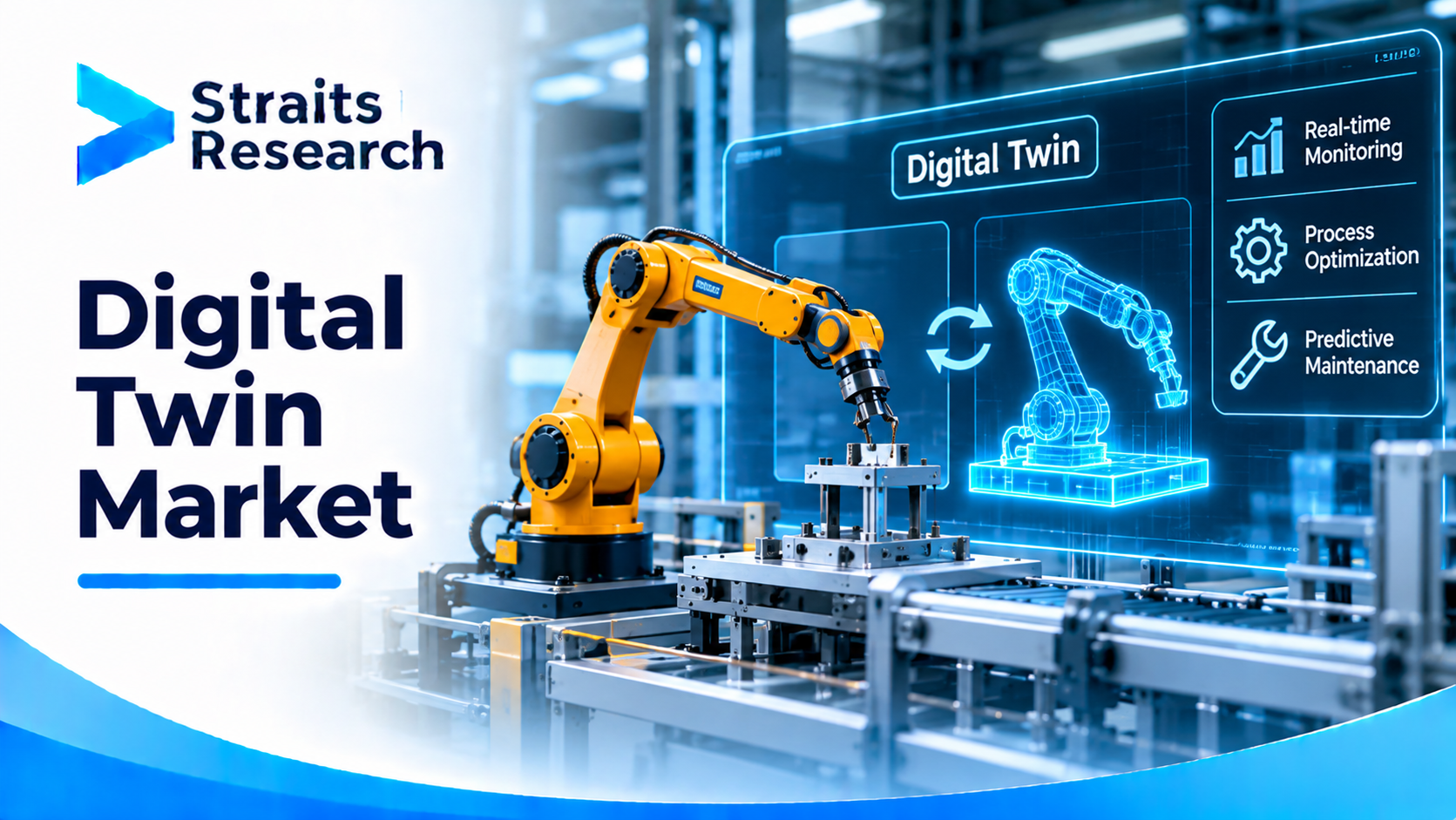

According to Straits Research , the global digital twin market size was valued at USD 28.1 billion in 2025 and is projected to grow from USD 39.12 billion in 2026 to USD 551.39 billion by 2034, recording a CAGR of 39.2% during the forecast period (2026–2034). Asia Pacific held the largest market share of 36.4% in 2025, while North America is set to record the fastest growth at a CAGR of 39.1%.
-
Market Size 2025: USD 28.1 Billion
-
Market Size 2026: USD 39.12 Billion
-
CAGR (Forecast Period): 39.2%
-
Forecast Year: 2034
-
Projected Market Size: USD 551.39 Billion
-
Dominant Region: Asia Pacific
-
Fastest Growing Region: North America
Market Overview
Digital twins are virtual representations of physical assets, products, processes, or systems that use real-time data, sensors, and analytical tools to simulate and monitor performance. These solutions help organizations assess asset conditions, test operational changes, and improve product and process design. Digital twin platforms are used across manufacturing, automotive, aerospace, healthcare, energy, and infrastructure. Adoption of industrial IoT, artificial intelligence, simulation software, and cloud computing supports market development.
Growth Drivers
Predictive maintenance programs support digital twin adoption by allowing industrial operators to monitor equipment conditions and identify potential faults before production is disrupted. Connected sensors and industrial IoT networks provide the continuous data required to maintain accurate virtual models. Manufacturers also use digital twins to test product designs, simulate factory layouts, and evaluate process changes before making physical modifications, helping reduce development time and operational risk.
Market Challenges
Differences in data formats and modeling standards can create interoperability issues across digital twin platforms. Organizations may need additional customization to connect software, simulation tools, and industrial data systems from multiple vendors. Integration with legacy machinery and control systems can also require new sensors, gateways, and infrastructure upgrades, increasing deployment time and technical costs.
Market Opportunities
Smart building applications offer opportunities for providers of digital twin software, facility management platforms, and property technology solutions. Virtual models can help property operators monitor building systems, manage space utilization, and assess asset performance. Industrial integration services also create revenue avenues for technology providers that connect digital twin platforms with enterprise software, operational data sources, and engineering systems.
Segment Analysis
By type, products twin held a market share of 27.8% in 2025, supported by its use in product design, performance monitoring, predictive maintenance, and lifecycle management. System twin is set to record a CAGR of 37.4%, as organizations seek integrated virtual models of interconnected assets and operations.
By technology outlook, IoT and IIoT held a share of 31.5% in 2025 due to their role in connected sensors, real-time data collection, and industrial monitoring. AI is set to record a CAGR of 39.6%, supported by machine learning, predictive analytics, and automated decision support.
By end user, manufacturing held a market share of 24.7% in 2025, reflecting the use of digital twins in production simulation, equipment monitoring, and process optimization. Healthcare and life sciences are set to record a CAGR of 38.6%, supported by digital patient models, medical device simulation, and personalized healthcare applications.
By solution, system solutions held a market share of 36.1% in 2025, supported by the need for integrated digital representations of interconnected operations. System solutions are also set to record a CAGR of 37.4% as enterprises adopt digital twins across facilities and complex industrial environments.
By application, manufacturing process planning held a market share of 56.8% in 2025 due to its use in production simulation, workflow assessment, and factory optimization. The application is set to record a CAGR of 36.5%, supported by investment in smart factories and industrial automation.
Regional Analysis
Asia Pacific held the largest share of the digital twin market in 2025, accounting for 36.4% of global revenue. Industrial automation, smart manufacturing projects, and investment in IoT and AI technologies support the region's position. North America is set to record the fastest growth at a CAGR of 39.1%, supported by adoption across manufacturing, aerospace, healthcare, and energy, along with investment in cloud platforms and advanced simulation tools.
Competitive Landscape
The digital twin market includes industrial software companies, engineering solution providers, and technology firms that develop simulation and data management platforms. Key players include Siemens AG, ABB, AVEVA Group plc, Dassault Systèmes, and Hexagon AB. Other participants include General Electric, IBM Corporation, Microsoft Corporation, PTC, and SAP. Companies compete through platform integration, simulation accuracy, AI capabilities, cloud infrastructure, and support for complex industrial applications.
Recent Developments
-
March 2026: AVEVA partnered with NVIDIA to integrate its engineering and operations software into the NVIDIA Omniverse DSX Blueprint. The collaboration supports the development of lifecycle digital twins for large-scale AI factories through simulation, visualization, engineering data, and operational intelligence.
-
January 2026: Siemens unveiled Digital Twin Composer at CES 2026. The software combines digital twin data with real-time physical information in a photorealistic virtual environment, allowing manufacturers to simulate products, processes, and facilities before physical construction or production changes.
Click to Read the Complete Insights & Report: https://straitsresearch.com/report/digital-twin-market
Future Outlook
The digital twin market is likely to gain from wider use of industrial IoT, AI, and simulation platforms across manufacturing and infrastructure. Virtual models that combine real-time operational data with predictive analytics can support asset management, product development, and factory planning. Smart building applications and digital engineering services may also create new revenue opportunities for software providers and system integrators.
About Straits Research
Straits Research is a market intelligence company that provides global business information and consulting services. The company offers market reports, industry analysis, and strategic insights to help organizations understand market trends, assess opportunities, and make informed business decisions.


