

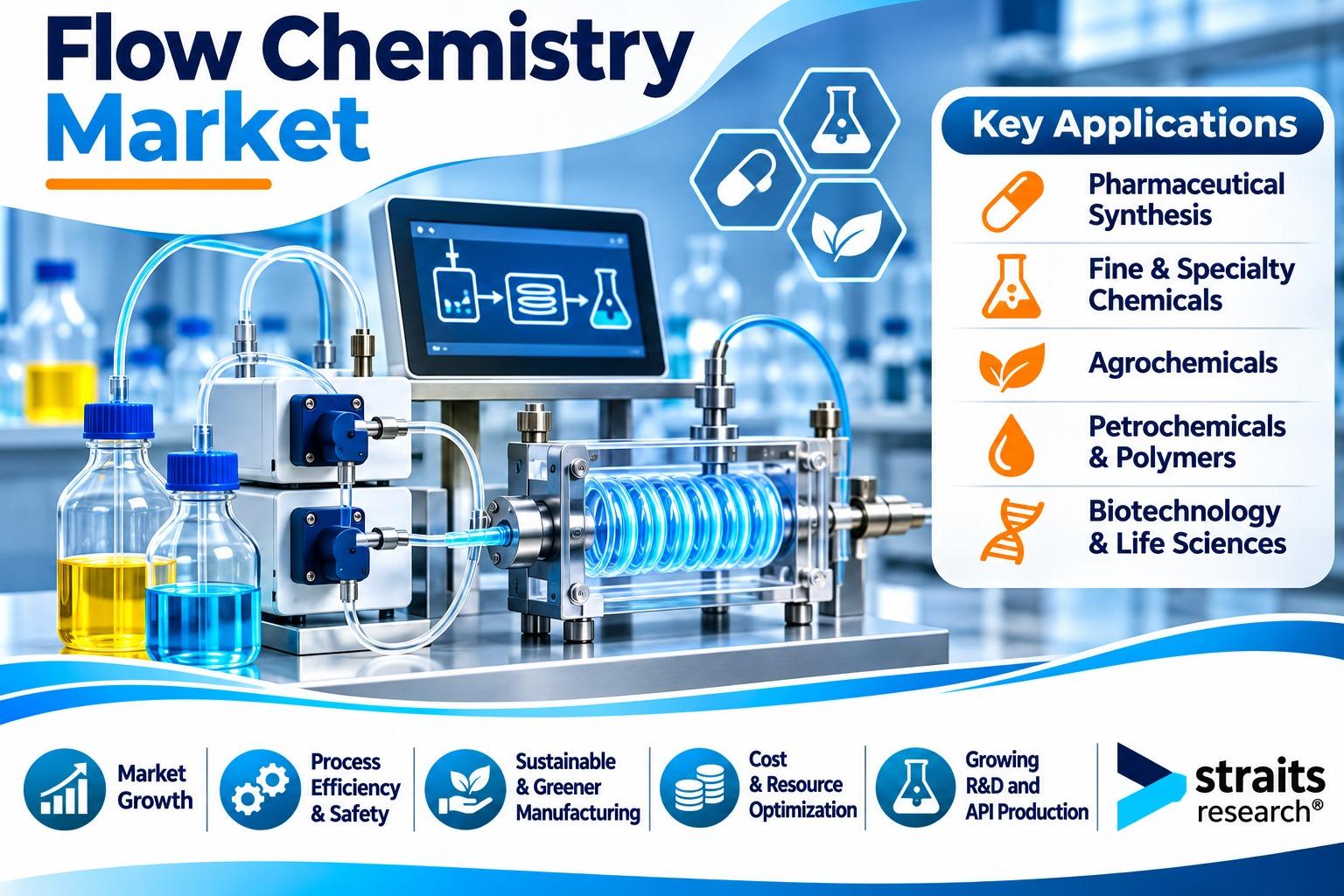

According to Straits Research, the global flow chemistry market size was valued at USD 2.19 billion in 2025 and is projected to grow from USD 2.44 billion in 2026 to USD 5.71 billion by 2034, registering a CAGR of 11.24% during the forecast period (2026–2034). North America dominated the flow chemistry market with a share of 38.5% in 2025.
The flow chemistry market includes technologies, equipment, and services used to conduct chemical reactions in continuously flowing streams rather than in traditional batch reactors. These systems typically use pumps, tubing, reactors, mixers, sensors, and process control equipment to regulate the movement of reactants and reaction conditions. Flow chemistry is used in pharmaceutical manufacturing, fine chemicals, petrochemicals, agrochemicals, and materials research. Its ability to provide controlled reaction conditions, improve heat and mass transfer, and support continuous production is encouraging adoption across chemical and pharmaceutical industries.
Get Full Report: https://straitsresearch.com/report/flow-chemistry-market
Growth Drivers of the Flow Chemistry Market
Increasing Adoption in Pharmaceutical Manufacturing
The pharmaceutical industry is a major application area for flow chemistry because drug manufacturing often requires precise control over reaction conditions. Continuous flow systems allow manufacturers to regulate temperature, pressure, mixing, and reaction time throughout chemical processes.
These capabilities are useful for reactions involving highly reactive or hazardous materials and for processes that require consistent product quality. Pharmaceutical companies are exploring flow chemistry to improve synthesis routes, reduce process variability, and support the development of more efficient manufacturing operations.
Growing Demand for Process Efficiency
Chemical manufacturers are increasingly focused on improving production efficiency, reducing waste, and optimizing resource use. Flow chemistry supports these objectives through controlled reactant delivery and continuous operation.
Unlike conventional batch processing, continuous systems can maintain more consistent reaction conditions and reduce the need for repeated vessel charging and discharge. These characteristics can help manufacturers improve process control and identify opportunities to increase production efficiency.
Improved Heat and Mass Transfer
Flow chemistry systems often use small reaction channels and controlled fluid movement, which can improve heat and mass transfer compared with some conventional batch processes. Efficient heat management is particularly important for reactions that release or absorb significant amounts of energy.
Improved temperature control can help reduce unwanted side reactions and support safer processing. These advantages are encouraging the use of flow reactors for complex chemical synthesis and reactions that require precise thermal management.
Increasing Focus on Chemical Process Safety
Chemical manufacturers are adopting technologies that help manage hazardous reactions and reduce operational risks. Flow chemistry can limit the quantity of reactive material present inside a reactor at any given time, depending on the system design and operating conditions.
This feature can be valuable for reactions involving unstable intermediates, toxic substances, or highly reactive chemicals. Continuous monitoring and automated control systems can also help operators maintain process conditions and respond to deviations.
Expansion of Research and Development Activities
Universities, pharmaceutical companies, and chemical research organizations are investing in advanced synthesis methods to develop new compounds and improve existing chemical processes. Flow chemistry provides researchers with a controlled environment for testing reaction conditions and optimizing synthesis routes.
Laboratory-scale flow systems allow researchers to study reaction parameters, screen catalysts, and evaluate process performance. These capabilities are supporting demand for flow chemistry equipment in academic and industrial research facilities.
Growing Interest in Continuous Manufacturing
Manufacturers are increasingly exploring continuous manufacturing as an alternative or complement to traditional batch production. Flow chemistry is an important part of this transition because it enables chemical reactions to operate continuously under controlled conditions.
Continuous processes can support consistent production and improve coordination between reaction, separation, and downstream processing stages. The growing interest in integrated manufacturing systems is encouraging investment in flow chemistry technologies.
Applications of the Flow Chemistry Market
Pharmaceutical and Drug Development
Pharmaceutical companies use flow chemistry for the synthesis of active pharmaceutical ingredients (APIs), intermediates, and other chemical compounds used in drug development. The technology allows researchers to control reaction conditions and investigate complex synthesis pathways.
Flow systems can also support the production of compounds that require precise temperature control or involve hazardous reaction intermediates. Their use in process development is helping pharmaceutical manufacturers evaluate continuous production methods.
Fine Chemicals and Specialty Chemicals
Fine chemical manufacturers use flow chemistry to produce high-value compounds with specific chemical properties. These products are used in pharmaceuticals, cosmetics, electronics, agriculture, and industrial applications.
Flow reactors help manufacturers manage reaction conditions and improve process consistency. The technology is particularly relevant for multistep synthesis and reactions that require controlled mixing or temperature management.
Petrochemicals
The petrochemical industry uses chemical reaction technologies to produce fuels, intermediates, polymers, and other industrial materials. Flow chemistry can support selected petrochemical processes that require controlled reaction conditions and efficient heat transfer.
Continuous reactors can also be integrated with downstream processing systems to support more coordinated production operations. Research into catalytic reactions and process intensification is expanding the potential use of flow chemistry in this sector.
Agrochemicals
Agrochemical manufacturers use flow chemistry for the synthesis of pesticides, herbicides, fungicides, and other agricultural chemicals. These production processes may involve multiple reaction stages and require consistent control over chemical composition.
Flow systems can help optimize reaction conditions and support the development of more efficient synthesis routes. They are also useful in research activities focused on new active ingredients and chemical intermediates.
Academic and Industrial Research
Research laboratories use flow chemistry equipment to investigate chemical reactions, test catalysts, and optimize synthesis methods. Small-scale reactors allow scientists to adjust flow rates, temperature, pressure, and reagent concentrations during experiments.
Industrial research teams also use these systems to evaluate whether laboratory processes can be transferred to larger production environments. This application supports technology development and process innovation across the chemical industry.
Polymer and Materials Manufacturing
Flow chemistry is being explored for the production of polymers, advanced materials, and specialty compounds. Continuous processing can provide controlled conditions for polymerization and other reactions where temperature, mixing, and reaction time influence material properties.
Research into continuous polymer synthesis and advanced materials is creating opportunities for flow chemistry equipment in materials development and manufacturing.
Emerging Trends in the Flow Chemistry Market
Integration of Automation and Process Monitoring
Flow chemistry systems are increasingly being integrated with automated pumps, sensors, control software, and monitoring technologies. These systems allow operators to regulate flow rates, pressure, temperature, and other process parameters in real time.
Automation can reduce manual intervention and improve repeatability during chemical synthesis. It also helps researchers collect process data and identify operating conditions that deliver consistent results.
Adoption of AI and Digital Process Optimization
Artificial intelligence and data analytics are emerging as tools for optimizing chemical reactions and continuous manufacturing processes. These technologies can analyze experimental data, identify relationships between reaction parameters, and support the selection of suitable operating conditions.
AI-assisted optimization can help researchers evaluate multiple reaction variables and reduce the time required for process development. Integration with automated laboratory equipment is further expanding opportunities for data-driven chemical synthesis.
Development of Modular Flow Chemistry Systems
Modular flow chemistry equipment is gaining attention because it allows manufacturers and researchers to configure systems according to specific reaction requirements. Individual components, including pumps, reactors, mixers, and monitoring units, can be combined or replaced to support different processes.
Modular designs can also help companies expand laboratory systems and adapt equipment for pilot-scale operations. This flexibility is useful for organizations working with different chemical reactions and production volumes.
Expansion of Continuous Pharmaceutical Manufacturing
Pharmaceutical manufacturers are exploring continuous processing to improve production consistency and optimize manufacturing operations. Flow chemistry can be combined with other continuous unit operations, including separation, crystallization, and purification.
The development of integrated systems is supporting the shift toward more connected pharmaceutical production processes. Regulatory interest in advanced manufacturing approaches is also encouraging companies to evaluate continuous processing technologies.
Increasing Use of Photochemistry and Electrochemistry
Flow reactors are being developed for specialized reaction methods such as photochemistry and electrochemistry. Continuous reactor designs can improve exposure to light or provide controlled conditions for electrochemical reactions.
These technologies are attracting interest in pharmaceutical synthesis and fine chemical production. Their combination with flow processing is creating additional options for developing chemical reactions that may be difficult to perform efficiently using conventional batch equipment.
Greater Focus on Process Intensification
Chemical manufacturers are exploring process intensification to improve productivity, reduce equipment requirements, and optimize energy and material use. Flow chemistry supports this approach by enabling controlled reactions in compact reactor systems.
Research into improved reactor designs, catalyst integration, and continuous processing is expanding the potential applications of flow chemistry. These developments are encouraging manufacturers to assess the technology for both new and existing production processes.