

Global Millet Market Outlook: Overview, Key Varieties & Consumer Demand Analysis 2034

Market Overview:
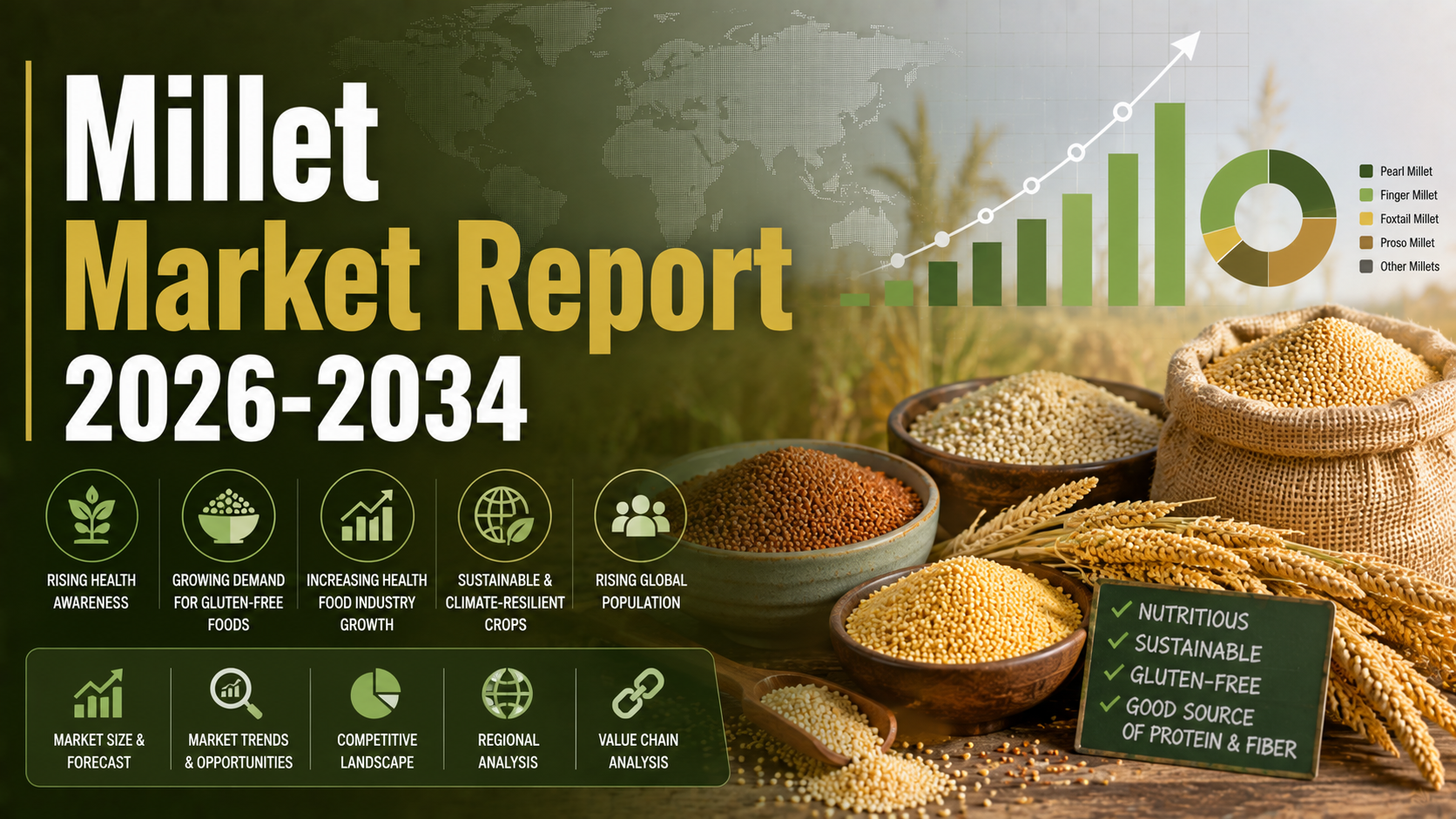
According to IMARC Group's latest research publication, "Millet Market Size, Share, Trends and Forecast by Product Type, Application, Distribution Channel, and Region", the global millet market size grew from USD 13.96 Billion in 2025 to USD 14.63 Billion in 2026 and is projected to reach USD 19.69 Billion by 2034, growing at a CAGR of 3.78% during 2026-2034. Asia Pacific currently dominates the market, holding a share of 49.5%.
This detailed analysis primarily encompasses industry size, business trends, market share, key growth factors, and regional forecasts. The report integrates research findings, market assessments, and data from different sources. It covers market dynamics such as drivers and challenges, and highlights growth opportunities, technological improvements, emerging trends, and innovations. It also provides a regional evaluation and a competitive landscape analysis.
How Climate Resilience and Nutrition Science Are Reshaping the Future of Millet Market
-
Millets are highly resilient to high temperatures and drought-prone conditions, requiring only around 350 mm of water compared with approximately 1,200 mm required for rice. Over 20 countries have incorporated millet production expansion into their national climate adaptation agricultural strategies, with incentivized cultivation programs providing guaranteed floor prices and subsidized inputs.
-
ICRISAT and ICAR developed RHB 273, the world's first three-way pearl millet hybrid, combining high yield, drought tolerance, disease resistance, and improved fodder quality. Released for India's dryland zones in Rajasthan, Gujarat, and Haryana, the hybrid produced about 2,230 kg/ha, achieving a 13–27% yield advantage over regional varieties.
-
Modern millet processing addresses traditional limitations through purpose-designed abrasive dehullers, reduced-gap roller mills, and pin mills for fine flour. Germination and fermentation pre-processing reduce anti-nutritional factors by 40–80%, improving mineral bioavailability in infant food formulations.
-
Blockchain traceability platforms are emerging for premium organic millet supply chains, enabling farm-to-shelf origin verification, while digital procurement platforms including DeHaat, Ninjacart, and AgriBazaar link Indian smallholder millet farmers directly to food company buyers.
-
The International Year of Millets campaign engaged more than 138 million users through social media and facilitated over 100 events across 35 countries, effectively raising awareness of millets' contribution to food security, climate resilience, and improved nutrition.
Grab a sample copy of this report: https://www.imarcgroup.com/millet-market/requestsample
Key Trends in the Millet Market
-
Rising Demand for Gluten-Free and Healthy Grains: The global gluten-free products market reached a value of USD 23.6 Billion, growing at 8%+ annually as coeliac disease diagnosis rates increase and non-coeliac gluten sensitivity gains mainstream consumer awareness.
-
Government Initiatives and Indian Institute of Millet Research: The UN's designation of 2023 as the International Year of Millets established over 500 millet start-ups in Hyderabad, aggregating INR 1,000 crore in funding rounds, leading to high consumption demand in the country.
-
Growing Infant Food Segment Demand: The global baby food and infant formula market is projected to reach USD 89.0 Billion, with millet-based infant cereals representing a rapidly growing sub-segment. Finger millet's calcium content at 344 mg/100g versus 28 mg/100g in rice supports infant bone development.
-
Millet Inclusion in Institutional Food Programs: Multiple state governments in India have mandated millet inclusion in school mid-day meal programs, Integrated Child Development Services supplementary nutrition, and the Public Distribution System covering 800 million beneficiaries.
-
Premium Millet Craft Beer and Functional Beverage Market: Great State Aleworks' Millet Beer Project explores the use of locally grown millets such as bajra and jowar in Indian craft beer, committing to using at least 5,000 kg of millet annually sourced directly from small farmers in drought-prone regions.
Growth Factors in the Millet Market
-
Climate-Resilient Crop Appeal: Millets' drought and heat tolerance positions them as a climate-resilient crop of growing strategic importance, with governments incorporating production expansion into national climate adaptation strategies and incentivizing cultivation.
-
Nutritional Advantages Over Mainstream Cereals: Millet's high iron (3.3–14.8 mg/100g in finger millet), calcium, dietary fiber, and essential amino acids directly address micronutrient deficiencies prevalent in infant populations across developing markets.
-
Government and International Organization Promotion: The IYM 2023 campaign generated over 2 Billion media impressions, triggered 40+ country-level policy actions, and catalyzed a wave of new millet product launches across infant food, bakery, and beverages globally.
-
Expanding Commercial Applications: Millet is transitioning from a subsistence staple to a globally recognized functional food ingredient with established commercial applications across infant food, bakery, beverage, and snack categories.
-
Venture and Institutional Investment: Impact investment funds including AgDevCo and Acumen are funding millet processing capacity in Sub-Saharan Africa, while the Gates Foundation and World Food Program are co-investing in crop improvement and market linkage programs across Nigeria, Senegal, and Ethiopia.
Leading Companies Operating in the Global Millet Industry:
-
Archer Daniels Midland Company
-
Cargill, Incorporated
-
BrettYoung
-
Ernst Conservation Seeds
The global millet market is fragmented, with no single company holding a dominant market position across all geographies and value chain stages. Archer Daniels Midland Company and Cargill are the most globally present players through their grain trading and processing operations, while BrettYoung and Ernst Conservation Seeds serve specialized North American seed markets. Market participants are increasingly investing in millet-based product innovation, improved crop varieties, sustainable sourcing, and partnerships with farmers.
Millet Market Report Segmentation:
Breakup By Product Type:
-
Pearl Millet
-
Finger Millet
-
Proso Millet
-
Others
Pearl millet leads at 46.3% market share, driven by its exceptional adaptability to arid, semi-arid, and low-fertility soils across Sub-Saharan Africa, South Asia, and the US Great Plains. Its high energy density, rich iron and zinc content, and lower anti-nutritional factor profile versus sorghum make it the preferred variety for food-grade commercial processing. Finger millet at 24.7% is the nutritionally densest species, making it the preferred variety for infant food and health food formulations. Proso millet at 16.8% serves primarily the North American and Eastern European birdseed and organic grain market.
Breakup By Application:
-
Infant Food
-
Bakery Products
-
Beverages
-
Others
Infant food leads at 34.6% market share. The application benefits from millet's superior micronutrient profile for infant nutrition, cultural embeddedness of millet porridges as first foods in South Asia and Sub-Saharan Africa, and the WHO's recommendation of millet-based complementary foods for weaning from 6 months. Bakery products at 28.3% incorporate millet flour in gluten-free bread, muffin, cracker, and cookie formulations, while beverages at 20.5% span traditional fermented drinks in Africa to premium craft beer and health drinks in developed markets.
Breakup By Distribution Channel:
-
Supermarkets and Hypermarkets
-
Traditional Grocery Stores
-
Online Stores
-
Others
Traditional grocery stores hold the leading position, particularly in South Asia and Sub-Saharan Africa where millet remains a staple purchased through established neighborhood retail networks. Supermarkets and hypermarkets serve the growing packaged and branded millet product segment, while online stores are expanding access to specialty and health food millet products in developed markets.
Breakup By Region:
-
North America (United States, Canada)
-
Europe (Germany, France, United Kingdom, Italy, Spain, Others)
-
Asia Pacific (China, Japan, India, South Korea, Australia, Indonesia, Others)
-
Latin America (Brazil, Mexico, Others)
-
Middle East and Africa
Asia-Pacific dominates with a 49.5% share, anchored by India as the world's largest millet producer and consumer, with millet forming a dietary staple across multiple states and the government's active Millets Mission driving both production expansion and commercial product development. Europe's 18.6% share reflects Germany and France's mature gluten-free food markets and the rapid growth of organic grain channels. North America holds 14.7%, driven by US gluten-free consumer demand and proso millet birdseed and organic grain markets. Latin America accounts for 9.6%, while the Middle East and Africa region at 7.6% represents significant volume given Africa's role as a major production and consumption region, with Nigeria, Niger, and Burkina Faso among the world's top millet-producing countries.
Real-World Applications: Where Millets Deliver Value
-
Infant Weaning Foods: Millet's iron, zinc, and calcium content and hypoallergenic profile make it an increasingly preferred weaning food ingredient, particularly in African and Asian markets where millet-based infant porridges are a cultural staple.
-
Gluten-Free Bakery Formulations: Millet flour is gaining shelf space in gluten-free bread, cookie, and cracker formulations as consumers seek grain-free and whole-grain alternatives to wheat-based products.
-
Traditional Fermented Beverages: Traditional fermented millet beverages remain dominant in West Africa, while kombucha-style probiotic millet drinks gain traction in premium health food channels.
-
Craft Beer and Gluten-Free Malt: Craft beer brewers are using millet as a gluten-free malt alternative for the growing gluten-sensitive consumer segment, with Great State Aleworks sourcing directly from small farmers in drought-prone regions.
-
Animal Feed and Birdseed: Proso millet serves primarily the North American and Eastern European birdseed and organic grain market, while pearl millet is widely deployed as both a food crop and animal feed.
Recent News and Developments in Millet Market
-
India's Ramoji Group launched the Sabala Millets brand, comprising 45 millet-based products positioned around preservative-free, nutrient-rich formulations, including ready-to-cook products, health bars, and snacks targeting India's health-conscious urban middle class through modern retail and e-commerce channels.
-
The Jammu and Kashmir government launched a three-year initiative to revive traditional millet cultivation across 8,000 hectares and double productivity from 10 to 20 quintals per hectare, including subsidized seeds, support for processing units and millet restaurants, and efforts to promote climate-resilient crops.
-
Cargill showcased millet cookies among its chef-curated bakery applications at AAHAR 2025, demonstrating the potential of millets in innovative, consumer-focused food products.
-
The European Union's Farm-to-Fork Strategy promotes diversification away from wheat and barley monocultures, with millet identified as a resilient alternative suitable for Mediterranean and Eastern European agricultural regions, while Horizon Europe is funding millet variety development across six member states.
Note: If you require specific details, data, or insights that are not currently included in the scope of this report, we are happy to accommodate your request. As part of our customization service, we will gather and provide the additional information you need, tailored to your specific requirements. Please let us know your exact needs, and we will ensure the report is updated accordingly to meet your expectations.
About Us:
IMARC Group is a global management consulting firm that helps the world’s most ambitious changemakers to create a lasting impact. The company provide a comprehensive suite of market entry and expansion services. IMARC offerings include thorough market assessment, feasibility studies, company incorporation assistance, factory setup support, regulatory approvals and licensing navigation, branding, marketing and sales strategies, competitive landscape and benchmarking analyses, pricing and cost research, and procurement research.
Contact Us:
IMARC Group
134 N 4th St. Brooklyn, NY 11249, USA
Email: sales@imarcgroup.com
Tel No:(D) +91 120 433 0800
United States: +1-201-971-6302


