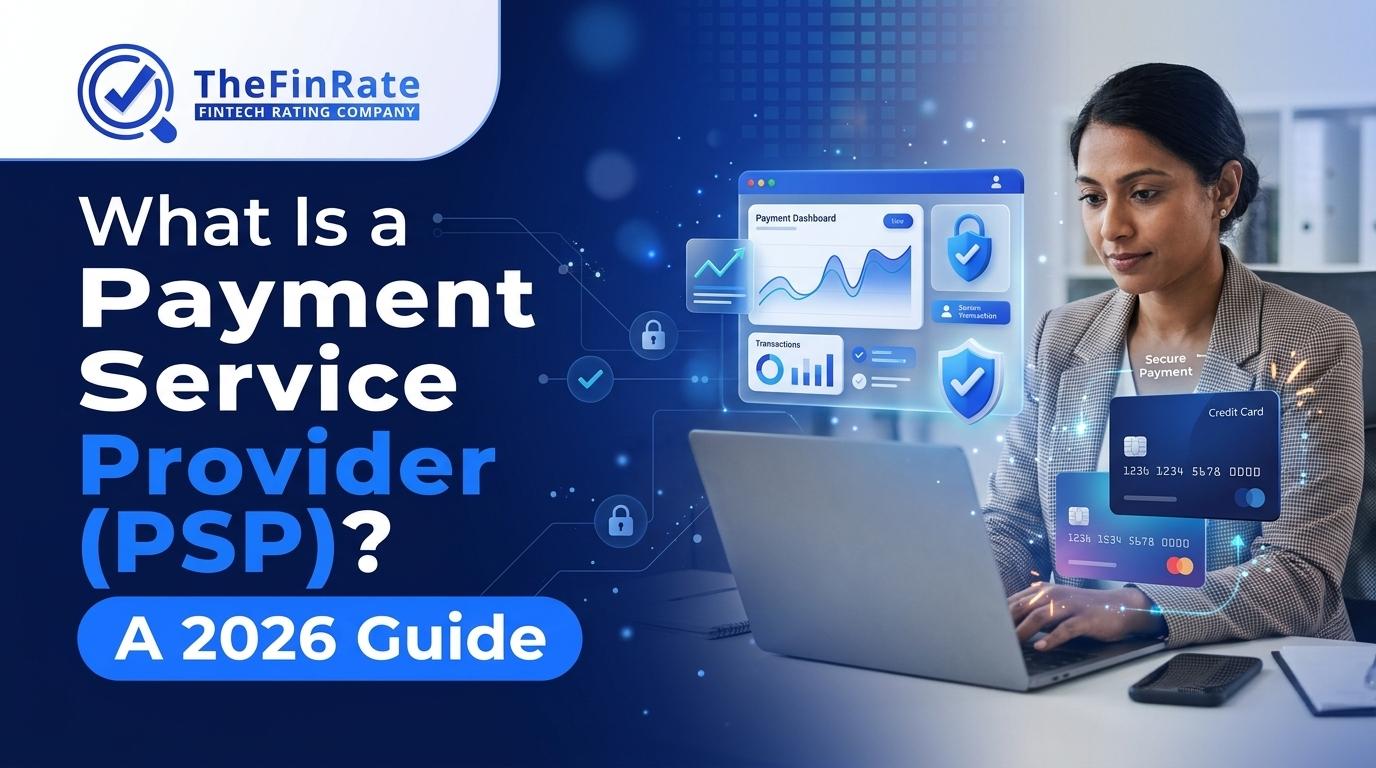
A payment service provider (PSP) is a company that lets a business accept online and in-store payments through one contract and one integration. Instead of setting up a gateway, a processor and an acquiring bank separately, you plug into the PSP and it handles the rest. This guide explains what a PSP is, how it works, how it differs from a gateway or merchant account, and compares ten widely used PSPs in the USA so you can match one to your business.
Quick answer
● Developers and online-first businesses: Stripe
● Customers who expect PayPal at checkout: PayPal or Braintree
● In-store and online together: Square
● Shopify stores: Shopify Payments
● Enterprise and global scale: Adyen or Worldpay
● POS-led setups and bank-resold processing: Fiserv (Clover)
● Digital wallet payments: Paysafe
● Multi-currency billing: Airwallex
“Top” here means a strong fit for a defined need based on published features and pricing. It is not a guarantee of performance for your business.
What a payment service provider does
A PSP sits between your checkout and the card networks. It bundles acquiring, gateway, fraud tools and settlement into a single contract and integration. When a customer pays, the PSP encrypts the payment details, sends them for authorization, returns the approval or decline, and settles the funds to your bank account.
Compare Payment Service Providers and Find the Right Provider
PSP vs gateway vs merchant account vs PayFac
● Payment gateway: The software that links your website to your acquiring partner and handles the technical side of accepting payment. A PSP is the company that offers a range of services, often including a gateway.
● Merchant account: The account that holds your funds before they reach your bank. A PSP can supply one or place you under a shared one.
● Payment facilitator (PayFac): Holds a master merchant account with an acquiring bank and onboards other businesses as sub-merchants beneath it.
● ISO: A more traditional processor reseller that usually sets you up with your own merchant account.
Terminology overlaps. A payment aggregator is often called a payment facilitator or a PSP, though the terms are not identical. Check what a provider actually offers instead of relying on the label.
How we compared them
- Pricing model and published fees
- Online and in-person support
- Integrations and developer tools
- Payout speed
- Contract terms
- Best-fit business type
Fee figures are indicative, based on published pricing in early 2026. Confirm current rates on each provider’s site.
Comparison table
| PSP | Pricing model | Online rate | Monthly fee | Best for |
|---|---|---|---|---|
| Stripe | Flat rate | 2.9% + $0.30 | $0 | Developers, online |
| PayPal | Flat rate | 2.99% + $0.49 | $0 | Wallet payments |
| Square | Flat rate | 3.3% + $0.30 | $0 (Free plan) | Retail plus online |
| Adyen | Interchange-plus | Custom, minimums apply | Confirm | Enterprise, global |
| Braintree | Flat rate or custom | See provider pricing page | Confirm | PayPal and Venmo users |
| Shopify Payments | Flat rate | 2.9% + $0.30 (Basic plan) | From $39 | Shopify stores |
| Worldpay | Quote-based | Confirm with provider | Confirm | Large merchants |
| Fiserv (Clover) | Quoted | Confirm with provider | Confirm | POS-led setups |
| Paysafe | Quote-based | Confirm with provider | Confirm | Wallet-friendly checkout |
| Airwallex | Confirm with provider | Confirm with provider | Confirm | Multi-currency billing |
The top 10 payment service providers in the USA
1. Stripe: best for developers and online businesses
Stripe offers customizable checkout, payment links and invoicing, supports more than 135 currencies, and has no monthly fee or long-term contract.
● Limits: It does not sell full countertop POS setups, and deposits can take up to two business days
● Suits: SaaS, eCommerce, marketplaces, developer-led teams
2. PayPal: best for wallet-friendly checkout
PayPal is one of the most widely used payment platforms and integrates with most shopping carts. It has no monthly fee and no PCI compliance fee.
● Limits: Deposits may take up to three days, and the product range can be confusing
● Suits: Merchants whose customers expect to pay with PayPal
3. Square: best for combined in-store and online sales
Square gives you gateway, processing, POS software and hardware in one place. The Free plan has no monthly fee and there are no termination, chargeback or PCI fees.
● Limits: Free plan rates are higher than many competitors
● Suits: Retail, cafes, service businesses
4. Adyen: best for enterprise and global scale
Adyen offers global acquiring and risk management on interchange-plus pricing, aimed at larger and multinational merchants.
● Limits: Minimum fees can make it a poor fit for small businesses
● Suits: High-volume enterprises selling in many countries
5. Braintree: best for PayPal and Venmo integration
Braintree is a PayPal service for web and mobile payments in the US and abroad, with a developer-friendly integration path.
● Limits: Pricing varies by setup, so model it on your own transaction data
● Suits: Online stores where a large share of buyers use PayPal
6. Shopify Payments: best for Shopify stores
Online rates fall as you move up Shopify plans, to as low as 2.5% plus 30 cents on higher tiers.
● Limits: Phone support is limited to the Plus plan, and business and American Express cards cost more on the Basic plan
● Suits: Online retailers already on Shopify
7. Worldpay: best for larger merchants
Worldpay serves larger merchants that want a custom pricing agreement and enterprise support. Pricing is quote-based, so request a written schedule before comparing it with flat-rate providers.
● Limits: Setup is more involved than self-serve providers
● Suits: Established merchants with significant volume
8. Fiserv (Clover): best for POS-led setups
Fiserv has over 6 million merchant accounts globally, largely because more than 10,000 financial institutions resell its processing. It also owns Clover, one of the most popular POS systems for small businesses.
● Limits: Contract terms vary by reseller, so read them closely
● Suits: Retail and restaurant businesses that want POS and processing together
9. Paysafe: best for wallet-friendly checkout
Paysafe is a public company that runs card acquiring and a gateway alongside its own wallets, Skrill and Neteller, and the PaysafeCard prepaid voucher. Card processing includes 3D Secure 2.0.
● Limits: Reserves and acceptance of new or previously declined merchants are settled in underwriting
● Suits: Online businesses whose buyers already pay with digital wallets
10. Airwallex: best for multi-currency billing
Airwallex added usage-based and multicurrency billing capabilities to its payments suite through its acquisition of OpenPay in September 2025.
● Limits: Confirm US coverage, pricing and eligibility directly
● Suits: Businesses that sell and collect in several currencies
Payment service provider pricing models
● Flat rate: One rate covers all costs. It is simple, but can cost more at high volume.
● Interchange-plus: You see the card network cost on each sale plus a fixed markup. It is more transparent but less predictable.
● Quote-based: Pricing is negotiated, common for enterprise.
A common benchmark is about 2.9% plus 30 cents for online transactions. On a $100 sale that is $3.20.
Pros and cons of using a PSP
● Pros: Quick onboarding, one contract, built-in fraud tools and simple pricing.
● Cons: You rely on the PSP’s system, roadmap and rules, so customizing payment flows, pricing and reporting is limited. Shared accounts can also mean holds or reviews when risk rises, and flat rates cost more at high volume.
How to choose the right PSP
- Match your sales channel. Online only, in-person or both.
- Check platform support. Make sure it works with your cart or CMS.
- Model total cost. Include monthly, chargeback, international and refund fees.
- Check payout speed and holds.
- Review support hours and contract terms, including data portability if you switch.
- Plan for growth. Look at multi-currency support and volume pricing.
Common mistakes
● Choosing on headline rate alone
● Ignoring refund and chargeback costs
● Assuming every PSP gives you your own merchant account
● Locking into a contract before testing
● Overlooking account-hold policies for new accounts
Need a PSP for a high-risk business?
Mainstream PSPs can decline or restrict some industries. In that case, review the best high-risk merchant account providers.
Verdict
A PSP is the simplest way to start taking payments, and the right one depends on your sales channel, volume and risk profile. Flat-rate platforms suit simplicity and lower volume, interchange-plus options suit scale, and enterprise providers suit global operations. Shortlist two or three, request written fee schedules and compare total monthly cost.
Recent News and Developments in Merchant Account Providers Market
● September 2025: Fiserv acquired CardFree and completed the purchase of the remaining stake in AIB Merchant Services, strengthening its Clover platform and eCommerce acquiring presence in Europe.
● September 2025: Airwallex acquired OpenPay, adding usage-based and multicurrency billing capabilities to its payments product suite.
● April 2026: FIS completed its acquisition of Global Payments’ Issuer Solutions business, leaving Global Payments focused on merchant solutions after its Worldpay deal.
Note: If you require specific details, provider comparisons, or insights that are not currently included in this overview, we are happy to accommodate your request. Please let us know your exact needs, and we will ensure the content is updated accordingly.
About Us:
TheFinRate is a B2B fintech information platform featuring payment provider reviews, comparisons, directories, industry guides, and educational resources. It helps online merchants, eCommerce businesses, SaaS companies, fintech startups, and payment professionals compare providers and make informed payment decisions.
Contact Us:
TheFinRate
Website: https://thefinrate.com/