

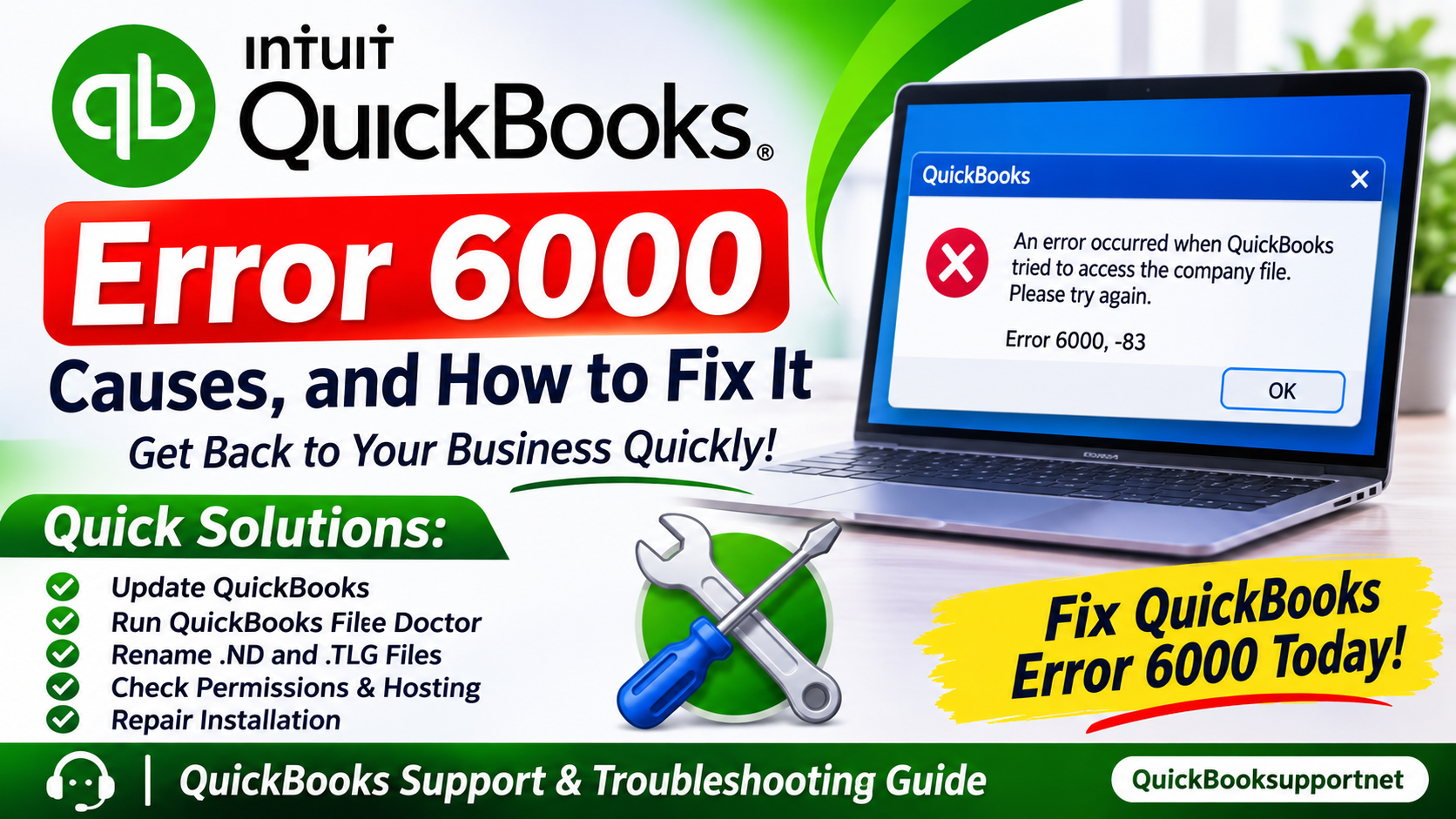

QuickBooks Error 6000 is a common company file error that can prevent users from opening their company files in QuickBooks Desktop. It usually occurs when QuickBooks encounters a problem accessing the company file stored on a local computer, external drive, or network server. This error can interrupt daily accounting activities, delay financial reporting, and prevent multiple users from accessing important business information.
QuickBooks Error 6000 belongs to the 6000 series of company file errors. It may appear with different additional error codes, such as 6000, -77, 6000, -80, 6000, -83, 6000, -82, and 6000, -305. Each variation can indicate a different issue related to file permissions, network connectivity, hosting configuration, or company file damage.
Understanding the reason behind the error is important because different 6000-series errors may require different troubleshooting methods. In this article, we will explain the common causes, symptoms, and practical solutions to help you troubleshoot QuickBooks Error 6000 and restore access to your company file.
What Is QuickBooks Error 6000?
QuickBooks Error 6000 is a company file access error that generally occurs when the software cannot open or communicate properly with a company file. QuickBooks Desktop uses company files to store essential accounting information, including customer details, vendor records, transactions, payroll information, invoices, and financial reports.
When QuickBooks encounters an issue while accessing this data, it may display an error message containing the 6000-series code.
The error can occur in both single-user and multi-user environments. However, network-related problems are particularly common when the company file is stored on a server or another computer.
Some users may encounter the error immediately after selecting their company file, while others may experience it after moving the file, updating QuickBooks, changing folder permissions, or configuring multi-user access.
Common Error Message:
"An error occurred when QuickBooks tried to access the company file. Please try again."
The exact message may vary depending on the specific 6000-series error code.
Common Causes of QuickBooks Error 6000
There are several reasons why QuickBooks Desktop may display a 6000-series error. Identifying the actual cause can help you choose the right troubleshooting method and avoid unnecessary changes to your accounting data.
1. Damaged or Corrupted Company File
One of the most common reasons behind QuickBooks Error 6000 is damage to the company file. If the QBW file becomes corrupted because of an unexpected system shutdown, improper software closure, or storage problems, QuickBooks may fail to open it.
2. Incorrect Folder Permissions
QuickBooks requires appropriate Windows permissions to read, write, and modify company files. If the folder containing your company file does not provide sufficient access, QuickBooks may display an error when you try to open it.
3. Damaged Network Data Files
QuickBooks uses Network Data (.ND) and Transaction Log (.TLG) files to manage company file connections and network communication. If these supporting files become damaged or outdated, QuickBooks may have difficulty accessing the company file.
4. Incorrect Hosting Configuration
In multi-user environments, hosting must be configured correctly. If multiple computers attempt to host the same company file, or a workstation is incorrectly configured as the host, QuickBooks may encounter connection problems.
5. Firewall or Antivirus Restrictions
Windows Firewall and third-party security applications may block communication between QuickBooks Desktop and the computer hosting the company file. Incorrect security settings can prevent workstations from accessing shared accounting data.
6. Damaged QuickBooks Installation
Missing, damaged, or outdated QuickBooks program components can also trigger Error 6000. This may happen after an interrupted software update, incomplete installation, or unexpected Windows system failure.
7. Company File Stored on an External Drive
Opening a company file directly from a USB drive, external hard disk, or unsupported storage location can sometimes create access problems. An unstable connection or incorrect drive permissions may interrupt communication with the file.
8. Incorrect File Location or Long File Path
If the company file is stored inside multiple nested folders, QuickBooks may encounter difficulties accessing it. Incorrect network paths or mapped drive configurations can also contribute to this issue.
Symptoms of QuickBooks Error 6000
QuickBooks Error 6000 can affect different parts of the accounting application. Users may notice one or more of the following symptoms:
-
QuickBooks displays a 6000-series error message when opening a company file.
-
The software freezes or becomes unresponsive during file access.
-
QuickBooks Desktop unexpectedly closes while opening company data.
-
Users cannot access the company file in multi-user mode.
-
The company file fails to open from a shared network folder.
-
QuickBooks takes longer than usual to load accounting information.
-
The application displays a message indicating that it cannot access the company file.
-
Users experience interruptions while creating or restoring company file backups.
-
Other workstations cannot connect to the company file hosted on the server.
Recognizing these symptoms can help determine whether the problem is related to the company file, QuickBooks installation, or network configuration.
How to Fix QuickBooks Error 6000?
Before applying any troubleshooting method, create a backup of your company file if you can access it. If the file is inaccessible, preserve the original QBW file and create a separate copy before attempting recovery procedures.
Follow the solutions below to troubleshoot QuickBooks Error 6000.
Solution 1: Update QuickBooks Desktop to the Latest Release
Using an outdated QuickBooks Desktop version may cause compatibility problems and prevent the application from accessing company files correctly.
Updating QuickBooks can resolve certain software-related issues and improve application stability.
Follow these steps:
-
Open QuickBooks Desktop.
-
Select the Help menu.
-
Choose Update QuickBooks Desktop.
-
Navigate to the Update Now tab.
-
Select the available updates.
-
Click Get Updates to download the latest release.
-
Close QuickBooks after the download finishes.
-
Reopen QuickBooks and install the downloaded updates if prompted.
-
Restart your computer.
-
Try opening your company file again.
If the error continues, move to the next troubleshooting method.
Solution 2: Run QuickBooks File Doctor
QuickBooks File Doctor is a diagnostic utility available through QuickBooks Tool Hub. It helps identify and repair certain company file and network-related problems.
Running this utility is a useful troubleshooting step when QuickBooks displays Error 6000.
Steps to run QuickBooks File Doctor:
-
Close QuickBooks Desktop.
-
Download and install the latest QuickBooks Tool Hub from the official Intuit website.
-
Open QuickBooks Tool Hub.
-
Select Company File Issues.
-
Click Run QuickBooks File Doctor.
-
Wait for the diagnostic utility to open.
-
Select your company file from the available list.
-
If the file is not listed, click Browse and locate it manually.
-
Select Check your file.
-
Click Continue.
-
Enter your QuickBooks administrator password when requested.
-
Select Next and allow the diagnostic process to finish.
Once the process is complete, reopen QuickBooks Desktop and check whether the company file is accessible.
Solution 3: Rename the .ND and .TLG Files
Network Data and Transaction Log files help QuickBooks manage company file connections. When these supporting files become damaged, the software may encounter Error 6000.
Renaming these files allows QuickBooks to create fresh versions when needed.
Follow these instructions:
-
Close QuickBooks Desktop on all computers.
-
Navigate to the folder containing your company file.
-
Locate the files with the same base name as your company file.
-
Find the files ending in
.NDand.TLG. -
Right-click the
.NDfile and select Rename. -
Add
.OLDto the end of its filename. -
Repeat the same process for the
.TLGfile. -
Open QuickBooks Desktop again.
-
Try accessing your company file.
For example:
-
Original: CompanyFile.qbw.nd
-
Renamed: CompanyFile.qbw.nd.OLD
-
Original: CompanyFile.qbw.tlg
-
Renamed: CompanyFile.qbw.tlg.OLD
Renaming these supporting files does not delete your company file data. QuickBooks can recreate them as required.
Solution 4: Open the Company File from a Different Location
Sometimes, the problem is not with the company file itself but with its current storage location. Incorrect folder permissions, network problems, or long file paths may prevent QuickBooks from accessing the data.
You can test whether the storage location is responsible by copying the company file to another local folder.
Steps to follow:
-
Close QuickBooks Desktop.
-
Open File Explorer.
-
Navigate to the folder where your company file is stored.
-
Locate the file ending in
.QBW. -
Right-click the company file and select Copy.
-
Navigate to your Windows Desktop.
-
Paste the copied company file.
-
Press and hold the Ctrl key while opening QuickBooks.
-
Continue holding Ctrl until the No Company Open window appears.
-
Select Open or Restore an Existing Company.
-
Choose Open a Company File.
-
Browse to the copied company file on your Desktop.
-
Select Open.
If the file opens successfully from the new location, the original folder or storage configuration may be causing the problem.
Avoid working on separate copies simultaneously, as this can create conflicting accounting records.
Solution 5: Check QuickBooks Hosting Settings
Incorrect hosting settings are another common reason for QuickBooks Error 6000, particularly when multiple users access the same company file.
In a multi-user environment, only the designated server computer should host the company file. Workstations should not independently host the same file.
Steps to check hosting settings:
-
Open QuickBooks Desktop on the affected computer.
-
Navigate to the File menu.
-
Select Utilities.
-
Check whether Stop Hosting Multi-User Access is displayed.
-
If this option appears on a workstation, select it.
-
Confirm the action when prompted.
-
Repeat the process on other workstations if necessary.
-
Verify that the designated server is configured to host the company file.
-
Reopen QuickBooks and test multi-user access.
Remember that stopping hosting on a computer disables its hosting function. Do not disable hosting on the designated server without ensuring that another correctly configured server is available.
Solution 6: Check Windows Folder Permissions
QuickBooks needs sufficient Windows permissions to access the folder containing the company file. Incorrect security settings may prevent the software from reading or modifying the required information.
To troubleshoot this issue, verify that the appropriate Windows user accounts have access to the shared company file folder.
Follow these steps:
-
Open File Explorer.
-
Navigate to the folder containing your company file.
-
Right-click the folder and select Properties.
-
Open the Security tab.
-
Select the Windows user account that requires access.
-
Review its permissions.
-
Ensure that the required read, write, modify, and folder access permissions are configured.
-
Open the Sharing tab and review the network-sharing settings.
-
Apply the necessary changes.
-
Restart QuickBooks Desktop and try opening the company file.
Make sure that permissions are configured securely rather than granting unnecessary access to everyone.
Solution 7: Configure Firewall and Antivirus Settings
Firewall restrictions can prevent QuickBooks Desktop from communicating with the server computer. This issue is particularly common in multi-user environments.
Your firewall or antivirus application may mistakenly block QuickBooks processes or network connections.
Here is how to troubleshoot it:
-
Open Windows Security or your installed firewall application.
-
Navigate to Firewall and Network Protection.
-
Review the firewall settings.
-
Check whether QuickBooks Desktop is allowed through the firewall.
-
Verify that the necessary QuickBooks programs have appropriate network access.
-
Review the QuickBooks Database Server Manager configuration.
-
Configure the required QuickBooks firewall ports according to your installed version.
-
Save the changes.
-
Restart QuickBooks Database Server Manager if necessary.
-
Try accessing the company file again.
Do not permanently disable your firewall or antivirus protection to resolve this error. If you are unsure about the required exceptions, contact your network administrator or security software provider.
Solution 8: Repair QuickBooks Desktop Installation
If the company file is accessible but QuickBooks continues displaying Error 6000, the software installation itself may be damaged.
The QuickBooks Tool Hub includes utilities that can help troubleshoot certain program-related issues.
Steps to repair QuickBooks:
-
Close QuickBooks Desktop.
-
Open QuickBooks Tool Hub.
-
Select Program Problems.
-
Choose Quick Fix my Program.
-
Wait for the repair process to finish.
-
Restart your computer.
-
Open QuickBooks Desktop.
-
Try accessing your company file.
If the problem persists, use the Windows Control Panel to access the QuickBooks installation repair option, where available.
Solution 9: Restore a Recent Company File Backup
If the company file is damaged and other troubleshooting methods have failed, restoring a recent backup may help recover access to your accounting information.
However, restoring a backup replaces the working company file with an earlier version, so you should understand the potential data loss before proceeding.
Follow these instructions:
-
Open QuickBooks Desktop.
-
Select the File menu.
-
Choose Open or Restore Company.
-
Select Restore a Backup Copy.
-
Click Next.
-
Choose Local Backup.
-
Browse to the location where your backup is stored.
-
Select the appropriate
.QBBbackup file. -
Choose a safe destination for the restored company file.
-
Follow the on-screen instructions to complete the restoration.
After restoring the backup, verify that your customers, vendors, transactions, and other accounting information are available.
Do not overwrite the original company file until you have confirmed that the restored backup contains the required information.
Also Read: How to Backup QuickBooks Company File in Easy Steps?
QuickBooks Error 6000 Series: Common Error Codes
QuickBooks Error 6000 is associated with several error codes. Although these errors share similar symptoms, their underlying causes can be different.
The following table explains some commonly encountered 6000-series errors.
|
Error code |
Possible cause |
|---|---|
|
QuickBooks Error -6000, -77 |
Company file location or access issue |
|
QuickBooks Error -6000, -80 |
Network connection or file access problem |
|
QuickBooks Error -6000, -82 |
Incorrect network configuration |
|
QuickBooks Error -6000, -83 |
Company file, backup, or network issue |
|
QuickBooks Error -6000, -106 |
Hosting or company file access problem |
|
QuickBooks Error -6000, -107 |
Damaged transaction log file |
|
QuickBooks Error -6000, -301 |
Damaged supporting files or company file |
|
QuickBooks Error -6000, -305 |
Network configuration or company file damage |
|
QuickBooks Error -6000, -832 |
Hosting configuration or damaged ND file |
Important: These are different error conditions, and the recommended troubleshooting steps may vary. Always check the complete error code before applying a specific repair method.
How to Prevent QuickBooks Error 6000 in the Future
Preventing QuickBooks Error 6000 requires maintaining your company file, software installation, and network configuration properly. Following a few maintenance practices can reduce the chances of encountering similar problems.
Maintain Regular Company File Backups: Create regular backups of your QuickBooks company file. Store backup copies in a separate, secure location so you can recover important accounting information if the original file becomes damaged.
Keep QuickBooks Updated: Install available QuickBooks Desktop updates to maintain software stability and address known program-related issues.
Avoid Unexpected Shutdowns: Always close QuickBooks properly before shutting down your computer. Unexpected power interruptions can sometimes affect company file integrity.
Maintain Proper Network Settings: If you use QuickBooks in multi-user mode, make sure that the server and workstations are configured correctly.
Check Folder Permissions: Review Windows folder permissions regularly to ensure that authorized QuickBooks users can access the company file.
Use Reliable Storage: Avoid frequently moving your company file between external drives or unsupported storage locations. Keep it in a properly configured local or network folder.
Monitor Antivirus Settings: Ensure that your security software does not unnecessarily block QuickBooks applications or required network connections.
Maintain Adequate Disk Space: Keep sufficient free storage available on the computer hosting your company file to prevent storage-related interruptions.
Frequently Asked Questions About QuickBooks Error 6000
1. What is QuickBooks Error 6000?
QuickBooks Error 6000 is a company file access error that occurs when QuickBooks Desktop cannot properly open or communicate with a company file. It can result from damaged company files, incorrect folder permissions, network configuration problems, or hosting issues.
2. Can QuickBooks Error 6000 cause data loss?
The error itself does not necessarily mean that your accounting data has been lost. However, if the company file is damaged, some information may become inaccessible. Creating a backup before troubleshooting is strongly recommended.
3. How do I fix QuickBooks Error 6000 quickly?
Start by updating QuickBooks Desktop and running QuickBooks File Doctor from QuickBooks Tool Hub. If the error continues, check the ND and TLG files, hosting configuration, network permissions, and firewall settings.
4. Why does QuickBooks Error 6000 occur in multi-user mode?
This problem may occur when multiple computers are configured to host the company file, the server connection is interrupted, or the firewall blocks required network communication.
5. What is the difference between QuickBooks Error 6000 and Error 6000 -83?
Both belong to the 6000-series company file errors, but they can indicate different problems. Error 6000 is a general reference to company file access issues, whereas Error -6000, -83 can occur when opening, restoring, or backing up a company file.
6. Can QuickBooks File Doctor resolve Error 6000?
Yes. QuickBooks File Doctor can help diagnose and repair certain company file and network-related problems associated with Error 6000. However, it may not resolve every variation of the error.
7. Should I rename the QBW company file to fix Error 6000?
Renaming the main QBW company file is not a universal solution. In some troubleshooting procedures, renaming the supporting ND and TLG files is recommended instead. Always create a backup before modifying company file-related components.
Conclusion
QuickBooks Error 6000 can interrupt accounting operations by preventing users from opening or accessing their company files. It may occur because of damaged company files, incorrect hosting settings, network connectivity problems, firewall restrictions, or damaged QuickBooks installation components.
Fortunately, several troubleshooting methods can help resolve this issue. Updating QuickBooks Desktop, running QuickBooks File Doctor, renaming damaged supporting files, checking folder permissions, and verifying hosting settings are some of the recommended approaches.
Before attempting advanced troubleshooting, always protect your original company file by creating a backup or working with a separate copy. If the problem continues after applying the recommended solutions, consider consulting a qualified QuickBooks professional to identify the specific cause.
QuickBooksupportnet provides information and guidance related to QuickBooks installation, company file errors, payroll issues, software troubleshooting, and accounting-related technical problems. Understanding the cause of an error can help users choose appropriate troubleshooting steps and maintain smoother accounting operations.