

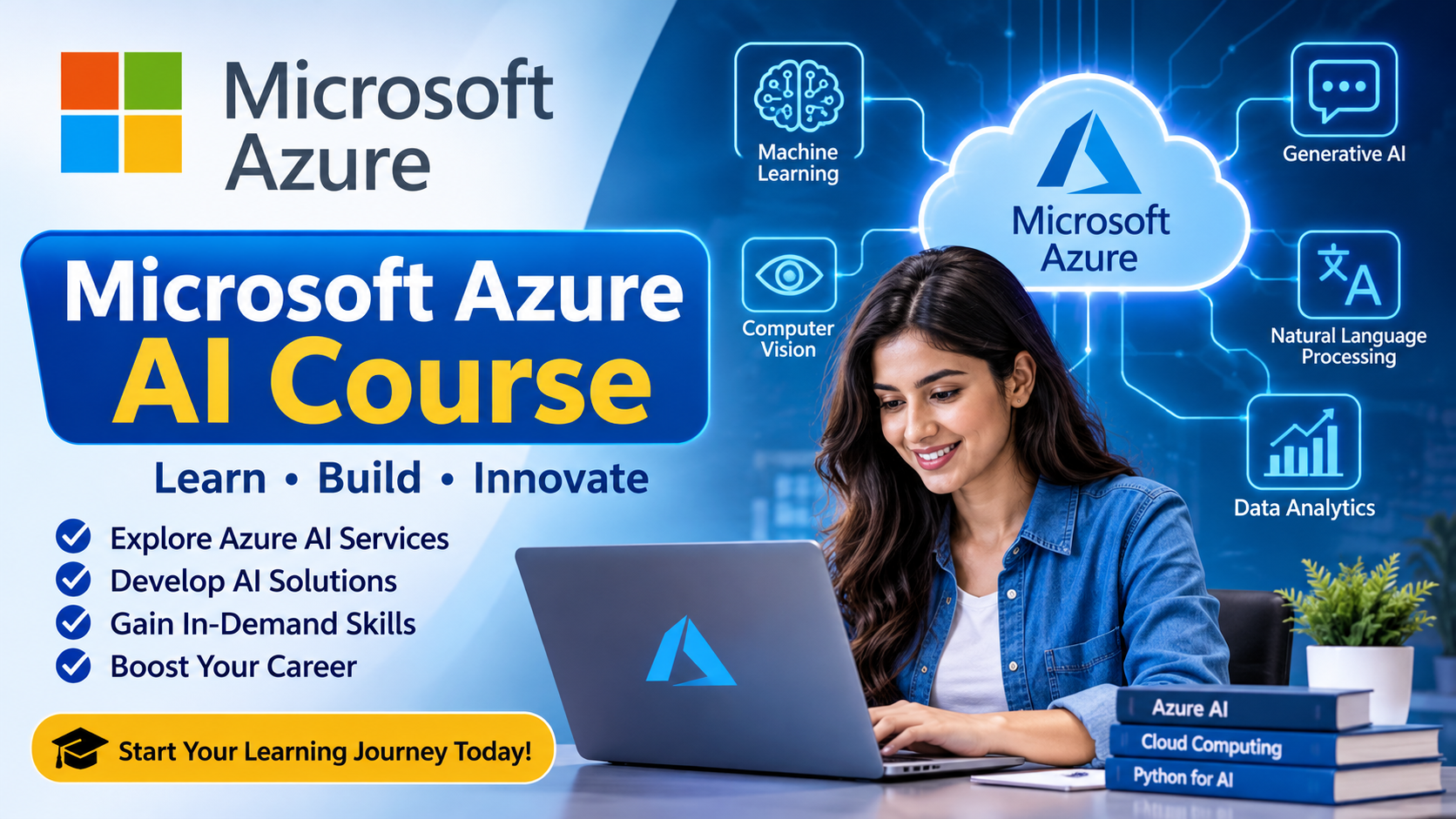
Azure AI Engineer Training: Skills, Certification, Benefits, and Career Opportunities

Artificial intelligence is transforming how businesses operate, make decisions, and deliver services. From intelligent chatbots and predictive analytics to computer vision and natural language processing, AI technologies are becoming essential across industries. Microsoft Azure provides a comprehensive cloud-based platform that enables professionals to develop, deploy, and manage AI-powered solutions. As a result, Azure AI Engineer Training has become an attractive learning option for students, IT professionals, developers, and individuals interested in building careers in artificial intelligence.
With practical knowledge, industry-relevant skills, and certification opportunities, Azure AI training can help learners prepare for emerging technology roles. Let’s explore the essential skills, certifications, benefits, and career opportunities associated with this training.
What Is Azure AI Engineer Training?
Azure AI Engineer Training is a learning program designed to help individuals understand and implement artificial intelligence solutions using Microsoft Azure services. It focuses on developing practical skills required to create intelligent applications, integrate AI models, and manage AI-powered systems.
Microsoft Azure offers several AI services that simplify the development process. These include Azure AI Foundry, Azure AI Search, Azure AI Language, Azure AI Speech, and Azure AI Vision. Learners gain exposure to these services and understand how they can be applied to real-world business challenges.
A well-structured Microsoft Azure AI Course generally combines theoretical concepts with hands-on exercises, practical projects, and certification preparation. This approach helps learners understand how AI solutions work in professional environments.
Key Skills You Can Develop Through Azure AI Training
Becoming an Azure AI Engineer requires a combination of technical knowledge, analytical thinking, and problem-solving abilities. Training programs help learners develop several important skills.
1. Understanding Artificial Intelligence Fundamentals
Before developing AI applications, learners need to understand the basic concepts of artificial intelligence and machine learning. This includes supervised learning, unsupervised learning, neural networks, deep learning, and model evaluation.
Understanding these concepts provides a strong foundation for working with advanced AI technologies.
2. Machine Learning and Model Development
Machine learning is an important part of AI engineering. Professionals should understand how to prepare datasets, train models, evaluate performance, and improve accuracy.
Azure Machine Learning provides tools for building, training, and deploying machine learning models. Training helps learners explore these capabilities and understand their practical applications.
3. Natural Language Processing
Natural Language Processing (NLP) enables computers to understand, interpret, and generate human language.
Azure AI Language offers capabilities such as sentiment analysis, entity recognition, language detection, and text classification. These technologies are widely used in customer support systems, chatbots, content analysis, and automated communication.
4. Computer Vision
Computer vision allows applications to identify and interpret information from images and videos.
Through Azure AI Vision, learners can explore image analysis, optical character recognition, object detection, and other visual AI capabilities. These skills are valuable in healthcare, manufacturing, retail, and security-related applications.
5. Generative AI and Large Language Models
Generative AI is one of the fastest-growing areas of artificial intelligence. It enables applications to generate text, summarize information, answer questions, and assist with complex tasks.
Learners explore large language models, prompt engineering, retrieval-augmented generation (RAG), and responsible AI practices. They also gain an understanding of how Azure AI services support the development of generative AI applications.
6. Cloud Deployment and Integration
AI engineers must understand how to deploy and integrate AI solutions into existing applications.
Azure training introduces cloud-based deployment, API integration, application monitoring, security, and scalability. These capabilities help professionals build reliable AI solutions for business environments.
Microsoft Azure AI Certification: Why Does It Matter?
Professional certifications help demonstrate technical knowledge and practical understanding. Microsoft offers role-based certification pathways that allow professionals to validate their cloud and AI skills.
One relevant certification is the Microsoft Certified: Azure AI Engineer Associate (AI-102), which focuses on designing and implementing AI solutions using Microsoft Azure.
Preparation for this certification generally covers:
-
Planning and managing Azure AI solutions.
-
Implementing generative AI solutions.
-
Developing natural language processing applications.
-
Building computer vision solutions.
-
Implementing knowledge mining and information extraction.
-
Integrating AI capabilities into applications.
Certification requirements and exam availability can change, so candidates should review the official Microsoft Learn website before registering.
Completing relevant training and preparing for certification can strengthen a professional profile and demonstrate commitment to continuous learning.
Benefits of Learning Azure AI Engineering
Azure AI training provides several advantages for individuals who want to develop technical expertise and explore opportunities in artificial intelligence.
1. Industry-Relevant Technical Knowledge
AI technologies are increasingly being adopted by businesses. Learning Azure AI services helps professionals understand tools and technologies used in modern cloud-based applications.
2. Hands-On Practical Experience
Practical learning allows participants to experiment with AI services, develop applications, and solve real-world problems. Projects involving chatbots, document processing, image recognition, and intelligent search can help build confidence.
3. Better Career Opportunities
AI engineering skills are relevant across industries, including finance, healthcare, education, retail, manufacturing, and information technology. Professionals with cloud and AI knowledge can explore several specialized roles.
4. Improved Problem-Solving Abilities
AI engineers work with complex datasets and business requirements. Training encourages analytical thinking, experimentation, and structured problem-solving.
5. Understanding Responsible AI
Developing AI applications involves more than technical implementation. Professionals must also understand data privacy, fairness, transparency, security, and responsible AI practices.
Azure AI training introduces learners to these important considerations, helping them develop solutions that are more reliable and trustworthy.
Career Opportunities After Azure AI Engineer Training
Artificial intelligence is creating new professional opportunities for individuals with cloud computing and machine learning expertise. After completing relevant training, learners can explore different career paths depending on their interests and experience.
Some popular career options include:
1. Azure AI Engineer: Responsible for designing, developing, integrating, and deploying AI solutions using Azure services.
2. Machine Learning Engineer: Works on developing machine learning models, preparing datasets, evaluating algorithms, and deploying predictive solutions.
3. AI Developer: Builds intelligent applications by integrating AI APIs, language models, and automation capabilities into software products.
4. Data Scientist: Analyzes complex datasets, identifies patterns, and develops predictive models to support business decisions.
5. Generative AI Engineer: Develops applications using large language models, prompt engineering, RAG architectures, and other generative AI technologies.
6. Cloud AI Consultant: Helps organizations identify business requirements and implement suitable cloud-based artificial intelligence solutions.
Career opportunities and salary expectations depend on technical expertise, practical experience, location, and industry demand. Building a strong project portfolio alongside certification can help candidates demonstrate their abilities to potential employers.
How to Choose the Right Azure AI Training Program
Selecting an appropriate training program is important for achieving learning goals. Before enrolling, consider the following factors:
-
Updated Curriculum: Choose a course that covers current Azure AI services, generative AI, machine learning, and responsible AI.
-
Experienced Trainers: Look for instructors with practical experience in cloud computing and artificial intelligence.
-
Hands-On Projects: Prioritize programs that include practical exercises and real-world application development.
-
Certification Preparation: Check whether the course aligns with relevant Microsoft certification objectives.
-
Learning Support: Access to study materials, practice assessments, and doubt-clearing sessions can improve the overall learning experience.
-
Flexible Learning Options: Online and instructor-led training options allow learners to select a format that suits their schedules.
A suitable course should balance theoretical understanding with practical implementation rather than focusing entirely on exam preparation.
Conclusion
Azure AI Engineer Training offers a valuable opportunity for individuals who want to develop expertise in artificial intelligence and cloud computing. By learning machine learning, natural language processing, computer vision, generative AI, and Azure deployment techniques, professionals can prepare for various technology-focused roles.
Whether you are a beginner exploring artificial intelligence or an experienced IT professional looking to expand your technical capabilities, structured training can provide a foundation for continuous career development. Combining practical projects, relevant certifications, and hands-on experience can help you stay competitive in the evolving AI industry.
Frequently Asked Questions (FAQs)
1. What is Azure AI Engineer Training?
Azure AI Engineer Training is a professional learning program that teaches individuals how to develop, deploy, and manage artificial intelligence solutions using Microsoft Azure services.
2. Is coding required to become an Azure AI Engineer?
Yes, programming knowledge is beneficial. Familiarity with Python, REST APIs, and basic software development concepts can help learners build and integrate AI applications more effectively.
3. Which certification is suitable for Azure AI Engineers?
The Microsoft Certified: Azure AI Engineer Associate (AI-102) is a relevant certification for professionals interested in designing and implementing AI solutions using Azure.
4. How long does it take to complete Azure AI training?
The duration depends on the course structure, learning format, and prior technical knowledge. Some training programs take a few weeks, while more comprehensive learning paths may require several months.
5. What career opportunities are available after completing a Microsoft Azure AI Course?
Learners can explore roles such as Azure AI Engineer, Machine Learning Engineer, AI Developer, Data Scientist, Generative AI Engineer, and Cloud AI Consultant, depending on their skills and experience.


