

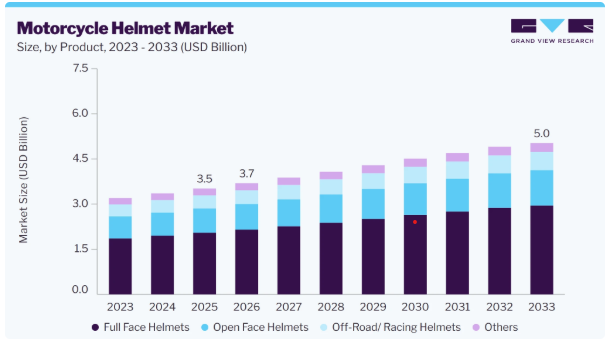

The global motorcycle helmet market is witnessing steady growth as rising motorcycle ownership, increasing road safety awareness, and stricter helmet regulations encourage riders to invest in protective headgear. The Motorcycle Helmet Market was valued at USD 3.5 billion in 2025 and is projected to grow from USD 3.7 billion in 2026 to USD 5.0 billion by 2033, registering a CAGR of 4.5% from 2026 to 2033. Asia Pacific dominated the market with a revenue share of 43.6% in 2025, supported by high motorcycle ownership and increasing emphasis on rider safety. Growing demand for certified helmets, lightweight materials, advanced impact protection, and smart connectivity features is further shaping the industry's development.
Motorcycle Helmet Market Trends and Key Insights
- Product: Full face helmets dominated the market, accounting for 58.1% of revenue in 2025. Open face helmets are projected to grow at the fastest CAGR of 5.4% over the forecast period mentioned in the source.
- Price Range: The up to USD 150 segment held the largest share of 50.9% in 2025 and is expected to grow at the fastest rate during the forecast period.
- End User: Commuters represented the largest segment, accounting for 84.6% of market revenue in 2025.
- Distribution Channel: Offline sales dominated with a revenue share of 78.3% in 2025, while online sales are projected to grow at a CAGR of 5.2% from 2026 to 2033.
- Regional Performance: Asia Pacific held the largest regional share at 43.6% in 2025, while India is expected to experience significant growth.
Want to Understand What’s Driving Market Growth? Ask Prism AI for research-backed insights into market size, evolving opportunities
How Are Smart Technologies Changing Motorcycle Helmet Design?
Technological innovation is becoming an important factor in product development. Manufacturers are incorporating Bluetooth communication systems, heads-up displays, enhanced ventilation, and advanced materials to improve rider convenience and safety.
At CES 2025, Intelligent Cranium Helmets introduced an AI-enabled motorcycle helmet featuring a 240-degree horizontal field of view, a front-facing action camera with 300-degree coverage, automatic crash detection, and proximity alerts. The helmet also includes Bluetooth connectivity and a heads-up display, demonstrating the growing integration of digital technologies into protective equipment.
In April 2024, Ather Energy introduced its Halo Smart Helmet series alongside the Rizta family scooter. The helmet features Harman Kardon speakers, handlebar-controlled music and call management, rider-pillion communication, wireless charging, and auto-WearDetect connectivity. The Halo Bit modular accessory also allows existing half-face helmets to incorporate smart features.
These developments highlight the industry's shift toward helmets that combine protective functionality with connected riding experiences.
Download a free sample report or claim your copy of this full market intelligence report
Which Product Categories Are Dominating the Market?
Full face helmets accounted for the largest product share of 58.1% in 2025. Their ability to protect the head, jaw, and chin makes them a preferred option among safety-conscious riders. Stricter helmet regulations and increasing awareness of accident-related injuries are further supporting demand for full-face designs.
Open face helmets are expected to register the fastest growth, with a projected CAGR of 5.4% over the forecast period stated in the source. Their lightweight construction, ventilation, and convenience appeal to urban commuters, cruiser enthusiasts, and electric two-wheeler users.
The up to USD 150 price category dominated the market with a 50.9% revenue share in 2025 and is also expected to grow at the fastest rate. Price-sensitive consumers increasingly seek affordable helmets that provide reliable protection and comply with certifications such as DOT, ECE, and Snell. The USD 150 to USD 250 segment is projected to grow at a CAGR of 3.5% from 2026 to 2033, supported by demand for mid-range products offering improved ventilation, anti-fog visors, lightweight materials, and Bluetooth compatibility.
Why Do Offline Stores Continue to Lead Helmet Distribution?
Offline distribution accounted for 78.3% of the market revenue in 2025. Helmet purchases require careful consideration of fit, size, comfort, padding, and visor functionality. Physical stores allow consumers to try different models and receive guidance from sales representatives before making a purchase.
However, online distribution is gaining momentum and is expected to grow at a CAGR of 5.2% from 2026 to 2033. Competitive pricing, discounts, product reviews, detailed size guides, and convenient delivery options are encouraging online purchases. Augmented reality and virtual try-on features are also improving the digital shopping experience. Direct-to-consumer platforms are helping manufacturers offer customization and personalized product recommendations.
What Role Do Safety Regulations Play in Market Development?
Mandatory helmet laws and certification requirements are influencing consumer purchasing decisions across major motorcycle markets. The U.S. follows the FMVSS 218 DOT standard, while Germany and France recognize ECE 22.05 or ECE 22.06 certification. India follows IS 4151:2015, requiring the ISI mark, and China introduced GB 811-2022 as its mandatory national standard for motorcycle and electric bicycle passenger helmets.
These regulations encourage manufacturers to meet specific requirements related to impact resistance, penetration protection, retention systems, and product quality. Greater enforcement and road safety campaigns are also encouraging consumers to replace uncertified products with compliant protective equipment.
Despite these developments, the availability of low-cost uncertified helmets remains a challenge, particularly in price-sensitive developing markets. This creates pricing pressure for established manufacturers and highlights the importance of product certification, brand reputation, and affordability.
Which Regions Are Creating Growth Opportunities?
Asia Pacific dominated the global motorcycle helmet market with a 43.6% revenue share in 2025. High motorcycle ownership, increasing urbanization, road safety initiatives, and mandatory helmet regulations are supporting regional demand. India is expected to grow at a CAGR of 8.9% from 2025 to 2030, driven by expanding urban populations, traffic congestion, and demand for affordable mobility. China held the largest market share within Asia Pacific in 2025, supported by regulatory developments, including the implementation of GB 811-2022.
North America is projected to grow at a CAGR of 2.9% from 2026 to 2033. Recreational motorcycling, motorcycle events, and the popularity of cost-effective transportation are supporting demand. The U.S. market is expected to register a CAGR of 1.9% from 2026 to 2033.
Europe is projected to grow at a CAGR of 2.8% from 2026 to 2033. Established motorcycling cultures, motorsports participation, and demand for high-quality protective gear are contributing to regional development. Motorcycle registrations across France, Germany, Italy, Spain, and the UK reached 1,155,640 units in 2024, increasing by 10.1% compared with 2023.
What Is the Future Outlook for the Motorcycle Helmet Market?
The motorcycle helmet market is expected to maintain steady growth through 2033 as motorcycle ownership, safety awareness, and regulatory compliance continue to influence purchasing decisions. Full face helmets and affordable price categories currently account for substantial market shares, while open face helmets and online distribution channels are creating additional growth opportunities. Increasing adoption of smart technologies, improved protective materials, and connected features is expected to influence future product development. With Asia Pacific maintaining its leading position and countries such as India offering significant growth potential, the global market is projected to reach USD 5.0 billion by 2033.


