English
 Arabic
 Français
 Spanish
 Portuguese
 Deutsch
 Turkish
 Dutch
Dutch
 Italiano
 Russian
 Romaian
 Portuguese (Brazil)
 Greek
Greek
 Réunionnais
 India
India
Lithium Market to Reach USD 20,000 Million by 2034 Amid Accelerating EV Adoption and Energy Storage Expansion
Technologies |
2026-06-27 10:55:48
 Entreprises locales
 Runsound music
 La silver économie
 Affiliation Matrice 3x9
 Récompenses
 Babarun (BBRN)
 Calculez vos calories
 Collab Influenceurs
 Événementiels
 Procaly
 Affiliation
 Prêts Immobiliers

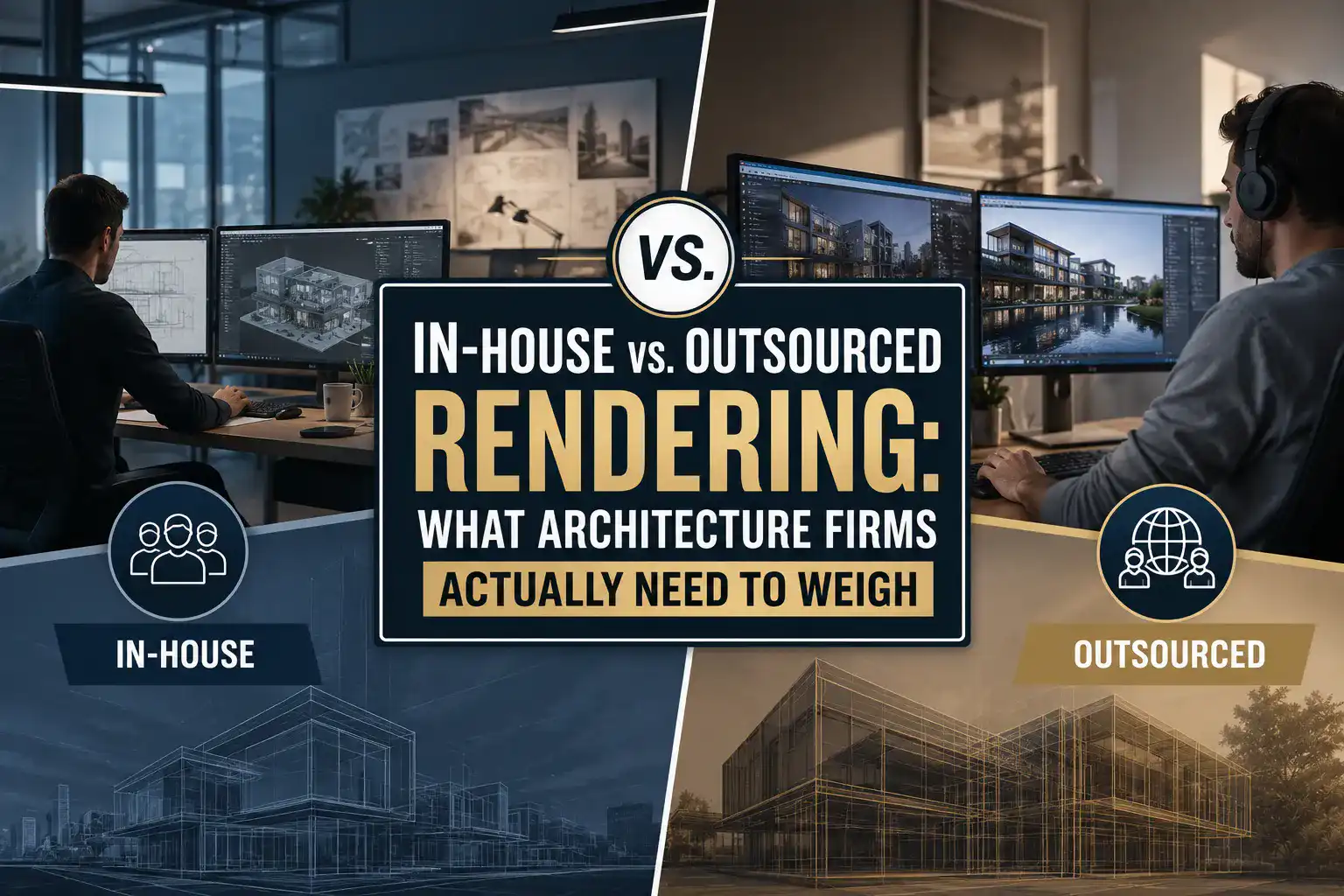
At some point, almost every growing architecture or design firm has the same internal debate: should we hire a dedicated visualization artist, or should we send rendering work out to a specialized studio? It's rarely a simple yes-or-no decision, and firms that get it wrong tend to either overspend on underused in-house talent or lose control and turnaround time by outsourcing everything blindly.
Here's a clearer way to think through the tradeoff.
Hiring a full-time visualization specialist looks straightforward on paper: one salary line, one set of software licenses. But the real cost stack is bigger than that. High-end rendering software subscriptions, powerful GPU workstations capable of handling complex scenes, and the ongoing time investment of keeping a single specialist current with evolving rendering engines all add up. And because rendering skill spans both technical software fluency and genuine artistic judgment lighting, materials, composition the hiring pool for someone genuinely good at it is smaller and more expensive than the job title might suggest.
The payoff for firms that get this right is real, though: instant availability, deep familiarity with the firm's specific design language, and no per-project negotiation overhead.
Outsourcing rendering work to a specialized studio flips the cost structure: no salary, no hardware investment, no software licensing burden. You pay per project, and you get access to a team that renders full-time across many different clients, which often means faster turnaround and a broader stylistic range than a single in-house hire could offer.
The real risk isn't cost, though. It's dependent on communication quality. A rendering studio that doesn't fully understand your design intent can produce technically polished images that miss the point entirely: the wrong mood, the wrong material read, subtle proportions that feel slightly off. The firms that outsource successfully are the ones that get disciplined about providing clear reference material, feedback rounds, and revision expectations upfront, rather than treating the rendering studio as a black box.
Most of the "in-house vs. outsourced" debate actually resolves once you look honestly at project volume and rendering frequency.
A firm producing constantly weekly client presentations, frequent design iterations, an active pipeline of concurrent projects often reaches a point where a dedicated in-house specialist genuinely pays for themselves through speed and availability alone. A firm that needs high-quality renders occasionally, for major milestones or client pitches rather than continuous iteration, usually gets better value paying a specialized studio per project rather than carrying full-time overhead for intermittent need.
In practice, many mid-sized firms eventually land somewhere in between: a smaller in-house team (sometimes just one generalist) handling quick internal visualization and early-stage concept sketches, while final, client-facing, high-polish renders get sent to an outside specialist studio for the images that actually need to close a sale or win an approval. This hybrid approach captures the responsiveness of in-house work for day-to-day iteration while still accessing specialist-level polish for the renders that matter most.
Whichever direction a firm leans, it helps to have a clear, shared understanding of what rendering actually involves the different types (interior, exterior, aerial, walkthrough animation), what each is suited for, and why the process has become such a standard part of the modern design workflow. This explanation of what render services actually mean breaks down the different categories of rendering work and their practical uses, which is a useful shared reference point whether you're briefing an in-house hire or scoping a project for an outside studio.
There's no universally right answer between in-house and outsourced rendering; the right choice depends almost entirely on how consistently your firm needs renders and how much control you need over the process versus how much speed and specialist polish you're willing to pay for externally. Get honest about your actual project volume before making the call, and the decision tends to become much less complicated than it first appears.