English
 Arabic
 Français
 Spanish
 Portuguese
 Deutsch
 Turkish
 Dutch
Dutch
 Italiano
 Russian
 Romaian
 Portuguese (Brazil)
 Greek
Greek
 Réunionnais
 India
India
 Babarun (BBRN)
 Collab Influenceurs
 Coupon
 Procaly
 Récompenses
 Événementiels
 Parrainage
 Calculez vos calories
 Affiliation Matrice 3x9
 La silver économie
 Maps Membres
 BabaShopCenter
 Bot IA de Trading
 Runsound music
 Films partner IMDb
 Affiliation
 Prêts Immobiliers

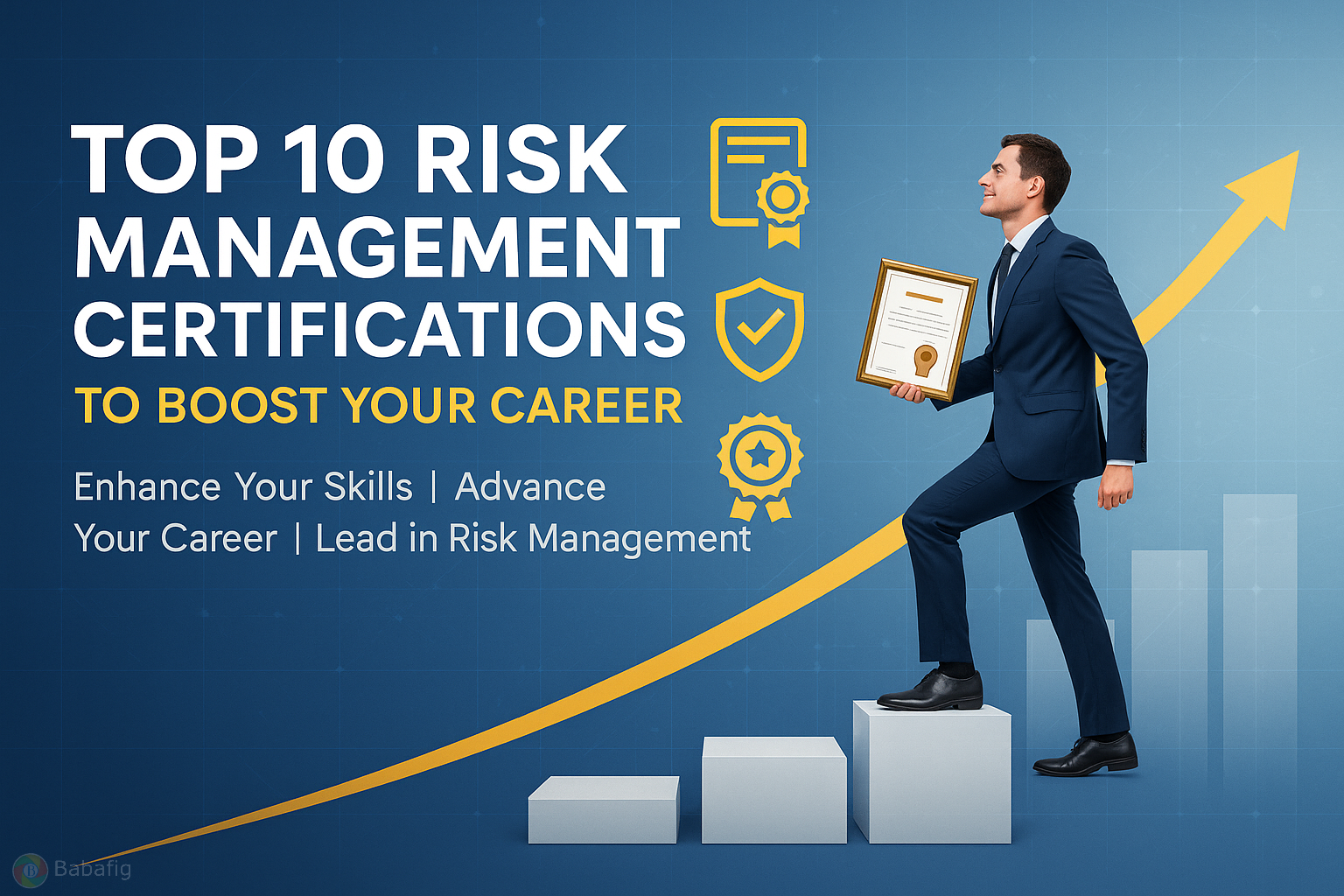
Top 10 Risk Management Certifications to Boost Your Career
In a world where uncertainty is the only constant, risk management has become one of the most valuable skills across industries. From cybersecurity threats to financial instability, organizations need professionals who can foresee potential risks and build resilience.
If you’re looking to stand out in your career or move into leadership roles, earning a globally recognized risk management certification is your smartest move. Here’s a list of the top 10 risk management certifications that can help you sharpen your expertise and future-proof your career.
1. ISO 31000 Risk Manager Certification
The ISO 31000 Certification sets the global benchmark for effective risk management. It provides a structured framework for identifying, assessing, and mitigating risks across any business environment.
Why choose it: Globally recognized, industry-agnostic, and aligned with the latest ISO standards.
Perfect for: Risk professionals and business leaders seeking a comprehensive, strategic approach to risk.
Offered by: NovelVista, PECB, and other accredited institutions.
2. RIMS-Certified Risk Management Professional (CRMP)
Issued by the Risk and Insurance Management Society (RIMS), this certification focuses on enterprise risk management (ERM) — helping professionals create resilient, agile organizations.
Why choose it: Builds credibility as a strategic risk leader.
Perfect for: Senior managers and ERM practitioners.
3. PMI Risk Management Professional (PMI-RMP)
From the Project Management Institute, this certification enhances your ability to identify, assess, and respond to project risks — ensuring projects stay on time, on budget, and on target.
Why choose it: Adds a valuable specialization to your project management skillset.
Perfect for: Project managers, coordinators, and PMO professionals.
4. Certified Risk Manager (CRM)
The CRM certification delivers a hands-on approach to managing organizational, financial, and operational risks. It’s highly respected in the insurance and finance sectors.
Why choose it: Focuses on real-world application and analytical techniques.
Perfect for: Finance, insurance, and compliance professionals.
5. Financial Risk Manager (FRM)
Recognized globally and administered by GARP, the FRM certification is considered the gold standard in financial risk management. It dives deep into credit, market, operational, and investment risks.
Why choose it: Globally recognized in banking and investment sectors.
Perfect for: Risk analysts, investment bankers, and financial consultants.
6. Professional Risk Manager (PRM)
Offered by PRMIA, this credential focuses on both quantitative and qualitative aspects of risk management, ensuring a balanced understanding of risk in financial and business contexts.
Why choose it: Recognized by global financial institutions.
Perfect for: Financial analysts and risk strategists.
7. Certified Enterprise Risk Manager (CERM)
The CERM certification integrates governance, risk, and compliance (GRC) into strategic business planning. It’s a top pick for leaders designing risk-aware business models.
Why choose it: Bridges risk management with business strategy.
Perfect for: Senior executives and risk consultants.
8. Associate in Risk Management (ARM)
This entry-to-mid-level certification builds a strong foundation in risk identification, control, and financing. Offered by The Institutes, it’s widely respected in the corporate and insurance sectors.
Why choose it: A great starting point for aspiring risk professionals.
Perfect for: Beginners and mid-level managers.
9. Certified Information Systems Risk Manager (CISRM)
With the rise of cyber threats, CISRM helps professionals manage IT and information security risks through governance and control frameworks.
Why choose it: Merges IT governance with risk mitigation.
Perfect for: Cybersecurity experts, IT auditors, and compliance officers.
10. Operational Risk Management Professional (ORMP)
This certification enhances your ability to manage day-to-day operational risks that impact business continuity, reputation, and performance.
Why choose it: Focuses on minimizing internal and process-based risks.
Perfect for: Business process managers and operations leaders.
Final Thoughts
Investing in a risk management certification is not just about adding credentials — it’s about gaining the knowledge to protect your organization, your team, and your career from uncertainty.
Among all, the ISO 31000 Training Course stands out as the most versatile and globally applicable credential, giving professionals a strong foundation to build a sustainable, risk-aware culture across industries.
In a world where uncertainty is the only constant, risk management has become one of the most valuable skills across industries. From cybersecurity threats to financial instability, organizations need professionals who can foresee potential risks and build resilience.
If you’re looking to stand out in your career or move into leadership roles, earning a globally recognized risk management certification is your smartest move. Here’s a list of the top 10 risk management certifications that can help you sharpen your expertise and future-proof your career.
1. ISO 31000 Risk Manager Certification
The ISO 31000 Certification sets the global benchmark for effective risk management. It provides a structured framework for identifying, assessing, and mitigating risks across any business environment.
Why choose it: Globally recognized, industry-agnostic, and aligned with the latest ISO standards.
Perfect for: Risk professionals and business leaders seeking a comprehensive, strategic approach to risk.
Offered by: NovelVista, PECB, and other accredited institutions.
2. RIMS-Certified Risk Management Professional (CRMP)
Issued by the Risk and Insurance Management Society (RIMS), this certification focuses on enterprise risk management (ERM) — helping professionals create resilient, agile organizations.
Why choose it: Builds credibility as a strategic risk leader.
Perfect for: Senior managers and ERM practitioners.
3. PMI Risk Management Professional (PMI-RMP)
From the Project Management Institute, this certification enhances your ability to identify, assess, and respond to project risks — ensuring projects stay on time, on budget, and on target.
Why choose it: Adds a valuable specialization to your project management skillset.
Perfect for: Project managers, coordinators, and PMO professionals.
4. Certified Risk Manager (CRM)
The CRM certification delivers a hands-on approach to managing organizational, financial, and operational risks. It’s highly respected in the insurance and finance sectors.
Why choose it: Focuses on real-world application and analytical techniques.
Perfect for: Finance, insurance, and compliance professionals.
5. Financial Risk Manager (FRM)
Recognized globally and administered by GARP, the FRM certification is considered the gold standard in financial risk management. It dives deep into credit, market, operational, and investment risks.
Why choose it: Globally recognized in banking and investment sectors.
Perfect for: Risk analysts, investment bankers, and financial consultants.
6. Professional Risk Manager (PRM)
Offered by PRMIA, this credential focuses on both quantitative and qualitative aspects of risk management, ensuring a balanced understanding of risk in financial and business contexts.
Why choose it: Recognized by global financial institutions.
Perfect for: Financial analysts and risk strategists.
7. Certified Enterprise Risk Manager (CERM)
The CERM certification integrates governance, risk, and compliance (GRC) into strategic business planning. It’s a top pick for leaders designing risk-aware business models.
Why choose it: Bridges risk management with business strategy.
Perfect for: Senior executives and risk consultants.
8. Associate in Risk Management (ARM)
This entry-to-mid-level certification builds a strong foundation in risk identification, control, and financing. Offered by The Institutes, it’s widely respected in the corporate and insurance sectors.
Why choose it: A great starting point for aspiring risk professionals.
Perfect for: Beginners and mid-level managers.
9. Certified Information Systems Risk Manager (CISRM)
With the rise of cyber threats, CISRM helps professionals manage IT and information security risks through governance and control frameworks.
Why choose it: Merges IT governance with risk mitigation.
Perfect for: Cybersecurity experts, IT auditors, and compliance officers.
10. Operational Risk Management Professional (ORMP)
This certification enhances your ability to manage day-to-day operational risks that impact business continuity, reputation, and performance.
Why choose it: Focuses on minimizing internal and process-based risks.
Perfect for: Business process managers and operations leaders.
Final Thoughts
Investing in a risk management certification is not just about adding credentials — it’s about gaining the knowledge to protect your organization, your team, and your career from uncertainty.
Among all, the ISO 31000 Training Course stands out as the most versatile and globally applicable credential, giving professionals a strong foundation to build a sustainable, risk-aware culture across industries.
Top 10 Risk Management Certifications to Boost Your Career
In a world where uncertainty is the only constant, risk management has become one of the most valuable skills across industries. From cybersecurity threats to financial instability, organizations need professionals who can foresee potential risks and build resilience.
If you’re looking to stand out in your career or move into leadership roles, earning a globally recognized risk management certification is your smartest move. Here’s a list of the top 10 risk management certifications that can help you sharpen your expertise and future-proof your career.
1. ISO 31000 Risk Manager Certification
The ISO 31000 Certification sets the global benchmark for effective risk management. It provides a structured framework for identifying, assessing, and mitigating risks across any business environment.
✅ Why choose it: Globally recognized, industry-agnostic, and aligned with the latest ISO standards.
🎯 Perfect for: Risk professionals and business leaders seeking a comprehensive, strategic approach to risk.
🏢 Offered by: NovelVista, PECB, and other accredited institutions.
2. RIMS-Certified Risk Management Professional (CRMP)
Issued by the Risk and Insurance Management Society (RIMS), this certification focuses on enterprise risk management (ERM) — helping professionals create resilient, agile organizations.
✅ Why choose it: Builds credibility as a strategic risk leader.
🎯 Perfect for: Senior managers and ERM practitioners.
3. PMI Risk Management Professional (PMI-RMP)
From the Project Management Institute, this certification enhances your ability to identify, assess, and respond to project risks — ensuring projects stay on time, on budget, and on target.
✅ Why choose it: Adds a valuable specialization to your project management skillset.
🎯 Perfect for: Project managers, coordinators, and PMO professionals.
4. Certified Risk Manager (CRM)
The CRM certification delivers a hands-on approach to managing organizational, financial, and operational risks. It’s highly respected in the insurance and finance sectors.
✅ Why choose it: Focuses on real-world application and analytical techniques.
🎯 Perfect for: Finance, insurance, and compliance professionals.
5. Financial Risk Manager (FRM)
Recognized globally and administered by GARP, the FRM certification is considered the gold standard in financial risk management. It dives deep into credit, market, operational, and investment risks.
✅ Why choose it: Globally recognized in banking and investment sectors.
🎯 Perfect for: Risk analysts, investment bankers, and financial consultants.
6. Professional Risk Manager (PRM)
Offered by PRMIA, this credential focuses on both quantitative and qualitative aspects of risk management, ensuring a balanced understanding of risk in financial and business contexts.
✅ Why choose it: Recognized by global financial institutions.
🎯 Perfect for: Financial analysts and risk strategists.
7. Certified Enterprise Risk Manager (CERM)
The CERM certification integrates governance, risk, and compliance (GRC) into strategic business planning. It’s a top pick for leaders designing risk-aware business models.
✅ Why choose it: Bridges risk management with business strategy.
🎯 Perfect for: Senior executives and risk consultants.
8. Associate in Risk Management (ARM)
This entry-to-mid-level certification builds a strong foundation in risk identification, control, and financing. Offered by The Institutes, it’s widely respected in the corporate and insurance sectors.
✅ Why choose it: A great starting point for aspiring risk professionals.
🎯 Perfect for: Beginners and mid-level managers.
9. Certified Information Systems Risk Manager (CISRM)
With the rise of cyber threats, CISRM helps professionals manage IT and information security risks through governance and control frameworks.
✅ Why choose it: Merges IT governance with risk mitigation.
🎯 Perfect for: Cybersecurity experts, IT auditors, and compliance officers.
10. Operational Risk Management Professional (ORMP)
This certification enhances your ability to manage day-to-day operational risks that impact business continuity, reputation, and performance.
✅ Why choose it: Focuses on minimizing internal and process-based risks.
🎯 Perfect for: Business process managers and operations leaders.
Final Thoughts
Investing in a risk management certification is not just about adding credentials — it’s about gaining the knowledge to protect your organization, your team, and your career from uncertainty.
Among all, the ISO 31000 Training Course stands out as the most versatile and globally applicable credential, giving professionals a strong foundation to build a sustainable, risk-aware culture across industries.
·5K Views
·0 previzualizare