 English
 Arabic
 Français
 Spanish
 Portuguese
 Deutsch
 Turkish
 Dutch
Dutch
 Italiano
 Russian
 Romaian
 Portuguese (Brazil)
 Greek
Greek
 Réunionnais
 India
India
 Entreprises locales
 Runsound music
 La silver économie
 Affiliation Matrice 3x9
 Récompenses
 Babarun (BBRN)
 Calculez vos calories
 Collab Influenceurs
 Événementiels
 Procaly
 Affiliation
 Prêts Immobiliers

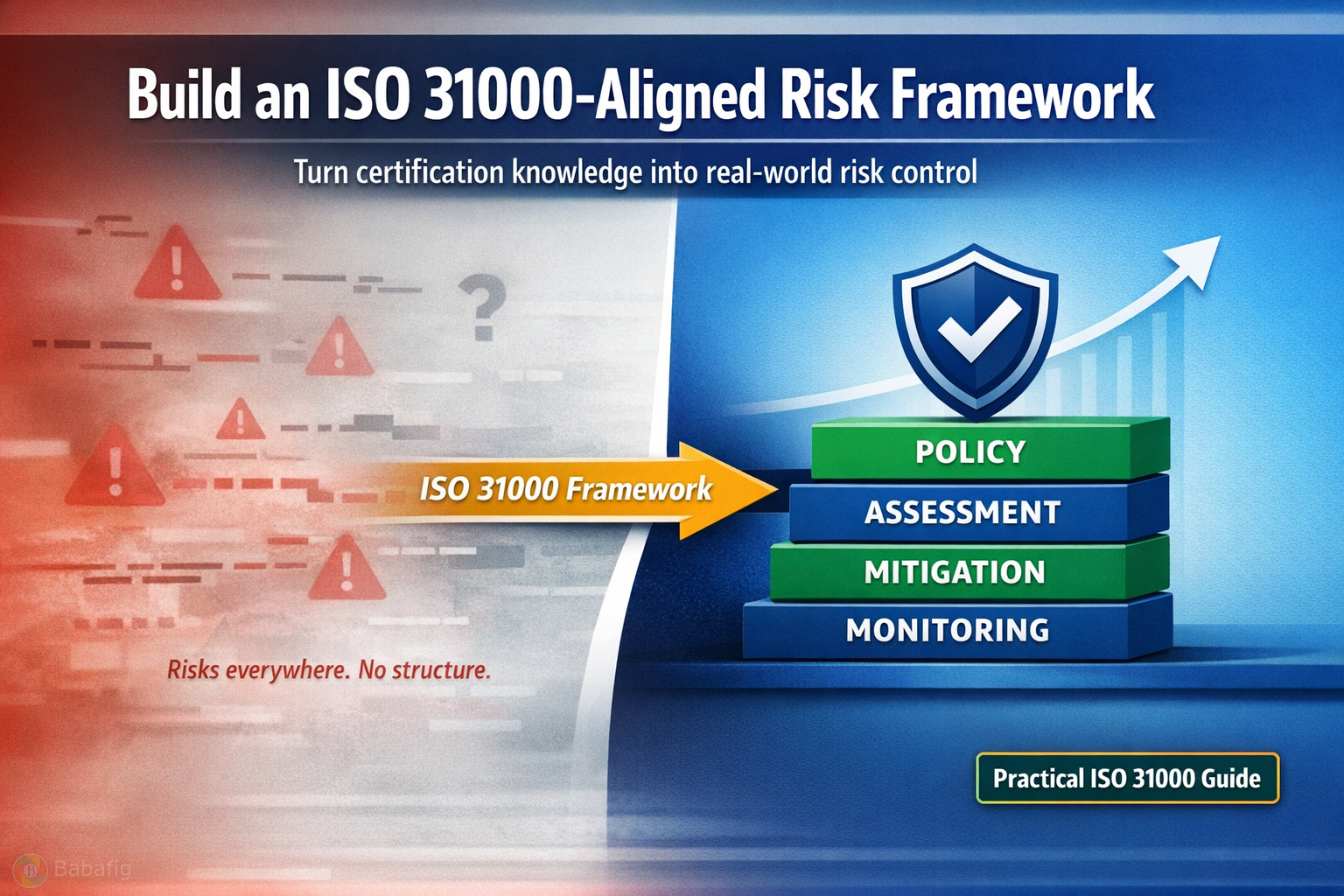
How to Build an ISO 31000-Aligned Risk Framework After Certification
You’ve earned your ISO 31000 certification—congratulations. But now comes the question almost every certified professional silently asks: “I understand the standard, but how do I actually apply it in the real world?”
Many risk professionals struggle at this stage. They know the principles, the terminology, and the framework model, yet when it’s time to build a practical risk system for an organization, things feel unclear. Existing risks are scattered across teams, ownership is undefined, and leadership wants outcomes—not theory.
The good news? ISO 31000 is not meant to be complex or rigid. When applied correctly, it becomes a clear, scalable, and decision-driven risk framework. This guide walks you step by step through building an ISO 31000-aligned risk framework after certification, turning knowledge into measurable impact.
Step 1: Start With Organizational Context, Not Risks
One of the most common mistakes after ISO 31000 certification is jumping straight into risk identification. ISO 31000 emphasizes context first—because risk only makes sense when linked to objectives.
Begin by understanding:
Strategic goals and business priorities
Internal factors such as culture, governance, and processes
External factors like regulations, market conditions, and stakeholders
This step ensures your risk framework supports decision-making, not just compliance. When leadership sees risks clearly linked to business objectives, risk management gains instant relevance.
Step 2: Define Risk Governance and Ownership Clearly
A strong ISO 31000-aligned framework requires clear accountability. Without defined roles, risks remain unmanaged even if they are documented.
Key actions include:
Assigning risk owners for each major risk category
Defining responsibilities for identification, analysis, and treatment
Establishing escalation paths for critical risks
ISO 31000 encourages integration into existing governance structures rather than creating parallel systems. This makes the framework easier to adopt and sustain across departments.
Step 3: Standardize Risk Identification Across the Organization
After certification, your goal is to move from ad-hoc risk identification to a consistent, repeatable process.
Use multiple techniques such as:
Workshops with cross-functional teams
Historical incident analysis
Process and project reviews
External risk scanning
Document risks in a centralized risk register using a common structure. Consistency helps leadership compare risks across functions and prioritize actions effectively.
Step 4: Analyze and Evaluate Risks Using Clear Criteria
ISO 31000 does not prescribe a single risk assessment method, but it does require defined evaluation criteria.
To align with the standard:
Establish likelihood and impact scales
Define risk appetite and tolerance levels
Apply the same criteria across all risk types
This step transforms subjective opinions into structured insights. When risks are evaluated against agreed criteria, discussions shift from “how bad it feels” to “how serious it is for our objectives.”
Step 5: Design Practical Risk Treatment Plans
Risk treatment is where many frameworks fail—either too theoretical or too aggressive. ISO 31000 promotes balanced, realistic treatment options.
Treatment strategies may include:
Avoiding the risk
Reducing likelihood or impact
Sharing the risk through insurance or contracts
Accepting the risk with justification
Each treatment plan should include timelines, responsible owners, and measurable outcomes. This makes risk management actionable rather than symbolic.
Step 6: Integrate Risk Management Into Daily Operations
An ISO 31000-aligned framework works best when it becomes part of how the organization operates, not an annual exercise.
Embed risk management into:
Strategic planning
Project management
Change management
Performance reviews
This integration ensures risks are considered proactively, supporting better decisions and reducing surprises.
Step 7: Monitor, Review, and Improve Continuously
ISO 31000 emphasizes continuous improvement. Risks evolve, and your framework must evolve with them.
Set up:
Regular risk reviews and reporting cycles
Key Risk Indicators (KRIs)
Lessons-learned reviews after incidents
This feedback loop strengthens risk maturity and builds confidence in leadership that the framework delivers real value.
Why ISO 31000 Risk Manager Certification Is Important for Your Career
ISO 31000 risk manager certification does more than validate knowledge—it signals your ability to translate risk theory into business value. Organizations today look for professionals who can connect risk management with strategy, governance, and performance.
With this certification, you demonstrate:
A globally recognized understanding of risk management principles
The ability to design and implement enterprise-wide frameworks
Credibility to advise leadership on risk-based decisions
As businesses face increasing uncertainty—from regulatory pressure to digital and operational risks—certified ISO 31000 professionals stand out as trusted decision partners, not just compliance specialists. This directly supports career growth into senior risk, governance, and leadership roles.
Final Thoughts
Building an ISO 31000-aligned risk framework after certification is about clarity, integration, and practicality. When risks are clearly linked to objectives, owned by the right people, and embedded into everyday decisions, risk management becomes a strategic advantage—not a checkbox.
Your certification is the foundation. The framework you build is what turns that foundation into long-term professional impact.
You’ve earned your ISO 31000 certification—congratulations. But now comes the question almost every certified professional silently asks: “I understand the standard, but how do I actually apply it in the real world?”
Many risk professionals struggle at this stage. They know the principles, the terminology, and the framework model, yet when it’s time to build a practical risk system for an organization, things feel unclear. Existing risks are scattered across teams, ownership is undefined, and leadership wants outcomes—not theory.
The good news? ISO 31000 is not meant to be complex or rigid. When applied correctly, it becomes a clear, scalable, and decision-driven risk framework. This guide walks you step by step through building an ISO 31000-aligned risk framework after certification, turning knowledge into measurable impact.
Step 1: Start With Organizational Context, Not Risks
One of the most common mistakes after ISO 31000 certification is jumping straight into risk identification. ISO 31000 emphasizes context first—because risk only makes sense when linked to objectives.
Begin by understanding:
Strategic goals and business priorities
Internal factors such as culture, governance, and processes
External factors like regulations, market conditions, and stakeholders
This step ensures your risk framework supports decision-making, not just compliance. When leadership sees risks clearly linked to business objectives, risk management gains instant relevance.
Step 2: Define Risk Governance and Ownership Clearly
A strong ISO 31000-aligned framework requires clear accountability. Without defined roles, risks remain unmanaged even if they are documented.
Key actions include:
Assigning risk owners for each major risk category
Defining responsibilities for identification, analysis, and treatment
Establishing escalation paths for critical risks
ISO 31000 encourages integration into existing governance structures rather than creating parallel systems. This makes the framework easier to adopt and sustain across departments.
Step 3: Standardize Risk Identification Across the Organization
After certification, your goal is to move from ad-hoc risk identification to a consistent, repeatable process.
Use multiple techniques such as:
Workshops with cross-functional teams
Historical incident analysis
Process and project reviews
External risk scanning
Document risks in a centralized risk register using a common structure. Consistency helps leadership compare risks across functions and prioritize actions effectively.
Step 4: Analyze and Evaluate Risks Using Clear Criteria
ISO 31000 does not prescribe a single risk assessment method, but it does require defined evaluation criteria.
To align with the standard:
Establish likelihood and impact scales
Define risk appetite and tolerance levels
Apply the same criteria across all risk types
This step transforms subjective opinions into structured insights. When risks are evaluated against agreed criteria, discussions shift from “how bad it feels” to “how serious it is for our objectives.”
Step 5: Design Practical Risk Treatment Plans
Risk treatment is where many frameworks fail—either too theoretical or too aggressive. ISO 31000 promotes balanced, realistic treatment options.
Treatment strategies may include:
Avoiding the risk
Reducing likelihood or impact
Sharing the risk through insurance or contracts
Accepting the risk with justification
Each treatment plan should include timelines, responsible owners, and measurable outcomes. This makes risk management actionable rather than symbolic.
Step 6: Integrate Risk Management Into Daily Operations
An ISO 31000-aligned framework works best when it becomes part of how the organization operates, not an annual exercise.
Embed risk management into:
Strategic planning
Project management
Change management
Performance reviews
This integration ensures risks are considered proactively, supporting better decisions and reducing surprises.
Step 7: Monitor, Review, and Improve Continuously
ISO 31000 emphasizes continuous improvement. Risks evolve, and your framework must evolve with them.
Set up:
Regular risk reviews and reporting cycles
Key Risk Indicators (KRIs)
Lessons-learned reviews after incidents
This feedback loop strengthens risk maturity and builds confidence in leadership that the framework delivers real value.
Why ISO 31000 Risk Manager Certification Is Important for Your Career
ISO 31000 risk manager certification does more than validate knowledge—it signals your ability to translate risk theory into business value. Organizations today look for professionals who can connect risk management with strategy, governance, and performance.
With this certification, you demonstrate:
A globally recognized understanding of risk management principles
The ability to design and implement enterprise-wide frameworks
Credibility to advise leadership on risk-based decisions
As businesses face increasing uncertainty—from regulatory pressure to digital and operational risks—certified ISO 31000 professionals stand out as trusted decision partners, not just compliance specialists. This directly supports career growth into senior risk, governance, and leadership roles.
Final Thoughts
Building an ISO 31000-aligned risk framework after certification is about clarity, integration, and practicality. When risks are clearly linked to objectives, owned by the right people, and embedded into everyday decisions, risk management becomes a strategic advantage—not a checkbox.
Your certification is the foundation. The framework you build is what turns that foundation into long-term professional impact.
How to Build an ISO 31000-Aligned Risk Framework After Certification
You’ve earned your ISO 31000 certification—congratulations. But now comes the question almost every certified professional silently asks: “I understand the standard, but how do I actually apply it in the real world?”
Many risk professionals struggle at this stage. They know the principles, the terminology, and the framework model, yet when it’s time to build a practical risk system for an organization, things feel unclear. Existing risks are scattered across teams, ownership is undefined, and leadership wants outcomes—not theory.
The good news? ISO 31000 is not meant to be complex or rigid. When applied correctly, it becomes a clear, scalable, and decision-driven risk framework. This guide walks you step by step through building an ISO 31000-aligned risk framework after certification, turning knowledge into measurable impact.
Step 1: Start With Organizational Context, Not Risks
One of the most common mistakes after ISO 31000 certification is jumping straight into risk identification. ISO 31000 emphasizes context first—because risk only makes sense when linked to objectives.
Begin by understanding:
Strategic goals and business priorities
Internal factors such as culture, governance, and processes
External factors like regulations, market conditions, and stakeholders
This step ensures your risk framework supports decision-making, not just compliance. When leadership sees risks clearly linked to business objectives, risk management gains instant relevance.
Step 2: Define Risk Governance and Ownership Clearly
A strong ISO 31000-aligned framework requires clear accountability. Without defined roles, risks remain unmanaged even if they are documented.
Key actions include:
Assigning risk owners for each major risk category
Defining responsibilities for identification, analysis, and treatment
Establishing escalation paths for critical risks
ISO 31000 encourages integration into existing governance structures rather than creating parallel systems. This makes the framework easier to adopt and sustain across departments.
Step 3: Standardize Risk Identification Across the Organization
After certification, your goal is to move from ad-hoc risk identification to a consistent, repeatable process.
Use multiple techniques such as:
Workshops with cross-functional teams
Historical incident analysis
Process and project reviews
External risk scanning
Document risks in a centralized risk register using a common structure. Consistency helps leadership compare risks across functions and prioritize actions effectively.
Step 4: Analyze and Evaluate Risks Using Clear Criteria
ISO 31000 does not prescribe a single risk assessment method, but it does require defined evaluation criteria.
To align with the standard:
Establish likelihood and impact scales
Define risk appetite and tolerance levels
Apply the same criteria across all risk types
This step transforms subjective opinions into structured insights. When risks are evaluated against agreed criteria, discussions shift from “how bad it feels” to “how serious it is for our objectives.”
Step 5: Design Practical Risk Treatment Plans
Risk treatment is where many frameworks fail—either too theoretical or too aggressive. ISO 31000 promotes balanced, realistic treatment options.
Treatment strategies may include:
Avoiding the risk
Reducing likelihood or impact
Sharing the risk through insurance or contracts
Accepting the risk with justification
Each treatment plan should include timelines, responsible owners, and measurable outcomes. This makes risk management actionable rather than symbolic.
Step 6: Integrate Risk Management Into Daily Operations
An ISO 31000-aligned framework works best when it becomes part of how the organization operates, not an annual exercise.
Embed risk management into:
Strategic planning
Project management
Change management
Performance reviews
This integration ensures risks are considered proactively, supporting better decisions and reducing surprises.
Step 7: Monitor, Review, and Improve Continuously
ISO 31000 emphasizes continuous improvement. Risks evolve, and your framework must evolve with them.
Set up:
Regular risk reviews and reporting cycles
Key Risk Indicators (KRIs)
Lessons-learned reviews after incidents
This feedback loop strengthens risk maturity and builds confidence in leadership that the framework delivers real value.
Why ISO 31000 Risk Manager Certification Is Important for Your Career
ISO 31000 risk manager certification does more than validate knowledge—it signals your ability to translate risk theory into business value. Organizations today look for professionals who can connect risk management with strategy, governance, and performance.
With this certification, you demonstrate:
A globally recognized understanding of risk management principles
The ability to design and implement enterprise-wide frameworks
Credibility to advise leadership on risk-based decisions
As businesses face increasing uncertainty—from regulatory pressure to digital and operational risks—certified ISO 31000 professionals stand out as trusted decision partners, not just compliance specialists. This directly supports career growth into senior risk, governance, and leadership roles.
Final Thoughts
Building an ISO 31000-aligned risk framework after certification is about clarity, integration, and practicality. When risks are clearly linked to objectives, owned by the right people, and embedded into everyday decisions, risk management becomes a strategic advantage—not a checkbox.
Your certification is the foundation. The framework you build is what turns that foundation into long-term professional impact.

1 Kommentare
·4KB Ansichten
·0 Bewertungen

