Deep Learning Market To Grow by almost $100.0 Billion during 2020–2030
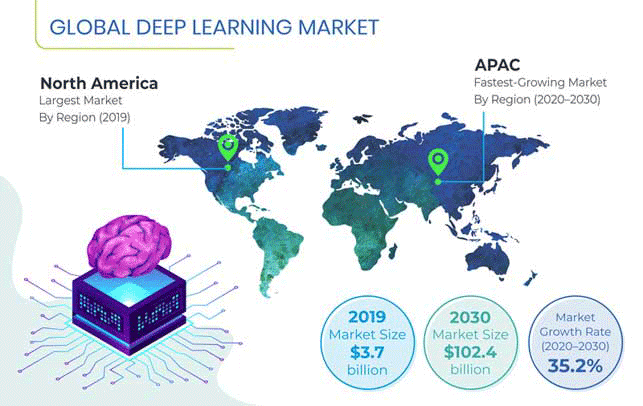
A number of factors, such as the rising focus of companies on reducing their operational costs and surging adoption of deep learning solutions in contact centers, are projected to boost the growth of the deep learning market at a CAGR of 35.2% during the forecast period (2020–2030). According to P&S Intelligence, the market generated $3.7 billion revenue in 2019, which is expected to reach $102.4 billion by 2030. Moreover, the market is witnessing the surging deployment of deep learning solutions in the healthcare sector.
One of the prime factors propelling the demand for deep learning solutions is their surging adoption in contact centers. These centers are the largest users of such algorithms, which help them in enhancing first-call resolution, shortening the call duration, improving the customer satisfaction, and reducing the call volume, which, in turn, increases the revenue of companies. On the basis of the nature of the solutions, the calls are efficiently routed to the concerned people possessing satisfactory knowledge, and these algorithms help in decreasing the time taken for issue resolution.
The application segment of the deep learning market is categorized into signal recognition, data mining, image recognition, recommendation engine, and natural language processing (NLP). Among these, the NLP category is projected to witness the highest CAGR in the coming years due to the surging demand for assimilating deep learning solutions with NLP to improve machine–human interactions. NLP with deep learning algorithms allows voice assistants and chatbots to better recognize the queries of customers and reply accordingly, without the intervention of human beings.
Additionally, based on industry, the deep learning market is classified into banking, financial services, and insurance (BFSI), healthcare, manufacturing, automotive, retail, and others. Among these, the healthcare industry is projected to generate the largest demand for deep learning solutions in the coming years. This can be ascribed to the surging deployment of artificial intelligence (AI) technologies, such as deep learning, machine learning (ML), and big data, in the healthcare sector to support medical researchers and professionals in the analysis and extraction of data, for improved medical results.
Geographically, the North American deep learning market accounted for the largest revenue share in 2019. This is attributed to the developed IT infrastructure, technological advancements, presence of several key market players, and rapid implementation of these solutions for product recommendations, voice assistance, and image recognition on social networks. The Asia-Pacific (APAC) market is set to witness the swiftest growth during the foreseeable period owing to the swift economic growth, increasing deployment of advanced technologies, rising IT investments, and mounting number of AI startups in the region.
Thus, the surging adoption of deep learning solutions in contact centers and rising focus of companies on reducing their operational costs are expected to propel the market growth across the world during the forecast period.
Read More:
https://www.psmarketresearch.com/market-analysis/deep-learning-market-reportDeep Learning Market To Grow by almost $100.0 Billion during 2020–2030
A number of factors, such as the rising focus of companies on reducing their operational costs and surging adoption of deep learning solutions in contact centers, are projected to boost the growth of the deep learning market at a CAGR of 35.2% during the forecast period (2020–2030). According to P&S Intelligence, the market generated $3.7 billion revenue in 2019, which is expected to reach $102.4 billion by 2030. Moreover, the market is witnessing the surging deployment of deep learning solutions in the healthcare sector.
One of the prime factors propelling the demand for deep learning solutions is their surging adoption in contact centers. These centers are the largest users of such algorithms, which help them in enhancing first-call resolution, shortening the call duration, improving the customer satisfaction, and reducing the call volume, which, in turn, increases the revenue of companies. On the basis of the nature of the solutions, the calls are efficiently routed to the concerned people possessing satisfactory knowledge, and these algorithms help in decreasing the time taken for issue resolution.
The application segment of the deep learning market is categorized into signal recognition, data mining, image recognition, recommendation engine, and natural language processing (NLP). Among these, the NLP category is projected to witness the highest CAGR in the coming years due to the surging demand for assimilating deep learning solutions with NLP to improve machine–human interactions. NLP with deep learning algorithms allows voice assistants and chatbots to better recognize the queries of customers and reply accordingly, without the intervention of human beings.
Additionally, based on industry, the deep learning market is classified into banking, financial services, and insurance (BFSI), healthcare, manufacturing, automotive, retail, and others. Among these, the healthcare industry is projected to generate the largest demand for deep learning solutions in the coming years. This can be ascribed to the surging deployment of artificial intelligence (AI) technologies, such as deep learning, machine learning (ML), and big data, in the healthcare sector to support medical researchers and professionals in the analysis and extraction of data, for improved medical results.
Geographically, the North American deep learning market accounted for the largest revenue share in 2019. This is attributed to the developed IT infrastructure, technological advancements, presence of several key market players, and rapid implementation of these solutions for product recommendations, voice assistance, and image recognition on social networks. The Asia-Pacific (APAC) market is set to witness the swiftest growth during the foreseeable period owing to the swift economic growth, increasing deployment of advanced technologies, rising IT investments, and mounting number of AI startups in the region.
Thus, the surging adoption of deep learning solutions in contact centers and rising focus of companies on reducing their operational costs are expected to propel the market growth across the world during the forecast period.
Read More: https://www.psmarketresearch.com/market-analysis/deep-learning-market-report
 English
 Arabic
 Français
 Spanish
 Portuguese
 Deutsch
 Turkish
 Dutch
Dutch
 Italiano
 Russian
 Romaian
 Portuguese (Brazil)
 Greek
Greek
 Réunionnais
 India
India
 Entreprises locales
 Runsound music
 La silver économie
 Affiliation Matrice 3x9
 Récompenses
 Babarun (BBRN)
 Calculez vos calories
 Collab Influenceurs
 Événementiels
 Procaly
 Affiliation
 Prêts Immobiliers