Babafig

Rechercher

Découvrez de nouvelles personnes, créez des liens et faites-vous de nouveaux amis

  • Conveyor Systems Market Trends in Digital Material Handling
    What does an online order have in common with a car assembled inside a modern factory? Both depend on something that most customers never see: controlled material movement. Behind every efficient warehouse and production line is a system that decides how products, components, cartons, pallets, and raw materials move. As factories and distribution centers become faster and more automated, that...
    1.4k Vues
  • Automotive Logistics Industry: Digital Supply Chain Transformation
    The global Automotive Logistics Market is expanding as vehicle production, automobile parts manufacturing, and international trade continue to increase across major economies. The market covers transportation, warehousing, distribution, loading, unloading, aftermarket logistics, and related supply chain services required to move vehicles and automotive components efficiently. Key...
    1.7k Vues
  • Roofing Materials Market Size, Share & Growth Forecast 2026–2034
    The roofing industry is undergoing a significant transformation as modern construction increasingly prioritizes durability, energy efficiency, and environmental sustainability. Roofing materials are no longer selected solely for structural protection—they have become an essential component of green building initiatives, climate resilience, and architectural design. As residential,...
    987 Vues
  • Workwear Market Regional Analysis and Growth Outlook, 2034
    The global Workwear Market is experiencing consistent growth as industries worldwide prioritize employee safety, regulatory compliance, and workforce productivity. Workwear includes specialized clothing and protective garments designed to safeguard workers from occupational hazards while enhancing comfort, durability, and functionality across various industries such as manufacturing,...
    1.2k Vues
  • Rail Logistics Market Benefits from Government Investments in Rail Networks
    The global rail logistics market size is estimated at USD 396.88 billion in 2025 and is projected to reach USD 678.42 billion by 2034, growing at a CAGR of 6.3% during the forecast period. The market is experiencing significant growth due to increasing demand for cost-effective and sustainable freight transportation solutions. Rail logistics plays a crucial role...
    3.4k Vues
  • PVC Strip Curtains Market Growth Trajectory and Long-Term Forecasts to 2034
    The PVC strip curtains market is witnessing substantial growth due to increasing demand for energy efficient industrial solutions and improved workplace safety standards across various industries. PVC strip curtains are widely used in warehouses, manufacturing facilities, cold storage units, and food processing plants because they help maintain temperature control, reduce dust contamination,...
    680 Vues
  • Freight Forwarding Market Analysis Across Maritime and Air Freight Sectors
    The global freight forwarding market size was estimated at USD 225.38 billion in 2025 and is projected to reach USD 340.08 billion by 2033, growing at a CAGR of 5.4% from 2026 to 2033. The market is witnessing strong growth due to increasing globalization, expanding international trade activities, and the growing need for efficient logistics and transportation management solutions...
    1k Vues
  • Industrial Robot Chip Market Analysis — 11.5% CAGR, USD 4127 million Target, Top 10
    Global Industrial Robot Chip Market, valued at a robust US$ 2060 million in 2024, is on a trajectory of significant expansion, projected to reach US$ 4127 million by 2032. This growth, representing a compound annual growth rate (CAGR) of 11.5%, is detailed in a comprehensive new report published by Semiconductor Insight. The study highlights the critical role of these specialized semiconductor...
    364 Vues
  • Dual Bridge Load Cell Market Technology Adoption, AI Integration and Industry Outlook (2026-2034)
    Global Dual Bridge Load Cell Market size was valued at USD 110 million in 2025. The market is projected to grow from USD 115 million in 2026 to USD 151 million by 2034, exhibiting a CAGR of 4.7% during the forecast period. 𝐃𝐨𝐰𝐧𝐥𝐨𝐚𝐝 𝐅𝐑𝐄𝐄 𝐒𝐚𝐦𝐩𝐥𝐞 𝐑𝐞𝐩𝐨𝐫𝐭:  https://semiconductorinsight.com/download-sample-report/?product_id=135713 Dual bridge load cells are high-precision force measurement...
    895 Vues
  • Why Structural Steel Demand Is Rising Across the GCC
    Structural steel is one of the most essential materials that have influenced the Gulf Cooperation Council's construction industry. With the Gulf Cooperation Council making rapid advancements through economic diversification, urbanization, and industrialization, high strength steel products have gained increasing demand. Starting from megacities and transport corridors to logistics and energy...
    3k Vues
  • Electronic Counting Machine Market Size and Share
    Electronic Counting Machine Market Size and Share Overview Steady expansion in the Electronic Counting Machine Market size reflects the market’s resilience to changing consumer patterns and regulatory shifts. Alongside this, the Electronic Counting Machine Market share has strengthened as new entrants and established players expand their global presence through innovation and...
    781 Vues
  • Warm Air Heaters Market Size, Share & Forecast 2025–2031: Trends and Growth Drivers

    Warm air heaters are emerging as a strategic heating solution across residential, commercial, and industrial environments, supported by rising demand for efficient, low-emission, and easily controllable space heating systems worldwide. The market is undergoing a clear shift toward smarter, more sustainable technologies as regulations tighten and end users prioritize energy savings and comfort.

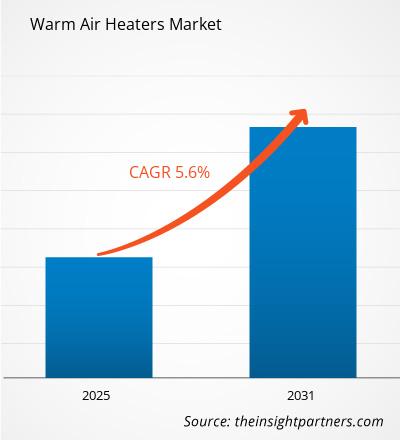
    The Warm Air Heaters Market is expected to register a CAGR of 5.6% from 2025 to 2031.

    Read More- https://www.theinsightpartners.com/reports/warm-air-heaters-market

    Market overview and growth dynamics

    The global warm air heaters market is advancing as building owners, facility managers, and industrial operators increasingly favor warm air systems over traditional hydronic or outdated combustion-based equipment due to faster response times, easier integration, and lower lifecycle operating costs. Industry analyses highlight consistent expansion through the forecast period, with warm air heaters consolidating their position as a core category within the broader heating equipment landscape.

    Across key regions, demand is supported by ongoing construction of residential complexes, logistics hubs, retail facilities, and industrial plants, all of which require reliable, uniform space heating. At the same time, replacement of legacy boilers and furnaces with modern warm air units is generating a substantial retrofit opportunity, particularly in mature markets with aging building stock.

    Key market drivers

    Several structural drivers underpin market momentum. Rising awareness of energy efficiency and cost optimization is pushing end users toward warm air heaters with improved combustion efficiency, high-performance heat exchangers, and advanced controls that optimize operation across fluctuating loads. In parallel, stricter environmental regulations and decarbonization policies are encouraging a migration from conventional fossil-fuel-heavy systems to cleaner electric, hybrid, or renewable-supported warm air solutions.

    Rapid urbanization and industrialization—especially in emerging economies—are expanding the installed base of warehouses, factories, cold-climate logistics centers, and commercial buildings, where warm air heaters are widely adopted to maintain worker comfort, protect sensitive equipment, and prevent frost damage. Seasonal peaks in heating demand during extended cold spells further reinforce the role of warm air heaters as a resilient, quickly deployable option in both permanent and temporary structures.

    Download PDF Copy- https://www.theinsightpartners.com/sample/TIPRE00010641

    Technology, product, and application trends

    Technological innovation is reshaping the competitive landscape. Vendors are introducing warm air heaters that integrate condensing technology, variable-speed fans, and intelligent thermostats, enabling precise temperature control, demand-driven modulation, and remote monitoring through building management systems. Smart, connected heaters capable of predictive maintenance and performance analytics are gaining traction among commercial and industrial customers seeking to reduce downtime and optimize total cost of ownership.

    On the product side, the market spans fired heaters, electric forced air units, convection heaters, and radiant warm air systems, providing options tailored to different facility sizes, ceiling heights, and ventilation strategies. Industrial users often favor robust units designed for high-temperature, heavy-duty environments such as manufacturing lines, curing processes, and large distribution centers, while commercial and residential end users prioritize compact, quiet, and aesthetically compatible systems. Portable and modular warm air heaters are also gaining visibility for use in temporary structures, construction sites, and off-grid applications.

    Regional landscape and regulatory influence

    Regionally, advanced markets in Europe and North America are characterized by strong regulatory pressure on building emissions and energy performance, driving accelerated adoption of high-efficiency and low-emission warm air heaters in both new build and retrofit projects. In these regions, policy incentives and building codes are pushing manufacturers to certify performance, reduce emissions, and support integration with heat pumps, solar thermal, and other renewable technologies.

    Asia-Pacific is positioned as a high-potential growth region, fueled by rapid expansion in commercial real estate, manufacturing output, and infrastructure development, all of which require dependable heating solutions for workforce comfort and process stability. Meanwhile, the Middle East, Africa, and Latin America are seeing growing adoption in warehousing, agriculture, and healthcare facilities, where warm air heaters help improve indoor environments and support year-round operations despite variable outdoor conditions.
    WWW.THEINSIGHTPARTNERS.COM
    Warm Air Heaters Market Analysis by Size, Share & Growth 2031
    Warm Air Heaters Market to achieve a CAGR of 5.6% 2031 with insights on key drivers, competitive landscape, regional outlook, and growth opportunities
    7.2k Vues
Plus de résultats