

Search
Discover new people, create new connections and make new friends

-
-
-
-
-
-
Wireless Broadband Enhancing Emergency Response
Polaris Market Research has published a brand-new report titled Wireless Broadband in Public Safety Market Share, Size, Trends, Industry Analysis Report, By Offering (Hardware, Software, And Service); By System; By Application; By End-Use And By Region; Segment Forecast, 2024- 2032 that includes extensive information and analysis of the industry dynamics. The opportunities and challenges in the report's dynamical trends might be useful for the worldwide Wireless Broadband in Public Safety Market. The study provides an outline of the market's foundation and organizational structure and forecasts an increase in market share. The study offers a comprehensive analysis of the Wireless Broadband in Public Safety market size, present revenue, regular deliverables, share, and profit projections. The study report includes a sizable database on future market forecasting based on an examination of previous data.
Brief About the Report
The market's supply-side and demand-side Wireless Broadband in Public Safety market trends are evaluated in the study. The study provides important details on applications and statistics, which are compiled in the report to provide a market prediction. Additionally, it offers thorough explanations of SWOT and PESTLE analyses depending on changes in the region and industry. It sheds light on risks, obstacles, and uncertainties, as well as present and future possibilities and challenges in the market.
Global Wireless Broadband in Public Safety Market size and share is currently valued at USD 31.53 billion in 2023 and is anticipated to generate an estimated revenue of USD 219.84 billion by 2032, according to the latest study by Polaris Market Research. Besides, the report notes that the market exhibits a robust 24.1% Compound Annual Growth Rate (CAGR) over the forecasted timeframe, 2024 - 2032
Key Aspects Covered in The Report
Market size and growth rate during the forecast period.
Key vendors operating in the market with their company profiles
Opportunities and threats faced by the existing vendors in the market.
Trending factors influencing the market in the geographical regions.
In-depth understanding of market drivers, constraints, and major micro markets.
The critical data of each segment is highlighted at an extensive level.
Wireless Broadband in Public Safety Market Segmentation Analysis
The study offers a thorough analysis of the numerous market segments, including application type, product component, service types, and several geographic locations. The report's segment analysis section contains thoroughly researched expert-verified industry data. Strategic recommendations are given in terms of key business segments based on market estimations.
𝐄𝐱𝐩𝐥𝐨𝐫𝐞 𝐓𝐡𝐞 𝐂𝐨𝐦𝐩𝐥𝐞𝐭𝐞 𝐂𝐨𝐦𝐩𝐫𝐞𝐡𝐞𝐧𝐬𝐢𝐯𝐞 𝐑𝐞𝐩𝐨𝐫𝐭 𝐇𝐞𝐫𝐞:
https://www.polarismarketresearch.com/industry-analysis/wireless-broadband-in-public-safety-market
Leading Players Analysis
The research report's chapter is entirely devoted to the competition environment. The Wireless Broadband in Public Safety market key players are examined, analyzing information on their evaluation and development in addition to a quick review of the company. Understanding the techniques employed by businesses and the steps they have recently taken to combat intense rivalry allows one to examine the competitive landscape. It covers each player's company profiles comprising sales, revenue, share, recent developments, SWOT analysis, capacity, production, revenue, gross margin, growth rate, and strategies employed by the major market players.
Different potentials in the domestic and regional markets are revealed by regional analysis of the sector. Each regional industry associated with this market is carefully examined to determine its potential for growth in the present and the future. Moreover, information on recent mergers and acquisitions that have taken place in the market is the subject of the research. This section provides important financial information about mergers and acquisitions that have recently shaped the Wireless Broadband in Public Safety industry.
Market Trends:
The wireless broadband in public safety market is growing rapidly as emergency services increasingly rely on high-speed, secure, and resilient communication networks. One of the strongest trends shaping the market is the transition toward dedicated 4G/5G public safety networks, which offer improved bandwidth, low latency, and enhanced coverage for real-time communication. These networks support critical applications such as mission-critical voice, live video streaming, remote diagnostics, and rapid incident coordination. Another trend is the widespread adoption of IoT-enabled devices such as body-worn cameras, smart sensors, drones, and biomonitoring wearables. These tools provide real-time situational awareness and help first responders make faster, more informed decisions. Cloud-based command platforms and AI-driven analytics are also transforming public safety operations by enabling predictive policing, early threat detection, and automated incident reporting. In addition, cybersecurity is becoming a central focus as agencies work to protect sensitive data from cyber threats. Investments in encrypted communication, secure access controls, and network hardening are increasing. Public-private partnerships, government funding programs, and smart city initiatives are further accelerating market adoption. Overall, the need for real-time, interoperable, and reliable communication solutions is driving robust growth in the wireless broadband public safety sector.
Top Players:
Verizon Communications Inc.
Cisco Systems, Inc
Ericsson
Huawei Technologies Co. Ltd
Broadcom
Extreme Networks
Motorola Solutions
L3Harris Technologies, Inc
Hughes Network Systems, LLC
ZTE Corporation
Regions Covered in This Report Are
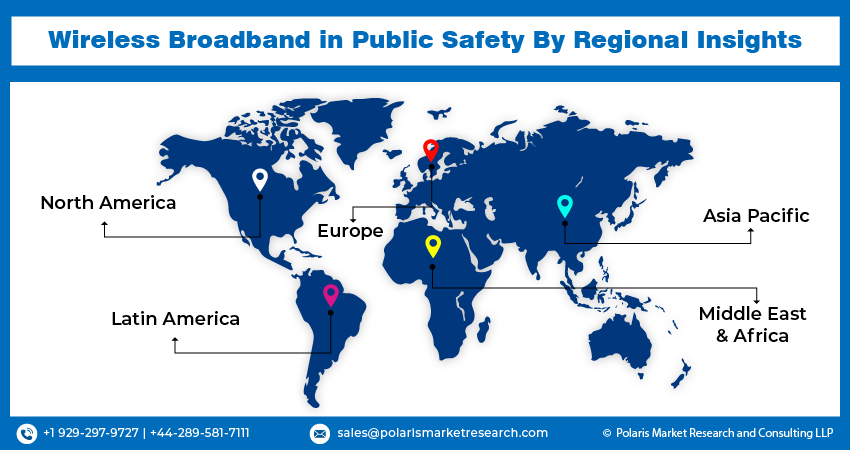
North America (United States, Canada, and Mexico)
Europe (Germany, France, United Kingdom, Russia, Italy, and the Rest of Europe)
Asia-Pacific (China, Japan, Korea, India, Southeast Asia, and Australia)
South America (Brazil, Argentina, Colombia, and the rest of South America)
The Middle East and Africa (Saudi Arabia, United Arab Emirates, Egypt, South Africa, and the Rest of the Middle East and Africa)
Report Summary
The analysis focuses on the regional forecast by type and application and the Wireless Broadband in Public Safety market sales and revenue prediction. The research report features data about the target market, such as pricing trends, customer requirements, and competitor analysis. The market growth has been examined using analytical approaches like PESTLE analysis, Porter's Five Forces analysis, feasibility studies, player-specific SWOT analyses, and ROI analyses.
Objectives of the Report
To carefully analyze and forecast the size of the market by value and volume.
To evaluate the market shares of major segments of the market
To explain the development of the industry in different parts of the world.
To analyze and study micro-markets in terms of their contributions to the market, their prospects, and individual growth trends.
To offer precise and valuable details about factors affecting the Wireless Broadband in Public Safety market forecasts
To provide a meticulous assessment of crucial business strategies used by leading companies.
More Trending Latest Reports By Polaris Market Research:
Kombucha Market
Directed Energy Weapons Market
Tomato Concentrate Market
Hospital Electronic Health Records Market
Directed Energy Weapons Market
Sports Nutrition Market
Oligonucleotide Synthesis Market
Inulin Market
Cell line development market8.6K Views -
Global Market Outlook for Medical Biomaterials
Polaris Market Research has published a brand-new report titled Biomaterials Market Share, Size, Trends, Industry Analysis Report, By Product (Metallic, Natural, Ceramics, Polymers); By Application; By Region; Segment Forecast, 2024 - 2032 that includes extensive information and analysis of the industry dynamics. The opportunities and challenges in the report's dynamical trends might be useful for the worldwide Biomaterials Market. The study provides an outline of the market's foundation and organizational structure and forecasts an increase in market share. The study offers a comprehensive analysis of the Biomaterials market size, present revenue, regular deliverables, share, and profit projections. The study report includes a sizable database on future market forecasting based on an examination of previous data.
Brief About the Report
The market's supply-side and demand-side Biomaterials market trends are evaluated in the study. The study provides important details on applications and statistics, which are compiled in the report to provide a market prediction. Additionally, it offers thorough explanations of SWOT and PESTLE analyses depending on changes in the region and industry. It sheds light on risks, obstacles, and uncertainties, as well as present and future possibilities and challenges in the market.
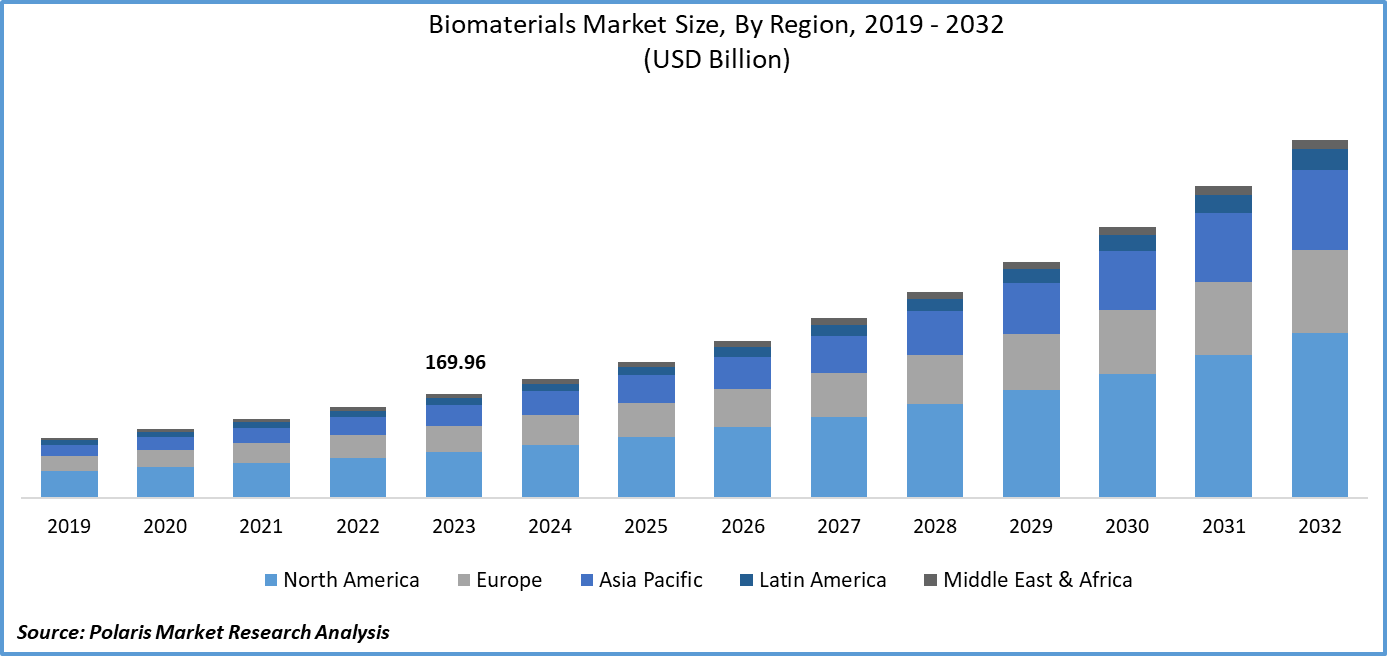
Global biomaterials market size and share is currently valued at USD 169.96 billion in 2023 and is anticipated to generate an estimated revenue of USD 587.08 billion by 2032 according to the latest study by Polaris Market Research. Besides, the report notes that the market exhibits a robust 14.8% Compound Annual Growth Rate (CAGR) over the forecasted timeframe, 2024 - 2032
Key Aspects Covered in The Report
Market size and growth rate during the forecast period.
Key vendors operating in the market with their company profiles
Opportunities and threats faced by the existing vendors in the market.
Trending factors influencing the market in the geographical regions.
In-depth understanding of market drivers, constraints, and major micro markets.
The critical data of each segment is highlighted at an extensive level.
Biomaterials Market Segmentation Analysis
The study offers a thorough analysis of the numerous market segments, including application type, product component, service types, and several geographic locations. The report's segment analysis section contains thoroughly researched expert-verified industry data. Strategic recommendations are given in terms of key business segments based on market estimations.
Future Scope:
The future scope of the Biomaterials Market is highly promising as advancements in regenerative medicine, tissue engineering, and biomedical research continue to accelerate. Rising applications in orthopedics, cardiovascular implants, wound care, dental products, and drug delivery systems are driving strong market expansion. Biocompatible materials such as natural polymers, synthetic polymers, ceramics, and metallic biomaterials are becoming increasingly sophisticated, offering improved mechanical strength, durability, and biological performance. The next decade will see major breakthroughs in smart biomaterials capable of responding to biological signals, releasing drugs on demand, and supporting cell growth for tissue regeneration. 3D printing of customized implants, artificial organs, and patient-specific prosthetics will revolutionize medical treatment and personalized healthcare. Nanomaterials will play a major role in enhancing drug delivery accuracy and improving implant integration. With the rise in chronic diseases and an aging population, demand for biomaterial-based medical devices and implants will continue to surge. Regulatory bodies are encouraging innovation in biodegradable materials to reduce long-term health risks and eliminate secondary surgeries. There is also significant potential in cosmetic surgery, ophthalmology, and advanced wound healing applications. Overall, the future market will be shaped by continuous R&D, personalized medicine, and the integration of biotechnology, nanotechnology, and material science.
𝐄𝐱𝐩𝐥𝐨𝐫𝐞 𝐓𝐡𝐞 𝐂𝐨𝐦𝐩𝐥𝐞𝐭𝐞 𝐂𝐨𝐦𝐩𝐫𝐞𝐡𝐞𝐧𝐬𝐢𝐯𝐞 𝐑𝐞𝐩𝐨𝐫𝐭 𝐇𝐞𝐫𝐞:
https://www.polarismarketresearch.com/industry-analysis/biomaterials-market
Leading Players Analysis
The research report's chapter is entirely devoted to the competition environment. The Biomaterials market key players are examined, analyzing information on their evaluation and development in addition to a quick review of the company. Understanding the techniques employed by businesses and the steps they have recently taken to combat intense rivalry allows one to examine the competitive landscape. It covers each player's company profiles comprising sales, revenue, share, recent developments, SWOT analysis, capacity, production, revenue, gross margin, growth rate, and strategies employed by the major market players.
Different potentials in the domestic and regional markets are revealed by regional analysis of the sector. Each regional industry associated with this market is carefully examined to determine its potential for growth in the present and the future. Moreover, information on recent mergers and acquisitions that have taken place in the market is the subject of the research. This section provides important financial information about mergers and acquisitions that have recently shaped the Biomaterials industry.
Top Players:
BASF SE
Berkeley Advanced Biomaterials
CoorsTek Inc.
Corbion
Covalon Technologies Ltd.
CRS Holdings, LLC
Dentsply Sirona
DSM
Evonik Industries AG
Invibio Ltd.
Johnson & Johnson Services, Inc.
Medtronic Plc
Regenity
Stryker
Zimmer Biomet
Regions Covered in This Report Are
North America (United States, Canada, and Mexico)
Europe (Germany, France, United Kingdom, Russia, Italy, and the Rest of Europe)
Asia-Pacific (China, Japan, Korea, India, Southeast Asia, and Australia)
South America (Brazil, Argentina, Colombia, and the rest of South America)
The Middle East and Africa (Saudi Arabia, United Arab Emirates, Egypt, South Africa, and the Rest of the Middle East and Africa)
Report Summary
The analysis focuses on the regional forecast by type and application and the Biomaterials market sales and revenue prediction. The research report features data about the target market, such as pricing trends, customer requirements, and competitor analysis. The market growth has been examined using analytical approaches like PESTLE analysis, Porter's Five Forces analysis, feasibility studies, player-specific SWOT analyses, and ROI analyses.
Objectives of the Report
To carefully analyze and forecast the size of the market by value and volume.
To evaluate the market shares of major segments of the market
To explain the development of the industry in different parts of the world.
To analyze and study micro-markets in terms of their contributions to the market, their prospects, and individual growth trends.
To offer precise and valuable details about factors affecting the Biomaterials market forecasts
To provide a meticulous assessment of crucial business strategies used by leading companies.
More Trending Latest Reports By Polaris Market Research:
Kombucha Market
Directed Energy Weapons Market
Tomato Concentrate Market
Hospital Electronic Health Records Market
Directed Energy Weapons Market
Sports Nutrition Market
Oligonucleotide Synthesis Market
Inulin Market
Cell line development market10K Views -
-
Precision Guided Munition Market Size, Share & Forecast by 2033
Global Precision Guided Munition (PGM) Market Overview
Precision guided munitions are weapons designed to accurately strike specific targets with minimal collateral damage. They are a cornerstone of modern warfare strategies due to their increased lethality, range, and efficiency compared to conventional ammunition.
The global Precision Guided Munition Market size was valued at USD 38.10 billion in 2024 and is projected to reach from USD 40.19 billion in 2025 to USD 61.69 billion by 2033, growing at a CAGR of 5.50% during the forecast period (2025-2033).
View report @ https://straitsresearch.com/report/precision-guided-munition-market
Key Market Drivers
Increasing Defense Spending
Global defense budgets are rising, particularly in regions such as North America, Europe, and Asia-Pacific. Countries are allocating more resources to advanced weapons systems, including PGMs, to strengthen military capabilities.
Geopolitical Tensions and Conflicts
Ongoing territorial disputes, border tensions, and military conflicts have led to a surge in demand for precision weapons to ensure effective, strategic targeting in contested zones.
Technological Advancements in Guidance Systems
Development of advanced guidance technologies such as GPS, laser guidance, and inertial navigation has significantly improved the accuracy and operational flexibility of PGMs.
Focus on Minimizing Collateral Damage
Modern military strategies increasingly focus on minimizing civilian casualties and infrastructure damage, making precision munitions essential for both offensive and defensive operations.
Request a sample report @ https://straitsresearch.com/report/precision-guided-munition-market/request-sample
Market Segmentation
By Product Type
Tactical Missiles
Represent the largest share of the market due to their extensive use in ground-to-ground, air-to-ground, and naval operations.
Guided Rockets and Ammunition
These systems are gaining traction for their cost-effectiveness and suitability in short-range combat environments.
Loitering Munitions
Also known as "kamikaze drones," these systems are rapidly growing in adoption due to their ability to hover before striking, enabling real-time target acquisition.
By Technology
Global Positioning System (GPS) Guided
These systems dominate the market owing to their accuracy and ease of integration with various platforms.
Inertial Navigation System (INS)
Often used in combination with GPS, INS provides navigation support when GPS signals are disrupted or unavailable.
Semi-Active Laser Guidance
Effective for targeting moving objects with high precision, particularly in close-combat or urban warfare.
Radar-Homing and Anti-Radiation Systems
These are used for targeting enemy radar and communication installations.
Detailed segmentation available @ https://straitsresearch.com/report/precision-guided-munition-market/segmentation
Regional Insights
Asia-Pacific
Leads the global market with the fastest growth rate, driven by rising defense budgets in countries like China, India, South Korea, and Japan. The region is also experiencing rapid adoption of indigenous precision strike systems.
North America
A mature and dominant market, led by the United States, with consistent investments in next-generation munitions and missile defense systems.
Europe
Growing focus on joint NATO initiatives and increased defense spending in response to regional threats has strengthened the demand for PGMs.
Middle East and Africa
Ongoing regional conflicts and modernization of defense arsenals are contributing to moderate market growth.
Latin America
Although still emerging, the region is beginning to adopt precision munitions as part of broader military upgrades.
Technology Trends
Miniaturization of Munitions
Smaller, lightweight PGMs are being developed to be deployed from UAVs and unmanned ground systems.
Artificial Intelligence (AI) Integration
AI is being incorporated into guidance and targeting systems to enable autonomous decision-making during combat operations.
Multi-Mode Guidance
Systems that combine GPS, laser, infrared, and radar guidance are increasingly favored for flexibility and accuracy in varied conditions.
Electronic Warfare Resistance
PGMs are being upgraded to function in GPS-denied environments through encrypted communication and signal-resilient guidance systems.
Having any query ask @ https://straitsresearch.com/buy-now/precision-guided-munition-market
Competitive Landscape
Leading companies in the precision guided munition market include:
Lockheed Martin Corporation
Raytheon Technologies Corporation
BAE Systems PLC
MBDA Inc.
Israel Aerospace Industries
Elbit Systems Ltd.
Northrop Grumman Corporation
Saab AB
General Dynamics Corporation
Rheinmetall AG
These companies are focusing on strategic collaborations, military contracts, technological innovation, and global expansion to maintain their competitive edge.
Market Outlook and Forecast
The market is expected to grow steadily, reaching nearly USD 58.4 billion by 2030.
Asia-Pacific will continue to be the fastest-growing region.
Tactical missiles and loitering munitions will remain the most in-demand product categories.
Emerging technologies such as AI-enabled targeting, autonomous weapon systems, and modular munitions will redefine the future of warfare.
Conclusion
The precision guided munition market is on a strong upward trajectory due to global military modernization, evolving combat strategies, and the demand for high-accuracy, low-collateral damage solutions. As technology advances, PGMs will become even more integral to defense operations worldwide, especially in regions experiencing geopolitical uncertainty and active military upgrades.
About Us
StraitsResearch.com is a leading research and intelligence organization, specializing in research, analytics, and advisory services. We provide comprehensive business insights and research reports to empower strategic decision-making across industries.
Contact Us:
Email: sales@straitsresearch.com
Website: https://straitsresearch.com12.4K Views -
-
-

More Results
© 2026 Babafig


Connexion
Appel pour rendez-vous de 15 minutes
Liste complète des emoticones à copier coller
Apprendre le créole Réunionnais 🇷🇪
Maps Membres
Entreprises locales
Runsound music
Affiliation Matrice 3x9
Mentions légales
Babarun (BBRN)
Collab Influenceurs
Événementiels
A propos
Terms
Confidentialité
Contact Us
Support Center
Directory
