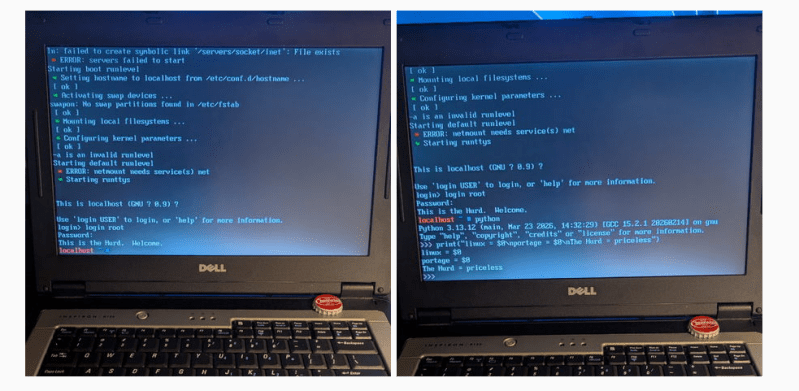
• 🚀 Exciting news for the tech community: Gentoo has officially been ported to GNU Hurd! This groundbreaking development revives the legacy of the Hurd kernel and reaffirms the spirit of innovation in the open-source realm.

    In the aftermath of the UNIX wars, we saw the rise of BSD, Linux, and Hurd, each carving its own niche in computing history. Gentoo's adaptation to Hurd opens new possibilities for enthusiasts and developers alike, encouraging experimentation and collaboration.

    Have you ever tried working with less conventional systems? This is your chance to dive in and explore what Gentoo and Hurd have to offer! Embrace the challenge and push the boundaries of what you think is possible!

    Learn more about this fascinating journey here: https://hackaday.com/2026/04/13/they-werent-joking-gentoo-was-ported-to-gnu-hurd/

    #Gentoo #GNUHurd #OpenSource #Innovation #TechCommunity
    🚀 Exciting news for the tech community: Gentoo has officially been ported to GNU Hurd! This groundbreaking development revives the legacy of the Hurd kernel and reaffirms the spirit of innovation in the open-source realm. In the aftermath of the UNIX wars, we saw the rise of BSD, Linux, and Hurd, each carving its own niche in computing history. Gentoo's adaptation to Hurd opens new possibilities for enthusiasts and developers alike, encouraging experimentation and collaboration. Have you ever tried working with less conventional systems? This is your chance to dive in and explore what Gentoo and Hurd have to offer! Embrace the challenge and push the boundaries of what you think is possible! Learn more about this fascinating journey here: https://hackaday.com/2026/04/13/they-werent-joking-gentoo-was-ported-to-gnu-hurd/ #Gentoo #GNUHurd #OpenSource #Innovation #TechCommunity
    HACKADAY.COM
    They Weren’t Joking: Gentoo WAS ported to GNU Hurd
    Long ago, in the aftermath of the UNIX wars, three kernels emerged from the rubble: BSD, Linux, and Hurd. BSD, being UNIX, was held back by legal wrangling in the …read more
    0 Commentaires 0 Parts 499 Vue 0 Avis
  • 🚀 Ready to take your career to the next level? The future of SEO is bright and full of opportunities! 🌟 A recent analysis of 3,900 job listings reveals that by 2026, successful SEO professionals will need to embrace experimentation, harness AI, and develop strategic thinking skills—while enjoying six-figure salaries!

    It's an exciting time to dive into the SEO world. Whether you're just starting or looking to upskill, now is your chance to be part of an ever-evolving field. Personally, I've seen how stepping out of my comfort zone has opened up incredible opportunities in my career.

    So, why not take that leap and explore the possibilities in SEO? The future is in your hands!

    For more insights, check out the full article here: https://www.semrush.com/blog/seo-job-market-study/
    #SEO #CareerGrowth #FutureOfWork #AIFuture #JobOpportunities
    🚀 Ready to take your career to the next level? The future of SEO is bright and full of opportunities! 🌟 A recent analysis of 3,900 job listings reveals that by 2026, successful SEO professionals will need to embrace experimentation, harness AI, and develop strategic thinking skills—while enjoying six-figure salaries! It's an exciting time to dive into the SEO world. Whether you're just starting or looking to upskill, now is your chance to be part of an ever-evolving field. Personally, I've seen how stepping out of my comfort zone has opened up incredible opportunities in my career. So, why not take that leap and explore the possibilities in SEO? The future is in your hands! For more insights, check out the full article here: https://www.semrush.com/blog/seo-job-market-study/ #SEO #CareerGrowth #FutureOfWork #AIFuture #JobOpportunities
    What 3,900 SEO Job Listings Reveal for 2026: Experiments, AI, and Six-Figure Salaries
    What does it take to build a career in SEO in 2026? We analyzed 3,900 job listings to uncover how the role is evolving—from experimentation and AI to shifts in salaries, responsibilities, and the growing demand for strategic thinking.
    0 Commentaires 0 Parts 336 Vue 0 Avis
  • D2R Items Tips for a Smooth Start

    Few action RPGs have had as much long-lasting influence as D2R Items. When Diablo II: Resurrected launched, it brought the legendary 2000 classic back with modern graphics, smoother animations, and updated quality-of-life features while preserving the original mechanics that made the game so beloved. For many players, the remaster is both nostalgic and brutally challenging. Unlike many modern ARPGs, Diablo II rewards preparation, careful planning, and patience rather than quick experimentation.

    If you’re planning to jump into the dark world of Sanctuary for the first time—or returning after many years—there are several key things you should understand before beginning your adventure. Learning these systems early will save you from frustration and help you progress smoothly through the game’s increasingly difficult challenges.

    Choose Your Class Carefully
    At the beginning of the game, you’ll choose one of several playable classes. Each class has its own abilities, skill trees, and combat style. Your options include the Amazon, Sorceress, Necromancer, Paladin, Barbarian, Druid, and Assassin.

    Each class plays very differently. The Sorceress specializes in powerful elemental magic, making her excellent for dealing large amounts of damage from a distance. The Barbarian is a melee powerhouse who relies on physical strength and durability. Meanwhile, the Necromancer can summon skeletons and other minions to fight on his behalf.

    What makes class choice particularly important is the skill system. Each level grants skill points that must be placed into abilities across three different skill trees. Although the game offers limited ways to reset your skill points, respec opportunities are not unlimited. This means poorly planned builds can make later difficulties significantly harder.

    Because of this, many experienced players recommend researching a build before committing too heavily to a skill tree. Having a long-term plan ensures your character will remain effective as enemies grow stronger in later acts and difficulties.

    Attribute Allocation Is More Important Than You Think
    Every time you level up, you also gain attribute points. These points can be assigned to four core stats: Strength, Dexterity, Vitality, and Energy.

    New players often make the mistake of spreading these points evenly across all attributes. While this might seem balanced, it usually results in a weaker character overall. Instead, most builds prioritize Vitality because it increases your health pool and helps you survive tougher fights.

    Strength and Dexterity should typically be increased only when necessary to equip certain weapons or armor. Energy increases mana, but most characters gain enough mana from equipment or potions that heavy investment isn’t required.

    Understanding how attributes affect your character is crucial. A poorly allocated stat distribution can significantly reduce your survivability, especially when facing bosses or elite monsters.

    Resistances Are Essential for Survival
    One of the most important defensive mechanics in the game is elemental resistance. Your character can resist four types of elemental damage: fire, cold, lightning, and poison.

    Early in the game, resistances might not seem particularly important. However, as you progress through the campaign, enemies begin using increasingly powerful elemental attacks. Without proper resistance gear, some monsters can eliminate your character in seconds.

    The situation becomes even more challenging in Nightmare and Hell difficulties. These modes impose resistance penalties that drastically lower your base resistances. To compensate, players must rely on equipment that boosts elemental resistance.

    For this reason, experienced players often prioritize gear that increases resistances rather than focusing purely on offensive stats.

    Death Comes With Real Consequences
    Unlike many modern RPGs, dying in Diablo II has meaningful consequences. When your character dies, your equipment remains on your corpse at the location where you fell. You respawn in town with nothing equipped and must return to your body to retrieve your items.

    This mechanic can lead to tense moments. If you died in a dangerous area filled with enemies, you may need to carefully fight your way back to recover your gear.

    The game also offers a Hardcore mode for players seeking an even greater challenge. In Hardcore mode, death is permanent. If your character dies, the entire character is lost forever.

    This high-risk gameplay adds intensity to every encounter and makes survival strategies extremely important.

    Inventory Management Is a Skill
    The inventory system in Diablo II is intentionally restrictive. Items take up different amounts of space depending on their size, which means your inventory fills quickly.

    To manage this effectively, you should acquire important utility items early in the game. The Tome of Town Portal and Tome of Identify are two of the most useful purchases you can make from early vendors. These tomes hold multiple scrolls while occupying only a small amount of space.

    Town Portal scrolls allow you to instantly open a portal back to town, giving you a quick escape from dangerous situations or a convenient way to sell items and repair equipment.

    Eventually, you will also meet Deckard Cain, a wise scholar who can identify magical items for you without requiring identify scrolls. His presence makes item management far easier.

    Learn to Use the Horadric Cube
    One of the most important items in the entire game is the Horadric Cube. You obtain this artifact during the early stages of Act II, and it quickly becomes an essential tool.

    The cube functions as both a crafting device and additional storage space. Players can combine items inside it to create new ones. For example, three lower-tier gems can be combined into a higher-tier gem.

    Runes can also be upgraded through cube recipes, and certain crafting formulas allow players to create powerful gear with unique properties.

    Mastering Horadric Cube recipes opens the door to advanced item crafting and is a crucial step toward optimizing your character’s equipment.

    Runewords Are Some of the Best Items in the Game
    Runewords are among the most powerful gear options available in the game. They are created by placing specific runes into socketed equipment in a precise order.

    When the correct combination is used, the item transforms into a Runeword and gains powerful bonuses. These bonuses can include massive stat boosts, new abilities, faster casting speed, or even teleportation.

    However, Runewords only work when placed in normal socketed items. If the item is magical, rare, or unique, the runeword will not activate.

    Because of this rule, players must carefully choose the base item before inserting runes. Learning which item bases are ideal for certain runewords is a major part of the game’s deep itemization system.

    Mercenaries Can Carry Your Character
    Mercenaries are AI companions that assist you in combat. You first gain access to one early in the game, and additional types become available in later acts.

    These companions are far more useful than they might initially appear. Mercenaries can equip weapons, armor, and helmets, making them surprisingly strong when properly geared.

    Some mercenaries also provide passive aura bonuses that enhance your character’s abilities. For example, certain mercenaries can boost attack speed, defense, or damage output.

    A well-equipped mercenary can tank enemies, deal additional damage, and help you handle difficult encounters that might otherwise overwhelm your character.

    Grinding Is Part of the Experience
    One of the defining aspects of Diablo II is item farming. Unlike story-focused RPGs, this game is built around repeated runs through specific areas to obtain better gear.

    Players frequently farm certain bosses, elite monsters, or locations known for good loot drops. Over time, these runs gradually improve your character’s equipment and power level.

    While this process can feel repetitive to some players, it is also one of the most satisfying aspects of the game. The excitement of finally finding a rare item after dozens of runs is a major part of Diablo II’s appeal.

    Final Thoughts
    Despite being more than two decades old, the core gameplay of Diablo II remains remarkably deep and engaging. Diablo II: Resurrected preserves everything that made the original game legendary while modernizing its visuals and performance.

    With patience, strategy, and a bit of cheap D2R Items, you’ll soon find yourself fully immersed in the addictive cycle of monster slaying, treasure hunting, and character progression that has kept players returning to Diablo II for decades.

    MMOexp.com boasts years of experience in the D2R Items industry and can guarantee to provide you with the highest quality service.

    D2R Items Tips for a Smooth Start Few action RPGs have had as much long-lasting influence as D2R Items. When Diablo II: Resurrected launched, it brought the legendary 2000 classic back with modern graphics, smoother animations, and updated quality-of-life features while preserving the original mechanics that made the game so beloved. For many players, the remaster is both nostalgic and brutally challenging. Unlike many modern ARPGs, Diablo II rewards preparation, careful planning, and patience rather than quick experimentation. If you’re planning to jump into the dark world of Sanctuary for the first time—or returning after many years—there are several key things you should understand before beginning your adventure. Learning these systems early will save you from frustration and help you progress smoothly through the game’s increasingly difficult challenges. Choose Your Class Carefully At the beginning of the game, you’ll choose one of several playable classes. Each class has its own abilities, skill trees, and combat style. Your options include the Amazon, Sorceress, Necromancer, Paladin, Barbarian, Druid, and Assassin. Each class plays very differently. The Sorceress specializes in powerful elemental magic, making her excellent for dealing large amounts of damage from a distance. The Barbarian is a melee powerhouse who relies on physical strength and durability. Meanwhile, the Necromancer can summon skeletons and other minions to fight on his behalf. What makes class choice particularly important is the skill system. Each level grants skill points that must be placed into abilities across three different skill trees. Although the game offers limited ways to reset your skill points, respec opportunities are not unlimited. This means poorly planned builds can make later difficulties significantly harder. Because of this, many experienced players recommend researching a build before committing too heavily to a skill tree. Having a long-term plan ensures your character will remain effective as enemies grow stronger in later acts and difficulties. Attribute Allocation Is More Important Than You Think Every time you level up, you also gain attribute points. These points can be assigned to four core stats: Strength, Dexterity, Vitality, and Energy. New players often make the mistake of spreading these points evenly across all attributes. While this might seem balanced, it usually results in a weaker character overall. Instead, most builds prioritize Vitality because it increases your health pool and helps you survive tougher fights. Strength and Dexterity should typically be increased only when necessary to equip certain weapons or armor. Energy increases mana, but most characters gain enough mana from equipment or potions that heavy investment isn’t required. Understanding how attributes affect your character is crucial. A poorly allocated stat distribution can significantly reduce your survivability, especially when facing bosses or elite monsters. Resistances Are Essential for Survival One of the most important defensive mechanics in the game is elemental resistance. Your character can resist four types of elemental damage: fire, cold, lightning, and poison. Early in the game, resistances might not seem particularly important. However, as you progress through the campaign, enemies begin using increasingly powerful elemental attacks. Without proper resistance gear, some monsters can eliminate your character in seconds. The situation becomes even more challenging in Nightmare and Hell difficulties. These modes impose resistance penalties that drastically lower your base resistances. To compensate, players must rely on equipment that boosts elemental resistance. For this reason, experienced players often prioritize gear that increases resistances rather than focusing purely on offensive stats. Death Comes With Real Consequences Unlike many modern RPGs, dying in Diablo II has meaningful consequences. When your character dies, your equipment remains on your corpse at the location where you fell. You respawn in town with nothing equipped and must return to your body to retrieve your items. This mechanic can lead to tense moments. If you died in a dangerous area filled with enemies, you may need to carefully fight your way back to recover your gear. The game also offers a Hardcore mode for players seeking an even greater challenge. In Hardcore mode, death is permanent. If your character dies, the entire character is lost forever. This high-risk gameplay adds intensity to every encounter and makes survival strategies extremely important. Inventory Management Is a Skill The inventory system in Diablo II is intentionally restrictive. Items take up different amounts of space depending on their size, which means your inventory fills quickly. To manage this effectively, you should acquire important utility items early in the game. The Tome of Town Portal and Tome of Identify are two of the most useful purchases you can make from early vendors. These tomes hold multiple scrolls while occupying only a small amount of space. Town Portal scrolls allow you to instantly open a portal back to town, giving you a quick escape from dangerous situations or a convenient way to sell items and repair equipment. Eventually, you will also meet Deckard Cain, a wise scholar who can identify magical items for you without requiring identify scrolls. His presence makes item management far easier. Learn to Use the Horadric Cube One of the most important items in the entire game is the Horadric Cube. You obtain this artifact during the early stages of Act II, and it quickly becomes an essential tool. The cube functions as both a crafting device and additional storage space. Players can combine items inside it to create new ones. For example, three lower-tier gems can be combined into a higher-tier gem. Runes can also be upgraded through cube recipes, and certain crafting formulas allow players to create powerful gear with unique properties. Mastering Horadric Cube recipes opens the door to advanced item crafting and is a crucial step toward optimizing your character’s equipment. Runewords Are Some of the Best Items in the Game Runewords are among the most powerful gear options available in the game. They are created by placing specific runes into socketed equipment in a precise order. When the correct combination is used, the item transforms into a Runeword and gains powerful bonuses. These bonuses can include massive stat boosts, new abilities, faster casting speed, or even teleportation. However, Runewords only work when placed in normal socketed items. If the item is magical, rare, or unique, the runeword will not activate. Because of this rule, players must carefully choose the base item before inserting runes. Learning which item bases are ideal for certain runewords is a major part of the game’s deep itemization system. Mercenaries Can Carry Your Character Mercenaries are AI companions that assist you in combat. You first gain access to one early in the game, and additional types become available in later acts. These companions are far more useful than they might initially appear. Mercenaries can equip weapons, armor, and helmets, making them surprisingly strong when properly geared. Some mercenaries also provide passive aura bonuses that enhance your character’s abilities. For example, certain mercenaries can boost attack speed, defense, or damage output. A well-equipped mercenary can tank enemies, deal additional damage, and help you handle difficult encounters that might otherwise overwhelm your character. Grinding Is Part of the Experience One of the defining aspects of Diablo II is item farming. Unlike story-focused RPGs, this game is built around repeated runs through specific areas to obtain better gear. Players frequently farm certain bosses, elite monsters, or locations known for good loot drops. Over time, these runs gradually improve your character’s equipment and power level. While this process can feel repetitive to some players, it is also one of the most satisfying aspects of the game. The excitement of finally finding a rare item after dozens of runs is a major part of Diablo II’s appeal. Final Thoughts Despite being more than two decades old, the core gameplay of Diablo II remains remarkably deep and engaging. Diablo II: Resurrected preserves everything that made the original game legendary while modernizing its visuals and performance. With patience, strategy, and a bit of cheap D2R Items, you’ll soon find yourself fully immersed in the addictive cycle of monster slaying, treasure hunting, and character progression that has kept players returning to Diablo II for decades. MMOexp.com boasts years of experience in the D2R Items industry and can guarantee to provide you with the highest quality service.
    0 Commentaires 0 Parts 3K Vue 0 Avis
  • What if the key to unlocking creativity lies in the playful experimentation of typography? 🌈

    In the fascinating article "Experimentación, aprendizaje e historia de la tipografía convergen en Catich Color," we delve into how playfulness is intricately linked to learning and discovery in the realm of typography. The new project by Dual Type showcases how experimental design pushes boundaries and invites us to engage with letters in innovative ways. This perspective resonates with me, as I’ve always found that the most unexpected ideas often emerge when we allow ourselves to play and explore.

    Isn't it time we embraced a more playful approach in our creative processes?

    Read more here: https://graffica.info/experimentacion-aprendizaje-e-historia-de-la-tipografia-convergen-en-catich-color-el-nuevo-proyecto-tipografico-de-dual-type/

    #Typography #Design #Creativity #ExperimentalDesign #LearningThroughPlay
    What if the key to unlocking creativity lies in the playful experimentation of typography? 🌈 In the fascinating article "Experimentación, aprendizaje e historia de la tipografía convergen en Catich Color," we delve into how playfulness is intricately linked to learning and discovery in the realm of typography. The new project by Dual Type showcases how experimental design pushes boundaries and invites us to engage with letters in innovative ways. This perspective resonates with me, as I’ve always found that the most unexpected ideas often emerge when we allow ourselves to play and explore. Isn't it time we embraced a more playful approach in our creative processes? Read more here: https://graffica.info/experimentacion-aprendizaje-e-historia-de-la-tipografia-convergen-en-catich-color-el-nuevo-proyecto-tipografico-de-dual-type/ #Typography #Design #Creativity #ExperimentalDesign #LearningThroughPlay
    GRAFFICA.INFO
    Experimentación, aprendizaje e historia de la tipografía convergen en Catich Color, el nuevo proyecto tipográfico de Dual Type
    La experimentación guarda un estrecha relación con lo lúdico. A través del juego, se aprende, se ensaya, se tantea, se descubre y se experimenta. Experimentamos y jugamos para aprender, pues probablemente no exista método de investigación como el jue
    J'adore
    1
    0 Commentaires 0 Parts 805 Vue 0 Avis
  • Saviez-vous que la conception de montagnes dans les jeux vidéo peut être aussi aléatoire que lancer des pierres contre un mur ? Selon Nick Kaman, le chef du studio Aggro Crab, c'est exactement ainsi qu'ils abordent le design de leurs jeux ! Dans un article captivant, il partage ses leçons sur ce qu’il appelle le "friendslop", une méthode créative qui encourage l'expérimentation et l'improvisation.

    Cette approche audacieuse nous rappelle qu'il n'y a pas de recette unique pour créer quelque chose d'incroyable. Parfois, il suffit de prendre des risques et d'apprendre de nos erreurs. Alors, pourquoi ne pas essayer quelque chose de nouveau aujourd'hui ?

    Pour en savoir plus sur cette philosophie inspirante, consultez l'article ici :
    https://www.gamedeveloper.com/business/peak-co-developer-aggro-crab-shares-lessons-in-friendslop

    #JeuxVidéo #Créativité #Inspiration #Développement #Innovation
    Saviez-vous que la conception de montagnes dans les jeux vidéo peut être aussi aléatoire que lancer des pierres contre un mur ? Selon Nick Kaman, le chef du studio Aggro Crab, c'est exactement ainsi qu'ils abordent le design de leurs jeux ! Dans un article captivant, il partage ses leçons sur ce qu’il appelle le "friendslop", une méthode créative qui encourage l'expérimentation et l'improvisation. Cette approche audacieuse nous rappelle qu'il n'y a pas de recette unique pour créer quelque chose d'incroyable. Parfois, il suffit de prendre des risques et d'apprendre de nos erreurs. Alors, pourquoi ne pas essayer quelque chose de nouveau aujourd'hui ? Pour en savoir plus sur cette philosophie inspirante, consultez l'article ici : https://www.gamedeveloper.com/business/peak-co-developer-aggro-crab-shares-lessons-in-friendslop #JeuxVidéo #Créativité #Inspiration #Développement #Innovation
    Peak co-developer Aggro Crab shares lessons in friendslop
    Aggro Crab studio head Nick Kaman's secret to expert mountain design? 'We throw rocks at the wall and pray, just like in real life'
    J'adore
    1
    0 Commentaires 0 Parts 1K Vue 0 Avis
  • 🎨 Have you ever considered how music could transform your approach to art? In his latest article, Thomas Brissot reveals how he treats painting like acting, using music as a catalyst for experimentation in his digital creations. By embracing the rhythm and emotion of music, he taps into new dimensions of creativity that push the boundaries of his artistry.

    This reminds me that inspiration can come from the most unexpected places. Why not challenge yourself to step outside your comfort zone today? Try painting to your favorite song or let a melody guide your brush. You may discover a whole new side of your creativity!

    Explore how music can enhance your artistic journey: https://www.creativebloq.com/art/digital-art/how-music-taught-this-concept-artist-how-to-paint

    #CreativityUnleashed #ArtInspiration #DigitalPainting #MusicAndArt #Experimentation
    🎨 Have you ever considered how music could transform your approach to art? In his latest article, Thomas Brissot reveals how he treats painting like acting, using music as a catalyst for experimentation in his digital creations. By embracing the rhythm and emotion of music, he taps into new dimensions of creativity that push the boundaries of his artistry. This reminds me that inspiration can come from the most unexpected places. Why not challenge yourself to step outside your comfort zone today? Try painting to your favorite song or let a melody guide your brush. You may discover a whole new side of your creativity! Explore how music can enhance your artistic journey: https://www.creativebloq.com/art/digital-art/how-music-taught-this-concept-artist-how-to-paint #CreativityUnleashed #ArtInspiration #DigitalPainting #MusicAndArt #Experimentation
    WWW.CREATIVEBLOQ.COM
    How music taught this artist to experiment in his digital painting
    Thomas Brissot discusses his career journey and why he treats painting like acting.
    0 Commentaires 0 Parts 634 Vue 0 Avis
  • Path of Exile Currency: How to Level and Evolve Mercenaries

    Path of exile currency has always been a game defined by complex systems, evolving mechanics, and ever-deepening customization. With Secrets of the Atlas, Grinding Gear Games once again raised the bar by introducing one of the most exciting features in years — Mercenaries. These powerful companions fundamentally change how Exiles approach combat, mapping, and even boss encounters. Whether you’re a veteran min-maxer or a returning player curious about this new addition, this guide will cover everything you need to know about Mercenaries in Secrets of the Atlas — from how to recruit them, to gearing, synergy, and advanced strategies for endgame use.

    Understanding Mercenaries

    Mercenaries are AI-controlled allies that accompany your character through the world of Wraeclast and beyond the Atlas. Think of them as an evolution of the Spectre or Animate Guardian concepts, but far more flexible and interactive. Each Mercenary comes with their own attribute profile, skills, AI behavior, and gear slots, allowing you to customize and develop them like a mini character of their own.

    While minions in Path of Exile are extensions of your skill gems, Mercenaries are independent companions with their own identity. They level alongside you, can equip specific gear types, and their progression often feels like managing a second adventurer. This system bridges the gap between traditional ARPG follower mechanics and Path of Exile’s deep itemization.

    How to Recruit a Mercenary

    Mercenaries are first introduced during the Acts as part of the Secrets of the Atlas questline. The initial encounter acts as a tutorial, teaching players the recruitment and command system. After this, Mercenaries can be found in special encounters across Wraeclast and the Atlas. These encounters often appear as Mercenary Contracts — missions where you duel or assist a wandering warrior. Upon completion, you earn the right to recruit them.

    Recruitment sometimes requires a cost, such as a Mercenary Sigil, a new currency introduced in the league. These Sigils can drop from league events, bosses, and map chests. Once hired, your Mercenary becomes available in your hideout, allowing you to summon or swap them out before entering maps.

    The system encourages experimentation — you’re not locked into one companion forever. You can hire multiple Mercenaries, each with unique skills, and choose which one best fits your current build or challenge.

    Mercenary Archetypes and Attributes

    Every Mercenary is built upon one of three core attribute archetypes — Strength, Dexterity, or Intelligence — with some hybrid variants combining two stats. These attributes determine what items your Mercenary can equip and influence their natural stats like health, damage scaling, and energy shield.

    Strength Mercenaries are typically tanks or melee bruisers. They specialize in physical damage, heavy armour, and life regeneration.

    Dexterity Mercenaries excel at ranged attacks, mobility, and evasion. They’re perfect for kiting enemies and clearing maps efficiently.

    Intelligence Mercenaries are spellcasters and support types. They rely on energy shield, elemental damage, and crowd control.

    Hybrid Mercenaries (such as Str/Dex or Dex/Int) blend roles, allowing for flexible builds. Choosing the right Mercenary depends on your own playstyle — for example, glass-cannon builds benefit from tank mercs, while melee builds may prefer ranged or support types for coverage.

    Gear and Equipment for Mercenaries

    One of the defining features of the Mercenary system is the ability to equip them with real gear. They have their own inventory slots for weapons, armour, and accessories. While some restrictions apply (they can’t use flasks or active skill gems directly), the rest of their gear follows standard PoE rules — stats, affixes, and uniques all apply.

    Several Mercenary-specific uniques were introduced in Secrets of the Atlas. These items grant powerful bonuses exclusive to NPC allies. Examples include helms that grant taunt immunity, chestpieces that share aura effects, or weapons that scale off both your and your Mercenary’s damage.

    Because Mercenaries cannot be manually micromanaged mid-fight, durability is key. Prioritize gear with high life, resistances, and damage reduction. Items that grant minion life or minion damage can sometimes affect Mercenaries, depending on how the modifiers are worded — though unique Mercenary affixes are usually better suited.

    Pro Tip: Crafting gear for Mercenaries is worthwhile. Because they do not require high attribute thresholds like players, you can focus entirely on functional modifiers without worrying about socket color requirements.

    Leveling and Scaling

    Mercenaries gain experience alongside you as you clear areas, but their level caps are tied to your character’s progression. In early Acts, they’ll scale automatically with your zone level. Once you reach mapping, Mercenaries level slower and require Mercenary Contracts or Atlas Memories to keep them up to par.

    Their stats scale with their level, but their effectiveness truly shines through equipment and synergy. Investing in their gear early on pays huge dividends in the endgame. Some passive nodes, Atlas notables, and even new unique jewels offer bonuses to Mercenaries — such as increased life regeneration, faster action speed, or enhanced skill cooldowns.

    Combat Behavior and Commands

    Mercenaries are semi-autonomous. They act according to their AI personality — aggressive, balanced, or cautious — and prioritize different enemies depending on the encounter. However, Secrets of the Atlas introduced a Command Wheel, letting players issue simple orders such as:

    Attack – Directs the Mercenary to focus on a specific target.

    Hold Position – Keeps them in place, ideal for setting up defensive lines.

    Retreat – Useful in boss fights when heavy AoE mechanics appear.

    The command system allows strategic micromanagement without overwhelming complexity. Experienced players can time these orders to maximize survivability and DPS output.

    Synergy With Your Build

    Choosing a Mercenary isn’t just about filling a slot — it’s about complementing your weaknesses. A good Mercenary feels like an extension of your build rather than a passive tagalong.

    For example:

    A glass-cannon spellcaster benefits from a Strength merc that tanks and taunts.

    A melee juggernaut may enjoy a Dexterity merc who deals with ranged threats.

    A summoner can amplify their army’s effectiveness by bringing an Intelligence support merc that grants aura synergy.

    Mercenaries can also trigger certain item effects that benefit you, like aura-sharing equipment or conditional buffs on kill. This opens the door to creative combinations — a Mercenary wielding a debuff weapon can amplify your own damage significantly.

    Mercenaries in Endgame and Boss Fights

    Mercenaries hold up surprisingly well in the endgame, but they’re not immortal. High-tier bosses can still wipe them out quickly if they’re not properly geared. To keep them alive, focus on mitigation rather than pure damage. Items that grant damage reduction, block chance, and life regeneration make a huge difference.

    During Pinnacle Bosses or Uber fights, Mercenaries serve best as utility tools — they distract, apply debuffs, or offer aura support while you handle mechanics. In some cases, you may choose to disable their aggressive behavior and use them purely for passive benefits, like aura sharing or taunt immunity.

    One particularly advanced technique involves “burst summoning.” You summon your Mercenary mid-battle to apply a buff or taunt, then dismiss them before a dangerous phase. This micro-optimization is especially valuable in Hardcore leagues where safety is paramount.

    Common Mistakes to Avoid

    Many new players make similar missteps when experimenting with Mercenaries:

    Overreliance on their damage. Mercenaries enhance your power, but they are not meant to replace it. You still need to pull your weight in every fight.

    Ignoring survivability. Without adequate defenses, Mercenaries melt in high-tier maps. Treat their gear with the same care you give your own.

    Mismatched roles. Pairing a glass-cannon Mercenary with a squishy caster build is a recipe for disaster. Choose synergy over style.

    Neglecting updates. Mercenaries need constant gear and level updates as you progress. A level 60 Merc in a level 90 map will be useless.

    Understanding these pitfalls early ensures that your Mercenary remains a powerful ally throughout your journey.

    Advanced Strategies

    Veteran players have already begun finding ingenious uses for Mercenaries. Some support-oriented builds focus entirely on amplifying the Mercenary’s damage — essentially turning them into the main damage dealer while the player stacks auras and buffs. Others use Mercenaries as “trigger carriers,” equipping them with items that activate effects when they hit or get hit.

    Another creative strategy involves dual-synergy scaling, where both you and your Mercenary benefit from overlapping stats, such as shared auras or curses. When optimized, this can rival some of the strongest solo builds in the current meta.

    Final Thoughts

    The Mercenary system in Path of Exile: Secrets of the Atlas is a masterstroke of design — a perfect blend of depth, experimentation, and accessibility. It empowers players to explore new playstyles, bridge build weaknesses, and inject fresh strategy into an already rich endgame. Mercenaries aren’t just followers; they’re true partners in battle.

    As the league evolves, the community will undoubtedly uncover even more hidden synergies and optimal setups to buy POE divine orbs. But one truth is already clear — with the right Mercenary by your side, even the most daunting challenges in Wraeclast become a little more survivable, and a lot more fun.

    Every player needs a lot of Path of exile currency, I suggest you go to a third-party website like MMOexp.com to buy some currency.
    Path of Exile Currency: How to Level and Evolve Mercenaries Path of exile currency has always been a game defined by complex systems, evolving mechanics, and ever-deepening customization. With Secrets of the Atlas, Grinding Gear Games once again raised the bar by introducing one of the most exciting features in years — Mercenaries. These powerful companions fundamentally change how Exiles approach combat, mapping, and even boss encounters. Whether you’re a veteran min-maxer or a returning player curious about this new addition, this guide will cover everything you need to know about Mercenaries in Secrets of the Atlas — from how to recruit them, to gearing, synergy, and advanced strategies for endgame use. Understanding Mercenaries Mercenaries are AI-controlled allies that accompany your character through the world of Wraeclast and beyond the Atlas. Think of them as an evolution of the Spectre or Animate Guardian concepts, but far more flexible and interactive. Each Mercenary comes with their own attribute profile, skills, AI behavior, and gear slots, allowing you to customize and develop them like a mini character of their own. While minions in Path of Exile are extensions of your skill gems, Mercenaries are independent companions with their own identity. They level alongside you, can equip specific gear types, and their progression often feels like managing a second adventurer. This system bridges the gap between traditional ARPG follower mechanics and Path of Exile’s deep itemization. How to Recruit a Mercenary Mercenaries are first introduced during the Acts as part of the Secrets of the Atlas questline. The initial encounter acts as a tutorial, teaching players the recruitment and command system. After this, Mercenaries can be found in special encounters across Wraeclast and the Atlas. These encounters often appear as Mercenary Contracts — missions where you duel or assist a wandering warrior. Upon completion, you earn the right to recruit them. Recruitment sometimes requires a cost, such as a Mercenary Sigil, a new currency introduced in the league. These Sigils can drop from league events, bosses, and map chests. Once hired, your Mercenary becomes available in your hideout, allowing you to summon or swap them out before entering maps. The system encourages experimentation — you’re not locked into one companion forever. You can hire multiple Mercenaries, each with unique skills, and choose which one best fits your current build or challenge. Mercenary Archetypes and Attributes Every Mercenary is built upon one of three core attribute archetypes — Strength, Dexterity, or Intelligence — with some hybrid variants combining two stats. These attributes determine what items your Mercenary can equip and influence their natural stats like health, damage scaling, and energy shield. Strength Mercenaries are typically tanks or melee bruisers. They specialize in physical damage, heavy armour, and life regeneration. Dexterity Mercenaries excel at ranged attacks, mobility, and evasion. They’re perfect for kiting enemies and clearing maps efficiently. Intelligence Mercenaries are spellcasters and support types. They rely on energy shield, elemental damage, and crowd control. Hybrid Mercenaries (such as Str/Dex or Dex/Int) blend roles, allowing for flexible builds. Choosing the right Mercenary depends on your own playstyle — for example, glass-cannon builds benefit from tank mercs, while melee builds may prefer ranged or support types for coverage. Gear and Equipment for Mercenaries One of the defining features of the Mercenary system is the ability to equip them with real gear. They have their own inventory slots for weapons, armour, and accessories. While some restrictions apply (they can’t use flasks or active skill gems directly), the rest of their gear follows standard PoE rules — stats, affixes, and uniques all apply. Several Mercenary-specific uniques were introduced in Secrets of the Atlas. These items grant powerful bonuses exclusive to NPC allies. Examples include helms that grant taunt immunity, chestpieces that share aura effects, or weapons that scale off both your and your Mercenary’s damage. Because Mercenaries cannot be manually micromanaged mid-fight, durability is key. Prioritize gear with high life, resistances, and damage reduction. Items that grant minion life or minion damage can sometimes affect Mercenaries, depending on how the modifiers are worded — though unique Mercenary affixes are usually better suited. Pro Tip: Crafting gear for Mercenaries is worthwhile. Because they do not require high attribute thresholds like players, you can focus entirely on functional modifiers without worrying about socket color requirements. Leveling and Scaling Mercenaries gain experience alongside you as you clear areas, but their level caps are tied to your character’s progression. In early Acts, they’ll scale automatically with your zone level. Once you reach mapping, Mercenaries level slower and require Mercenary Contracts or Atlas Memories to keep them up to par. Their stats scale with their level, but their effectiveness truly shines through equipment and synergy. Investing in their gear early on pays huge dividends in the endgame. Some passive nodes, Atlas notables, and even new unique jewels offer bonuses to Mercenaries — such as increased life regeneration, faster action speed, or enhanced skill cooldowns. Combat Behavior and Commands Mercenaries are semi-autonomous. They act according to their AI personality — aggressive, balanced, or cautious — and prioritize different enemies depending on the encounter. However, Secrets of the Atlas introduced a Command Wheel, letting players issue simple orders such as: Attack – Directs the Mercenary to focus on a specific target. Hold Position – Keeps them in place, ideal for setting up defensive lines. Retreat – Useful in boss fights when heavy AoE mechanics appear. The command system allows strategic micromanagement without overwhelming complexity. Experienced players can time these orders to maximize survivability and DPS output. Synergy With Your Build Choosing a Mercenary isn’t just about filling a slot — it’s about complementing your weaknesses. A good Mercenary feels like an extension of your build rather than a passive tagalong. For example: A glass-cannon spellcaster benefits from a Strength merc that tanks and taunts. A melee juggernaut may enjoy a Dexterity merc who deals with ranged threats. A summoner can amplify their army’s effectiveness by bringing an Intelligence support merc that grants aura synergy. Mercenaries can also trigger certain item effects that benefit you, like aura-sharing equipment or conditional buffs on kill. This opens the door to creative combinations — a Mercenary wielding a debuff weapon can amplify your own damage significantly. Mercenaries in Endgame and Boss Fights Mercenaries hold up surprisingly well in the endgame, but they’re not immortal. High-tier bosses can still wipe them out quickly if they’re not properly geared. To keep them alive, focus on mitigation rather than pure damage. Items that grant damage reduction, block chance, and life regeneration make a huge difference. During Pinnacle Bosses or Uber fights, Mercenaries serve best as utility tools — they distract, apply debuffs, or offer aura support while you handle mechanics. In some cases, you may choose to disable their aggressive behavior and use them purely for passive benefits, like aura sharing or taunt immunity. One particularly advanced technique involves “burst summoning.” You summon your Mercenary mid-battle to apply a buff or taunt, then dismiss them before a dangerous phase. This micro-optimization is especially valuable in Hardcore leagues where safety is paramount. Common Mistakes to Avoid Many new players make similar missteps when experimenting with Mercenaries: Overreliance on their damage. Mercenaries enhance your power, but they are not meant to replace it. You still need to pull your weight in every fight. Ignoring survivability. Without adequate defenses, Mercenaries melt in high-tier maps. Treat their gear with the same care you give your own. Mismatched roles. Pairing a glass-cannon Mercenary with a squishy caster build is a recipe for disaster. Choose synergy over style. Neglecting updates. Mercenaries need constant gear and level updates as you progress. A level 60 Merc in a level 90 map will be useless. Understanding these pitfalls early ensures that your Mercenary remains a powerful ally throughout your journey. Advanced Strategies Veteran players have already begun finding ingenious uses for Mercenaries. Some support-oriented builds focus entirely on amplifying the Mercenary’s damage — essentially turning them into the main damage dealer while the player stacks auras and buffs. Others use Mercenaries as “trigger carriers,” equipping them with items that activate effects when they hit or get hit. Another creative strategy involves dual-synergy scaling, where both you and your Mercenary benefit from overlapping stats, such as shared auras or curses. When optimized, this can rival some of the strongest solo builds in the current meta. Final Thoughts The Mercenary system in Path of Exile: Secrets of the Atlas is a masterstroke of design — a perfect blend of depth, experimentation, and accessibility. It empowers players to explore new playstyles, bridge build weaknesses, and inject fresh strategy into an already rich endgame. Mercenaries aren’t just followers; they’re true partners in battle. As the league evolves, the community will undoubtedly uncover even more hidden synergies and optimal setups to buy POE divine orbs. But one truth is already clear — with the right Mercenary by your side, even the most daunting challenges in Wraeclast become a little more survivable, and a lot more fun. Every player needs a lot of Path of exile currency, I suggest you go to a third-party website like MMOexp.com to buy some currency.
    0 Commentaires 0 Parts 3K Vue 0 Avis
  • 🌟 Plongez dans l'univers fascinant de Jurassic World: Renaissance avec les gaussian splats, une technique révolutionnaire qui redéfinit la visualisation ! Dans notre interview avec Pawl Fulker du studio Proof, découvrez comment son équipe a su tirer parti de cette méthode novatrice, transformant une simple exploration en une expérience immersive grâce à Unreal. 🎮

    C'est incroyable de voir comment l'innovation technologique peut donner vie à des idées créatives. Cela nous rappelle que, dans notre propre parcours, l'expérimentation peut mener à des découvertes surprenantes. Osez explorer de nouvelles techniques et n'ayez pas peur de sortir des sentiers battus !

    Quelles innovations souhaitez-vous essayer dans votre domaine ? 🤔

    👉 Lisez l'article complet ici : https://3dvf.com/les-gaussian-splats-larme-secrete-de-jurassic-world-renaissance/

    #Innovation #JurassicWorld #Visualisation #Créativité #Technologie
    🌟 Plongez dans l'univers fascinant de Jurassic World: Renaissance avec les gaussian splats, une technique révolutionnaire qui redéfinit la visualisation ! Dans notre interview avec Pawl Fulker du studio Proof, découvrez comment son équipe a su tirer parti de cette méthode novatrice, transformant une simple exploration en une expérience immersive grâce à Unreal. 🎮 C'est incroyable de voir comment l'innovation technologique peut donner vie à des idées créatives. Cela nous rappelle que, dans notre propre parcours, l'expérimentation peut mener à des découvertes surprenantes. Osez explorer de nouvelles techniques et n'ayez pas peur de sortir des sentiers battus ! Quelles innovations souhaitez-vous essayer dans votre domaine ? 🤔 👉 Lisez l'article complet ici : https://3dvf.com/les-gaussian-splats-larme-secrete-de-jurassic-world-renaissance/ #Innovation #JurassicWorld #Visualisation #Créativité #Technologie
    Les gaussian splats, l’arme secrète de Jurassic World: Renaissance !
    Découvrez notre interview de Pawl Fulker du studio Proof, spécialisé en visualisation. Découvrez comment ses équipes et lui ont utilisé les gaussian splats sur Jurassic World: Renaissance. Une expérimentation réussie Comme nous l’explique Pawl
    0 Commentaires 0 Parts 903 Vue 0 Avis
  • continuous discovery, user research, effective delivery, experimentation, Decathlon, user experience, agile methodology, product development, innovation

    ## Introduction

    In today’s fast-paced digital landscape, understanding user needs is paramount for successful product development. Continuous Discovery is a methodology that seeks to bridge the gap between user research and delivery, ensuring that teams can effectively align their offerings with user expectations. In this article, we delve in...
    continuous discovery, user research, effective delivery, experimentation, Decathlon, user experience, agile methodology, product development, innovation ## Introduction In today’s fast-paced digital landscape, understanding user needs is paramount for successful product development. Continuous Discovery is a methodology that seeks to bridge the gap between user research and delivery, ensuring that teams can effectively align their offerings with user expectations. In this article, we delve in...
    REX: Testing Continuous Discovery at Decathlon
    continuous discovery, user research, effective delivery, experimentation, Decathlon, user experience, agile methodology, product development, innovation ## Introduction In today’s fast-paced digital landscape, understanding user needs is paramount for successful product development. Continuous Discovery is a methodology that seeks to bridge the gap between user research and delivery,...
    0 Commentaires 0 Parts 1K Vue 0 Avis
  • 🎨 Have you ever wished your editing process was smoother and more efficient?

    Photoshop has just rolled out exciting updates that tackle some of its most frustrating workflow issues! With new non-destructive editing options and enhanced AI tools, editing your images has never been easier or more precise. These innovations promise to empower creators by streamlining tasks and enhancing creativity without worrying about the edits being permanent.

    As someone who often juggles multiple projects, I can’t wait to explore these improvements. They could save me valuable time and allow for more experimentation in my work!

    Are these updates a game changer for you, too?

    Read more about the latest Photoshop features here: https://www.creativebloq.com/art/digital-art/photoshop-just-fixed-some-of-its-most-annoying-workflow-problems

    #Photoshop #DigitalArt #CreativeTools #AIEditing #WorkflowImprovements
    🎨 Have you ever wished your editing process was smoother and more efficient? Photoshop has just rolled out exciting updates that tackle some of its most frustrating workflow issues! With new non-destructive editing options and enhanced AI tools, editing your images has never been easier or more precise. These innovations promise to empower creators by streamlining tasks and enhancing creativity without worrying about the edits being permanent. As someone who often juggles multiple projects, I can’t wait to explore these improvements. They could save me valuable time and allow for more experimentation in my work! Are these updates a game changer for you, too? Read more about the latest Photoshop features here: https://www.creativebloq.com/art/digital-art/photoshop-just-fixed-some-of-its-most-annoying-workflow-problems #Photoshop #DigitalArt #CreativeTools #AIEditing #WorkflowImprovements
    WWW.CREATIVEBLOQ.COM
    Photoshop just fixed some of its most annoying workflow problems
    New non-destructive editing and sharper AI tools stand out.
    0 Commentaires 0 Parts 1K Vue 0 Avis
  • Path of Exile Currency: The Mercenary Scaling System Explained

    Path of exile currency has always been a game defined by complex systems, evolving mechanics, and ever-deepening customization. With Secrets of the Atlas, Grinding Gear Games once again raised the bar by introducing one of the most exciting features in years — Mercenaries. These powerful companions fundamentally change how Exiles approach combat, mapping, and even boss encounters. Whether you’re a veteran min-maxer or a returning player curious about this new addition, this guide will cover everything you need to know about Mercenaries in Secrets of the Atlas — from how to recruit them, to gearing, synergy, and advanced strategies for endgame use.

    Understanding Mercenaries

    Mercenaries are AI-controlled allies that accompany your character through the world of Wraeclast and beyond the Atlas. Think of them as an evolution of the Spectre or Animate Guardian concepts, but far more flexible and interactive. Each Mercenary comes with their own attribute profile, skills, AI behavior, and gear slots, allowing you to customize and develop them like a mini character of their own.

    While minions in Path of Exile are extensions of your skill gems, Mercenaries are independent companions with their own identity. They level alongside you, can equip specific gear types, and their progression often feels like managing a second adventurer. This system bridges the gap between traditional ARPG follower mechanics and Path of Exile’s deep itemization.

    How to Recruit a Mercenary

    Mercenaries are first introduced during the Acts as part of the Secrets of the Atlas questline. The initial encounter acts as a tutorial, teaching players the recruitment and command system. After this, Mercenaries can be found in special encounters across Wraeclast and the Atlas. These encounters often appear as Mercenary Contracts — missions where you duel or assist a wandering warrior. Upon completion, you earn the right to recruit them.

    Recruitment sometimes requires a cost, such as a Mercenary Sigil, a new currency introduced in the league. These Sigils can drop from league events, bosses, and map chests. Once hired, your Mercenary becomes available in your hideout, allowing you to summon or swap them out before entering maps.

    The system encourages experimentation — you’re not locked into one companion forever. You can hire multiple Mercenaries, each with unique skills, and choose which one best fits your current build or challenge.

    Mercenary Archetypes and Attributes

    Every Mercenary is built upon one of three core attribute archetypes — Strength, Dexterity, or Intelligence — with some hybrid variants combining two stats. These attributes determine what items your Mercenary can equip and influence their natural stats like health, damage scaling, and energy shield.

    Strength Mercenaries are typically tanks or melee bruisers. They specialize in physical damage, heavy armour, and life regeneration.

    Dexterity Mercenaries excel at ranged attacks, mobility, and evasion. They’re perfect for kiting enemies and clearing maps efficiently.

    Intelligence Mercenaries are spellcasters and support types. They rely on energy shield, elemental damage, and crowd control.

    Hybrid Mercenaries (such as Str/Dex or Dex/Int) blend roles, allowing for flexible builds. Choosing the right Mercenary depends on your own playstyle — for example, glass-cannon builds benefit from tank mercs, while melee builds may prefer ranged or support types for coverage.

    Gear and Equipment for Mercenaries

    One of the defining features of the Mercenary system is the ability to equip them with real gear. They have their own inventory slots for weapons, armour, and accessories. While some restrictions apply (they can’t use flasks or active skill gems directly), the rest of their gear follows standard PoE rules — stats, affixes, and uniques all apply.

    Several Mercenary-specific uniques were introduced in Secrets of the Atlas. These items grant powerful bonuses exclusive to NPC allies. Examples include helms that grant taunt immunity, chestpieces that share aura effects, or weapons that scale off both your and your Mercenary’s damage.

    Because Mercenaries cannot be manually micromanaged mid-fight, durability is key. Prioritize gear with high life, resistances, and damage reduction. Items that grant minion life or minion damage can sometimes affect Mercenaries, depending on how the modifiers are worded — though unique Mercenary affixes are usually better suited.

    Pro Tip: Crafting gear for Mercenaries is worthwhile. Because they do not require high attribute thresholds like players, you can focus entirely on functional modifiers without worrying about socket color requirements.

    Leveling and Scaling

    Mercenaries gain experience alongside you as you clear areas, but their level caps are tied to your character’s progression. In early Acts, they’ll scale automatically with your zone level. Once you reach mapping, Mercenaries level slower and require Mercenary Contracts or Atlas Memories to keep them up to par.

    Their stats scale with their level, but their effectiveness truly shines through equipment and synergy. Investing in their gear early on pays huge dividends in the endgame. Some passive nodes, Atlas notables, and even new unique jewels offer bonuses to Mercenaries — such as increased life regeneration, faster action speed, or enhanced skill cooldowns.

    Combat Behavior and Commands

    Mercenaries are semi-autonomous. They act according to their AI personality — aggressive, balanced, or cautious — and prioritize different enemies depending on the encounter. However, Secrets of the Atlas introduced a Command Wheel, letting players issue simple orders such as:

    Attack – Directs the Mercenary to focus on a specific target.

    Hold Position – Keeps them in place, ideal for setting up defensive lines.

    Retreat – Useful in boss fights when heavy AoE mechanics appear.

    The command system allows strategic micromanagement without overwhelming complexity. Experienced players can time these orders to maximize survivability and DPS output.

    Synergy With Your Build

    Choosing a Mercenary isn’t just about filling a slot — it’s about complementing your weaknesses. A good Mercenary feels like an extension of your build rather than a passive tagalong.

    For example:

    A glass-cannon spellcaster benefits from a Strength merc that tanks and taunts.

    A melee juggernaut may enjoy a Dexterity merc who deals with ranged threats.

    A summoner can amplify their army’s effectiveness by bringing an Intelligence support merc that grants aura synergy.

    Mercenaries can also trigger certain item effects that benefit you, like aura-sharing equipment or conditional buffs on kill. This opens the door to creative combinations — a Mercenary wielding a debuff weapon can amplify your own damage significantly.

    Mercenaries in Endgame and Boss Fights

    Mercenaries hold up surprisingly well in the endgame, but they’re not immortal. High-tier bosses can still wipe them out quickly if they’re not properly geared. To keep them alive, focus on mitigation rather than pure damage. Items that grant damage reduction, block chance, and life regeneration make a huge difference.

    During Pinnacle Bosses or Uber fights, Mercenaries serve best as utility tools — they distract, apply debuffs, or offer aura support while you handle mechanics. In some cases, you may choose to disable their aggressive behavior and use them purely for passive benefits, like aura sharing or taunt immunity.

    One particularly advanced technique involves “burst summoning.” You summon your Mercenary mid-battle to apply a buff or taunt, then dismiss them before a dangerous phase. This micro-optimization is especially valuable in Hardcore leagues where safety is paramount.

    Common Mistakes to Avoid

    Many new players make similar missteps when experimenting with Mercenaries:

    Overreliance on their damage. Mercenaries enhance your power, but they are not meant to replace it. You still need to pull your weight in every fight.

    Ignoring survivability. Without adequate defenses, Mercenaries melt in high-tier maps. Treat their gear with the same care you give your own.

    Mismatched roles. Pairing a glass-cannon Mercenary with a squishy caster build is a recipe for disaster. Choose synergy over style.

    Neglecting updates. Mercenaries need constant gear and level updates as you progress. A level 60 Merc in a level 90 map will be useless.

    Understanding these pitfalls early ensures that your Mercenary remains a powerful ally throughout your journey.

    Advanced Strategies

    Veteran players have already begun finding ingenious uses for Mercenaries. Some support-oriented builds focus entirely on amplifying the Mercenary’s damage — essentially turning them into the main damage dealer while the player stacks auras and buffs. Others use Mercenaries as “trigger carriers,” equipping them with items that activate effects when they hit or get hit.

    Another creative strategy involves dual-synergy scaling, where both you and your Mercenary benefit from overlapping stats, such as shared auras or curses. When optimized, this can rival some of the strongest solo builds in the current meta.

    Final Thoughts

    The Mercenary system in Path of Exile: Secrets of the Atlas is a masterstroke of design — a perfect blend of depth, experimentation, and accessibility. It empowers players to explore new playstyles, bridge build weaknesses, and inject fresh strategy into an already rich endgame. Mercenaries aren’t just followers; they’re true partners in POE orbs for sale.

    Every player needs a lot of Path of exile currency, I suggest you go to a third-party website like MMOexp.com to buy some currency.
    Path of Exile Currency: The Mercenary Scaling System Explained Path of exile currency has always been a game defined by complex systems, evolving mechanics, and ever-deepening customization. With Secrets of the Atlas, Grinding Gear Games once again raised the bar by introducing one of the most exciting features in years — Mercenaries. These powerful companions fundamentally change how Exiles approach combat, mapping, and even boss encounters. Whether you’re a veteran min-maxer or a returning player curious about this new addition, this guide will cover everything you need to know about Mercenaries in Secrets of the Atlas — from how to recruit them, to gearing, synergy, and advanced strategies for endgame use. Understanding Mercenaries Mercenaries are AI-controlled allies that accompany your character through the world of Wraeclast and beyond the Atlas. Think of them as an evolution of the Spectre or Animate Guardian concepts, but far more flexible and interactive. Each Mercenary comes with their own attribute profile, skills, AI behavior, and gear slots, allowing you to customize and develop them like a mini character of their own. While minions in Path of Exile are extensions of your skill gems, Mercenaries are independent companions with their own identity. They level alongside you, can equip specific gear types, and their progression often feels like managing a second adventurer. This system bridges the gap between traditional ARPG follower mechanics and Path of Exile’s deep itemization. How to Recruit a Mercenary Mercenaries are first introduced during the Acts as part of the Secrets of the Atlas questline. The initial encounter acts as a tutorial, teaching players the recruitment and command system. After this, Mercenaries can be found in special encounters across Wraeclast and the Atlas. These encounters often appear as Mercenary Contracts — missions where you duel or assist a wandering warrior. Upon completion, you earn the right to recruit them. Recruitment sometimes requires a cost, such as a Mercenary Sigil, a new currency introduced in the league. These Sigils can drop from league events, bosses, and map chests. Once hired, your Mercenary becomes available in your hideout, allowing you to summon or swap them out before entering maps. The system encourages experimentation — you’re not locked into one companion forever. You can hire multiple Mercenaries, each with unique skills, and choose which one best fits your current build or challenge. Mercenary Archetypes and Attributes Every Mercenary is built upon one of three core attribute archetypes — Strength, Dexterity, or Intelligence — with some hybrid variants combining two stats. These attributes determine what items your Mercenary can equip and influence their natural stats like health, damage scaling, and energy shield. Strength Mercenaries are typically tanks or melee bruisers. They specialize in physical damage, heavy armour, and life regeneration. Dexterity Mercenaries excel at ranged attacks, mobility, and evasion. They’re perfect for kiting enemies and clearing maps efficiently. Intelligence Mercenaries are spellcasters and support types. They rely on energy shield, elemental damage, and crowd control. Hybrid Mercenaries (such as Str/Dex or Dex/Int) blend roles, allowing for flexible builds. Choosing the right Mercenary depends on your own playstyle — for example, glass-cannon builds benefit from tank mercs, while melee builds may prefer ranged or support types for coverage. Gear and Equipment for Mercenaries One of the defining features of the Mercenary system is the ability to equip them with real gear. They have their own inventory slots for weapons, armour, and accessories. While some restrictions apply (they can’t use flasks or active skill gems directly), the rest of their gear follows standard PoE rules — stats, affixes, and uniques all apply. Several Mercenary-specific uniques were introduced in Secrets of the Atlas. These items grant powerful bonuses exclusive to NPC allies. Examples include helms that grant taunt immunity, chestpieces that share aura effects, or weapons that scale off both your and your Mercenary’s damage. Because Mercenaries cannot be manually micromanaged mid-fight, durability is key. Prioritize gear with high life, resistances, and damage reduction. Items that grant minion life or minion damage can sometimes affect Mercenaries, depending on how the modifiers are worded — though unique Mercenary affixes are usually better suited. Pro Tip: Crafting gear for Mercenaries is worthwhile. Because they do not require high attribute thresholds like players, you can focus entirely on functional modifiers without worrying about socket color requirements. Leveling and Scaling Mercenaries gain experience alongside you as you clear areas, but their level caps are tied to your character’s progression. In early Acts, they’ll scale automatically with your zone level. Once you reach mapping, Mercenaries level slower and require Mercenary Contracts or Atlas Memories to keep them up to par. Their stats scale with their level, but their effectiveness truly shines through equipment and synergy. Investing in their gear early on pays huge dividends in the endgame. Some passive nodes, Atlas notables, and even new unique jewels offer bonuses to Mercenaries — such as increased life regeneration, faster action speed, or enhanced skill cooldowns. Combat Behavior and Commands Mercenaries are semi-autonomous. They act according to their AI personality — aggressive, balanced, or cautious — and prioritize different enemies depending on the encounter. However, Secrets of the Atlas introduced a Command Wheel, letting players issue simple orders such as: Attack – Directs the Mercenary to focus on a specific target. Hold Position – Keeps them in place, ideal for setting up defensive lines. Retreat – Useful in boss fights when heavy AoE mechanics appear. The command system allows strategic micromanagement without overwhelming complexity. Experienced players can time these orders to maximize survivability and DPS output. Synergy With Your Build Choosing a Mercenary isn’t just about filling a slot — it’s about complementing your weaknesses. A good Mercenary feels like an extension of your build rather than a passive tagalong. For example: A glass-cannon spellcaster benefits from a Strength merc that tanks and taunts. A melee juggernaut may enjoy a Dexterity merc who deals with ranged threats. A summoner can amplify their army’s effectiveness by bringing an Intelligence support merc that grants aura synergy. Mercenaries can also trigger certain item effects that benefit you, like aura-sharing equipment or conditional buffs on kill. This opens the door to creative combinations — a Mercenary wielding a debuff weapon can amplify your own damage significantly. Mercenaries in Endgame and Boss Fights Mercenaries hold up surprisingly well in the endgame, but they’re not immortal. High-tier bosses can still wipe them out quickly if they’re not properly geared. To keep them alive, focus on mitigation rather than pure damage. Items that grant damage reduction, block chance, and life regeneration make a huge difference. During Pinnacle Bosses or Uber fights, Mercenaries serve best as utility tools — they distract, apply debuffs, or offer aura support while you handle mechanics. In some cases, you may choose to disable their aggressive behavior and use them purely for passive benefits, like aura sharing or taunt immunity. One particularly advanced technique involves “burst summoning.” You summon your Mercenary mid-battle to apply a buff or taunt, then dismiss them before a dangerous phase. This micro-optimization is especially valuable in Hardcore leagues where safety is paramount. Common Mistakes to Avoid Many new players make similar missteps when experimenting with Mercenaries: Overreliance on their damage. Mercenaries enhance your power, but they are not meant to replace it. You still need to pull your weight in every fight. Ignoring survivability. Without adequate defenses, Mercenaries melt in high-tier maps. Treat their gear with the same care you give your own. Mismatched roles. Pairing a glass-cannon Mercenary with a squishy caster build is a recipe for disaster. Choose synergy over style. Neglecting updates. Mercenaries need constant gear and level updates as you progress. A level 60 Merc in a level 90 map will be useless. Understanding these pitfalls early ensures that your Mercenary remains a powerful ally throughout your journey. Advanced Strategies Veteran players have already begun finding ingenious uses for Mercenaries. Some support-oriented builds focus entirely on amplifying the Mercenary’s damage — essentially turning them into the main damage dealer while the player stacks auras and buffs. Others use Mercenaries as “trigger carriers,” equipping them with items that activate effects when they hit or get hit. Another creative strategy involves dual-synergy scaling, where both you and your Mercenary benefit from overlapping stats, such as shared auras or curses. When optimized, this can rival some of the strongest solo builds in the current meta. Final Thoughts The Mercenary system in Path of Exile: Secrets of the Atlas is a masterstroke of design — a perfect blend of depth, experimentation, and accessibility. It empowers players to explore new playstyles, bridge build weaknesses, and inject fresh strategy into an already rich endgame. Mercenaries aren’t just followers; they’re true partners in POE orbs for sale. Every player needs a lot of Path of exile currency, I suggest you go to a third-party website like MMOexp.com to buy some currency.
    0 Commentaires 0 Parts 4K Vue 0 Avis
  • 🌍 L'avenir du monde technologique se dessine avec le développement de l'intelligence artificielle ! Selon le rapport de Gartner, les dépenses mondiales en IA devraient atteindre 2,52 billions de dollars d'ici 2026, avec une croissance annuelle impressionnante de 44%. Cela signifie que l'IA passe d'expérimentations à une intégration fondamentale dans les structures des entreprises.

    Dans un monde où la technologie évolue rapidement, il est essentiel de rester informé et d'intégrer ces innovations dans nos stratégies professionnelles dès maintenant. Quelles mesures prenez-vous pour vous préparer à cette transformation ?

    L'IA n'est pas seulement une tendance, elle est là pour façonner notre futur ! 🤖

    Pour en savoir plus, consultez l'article ici : https://www.tech-wd.com/wd/2026/01/15/%d8%ac%d8%a7%d8%b1%d8%aa%d9%86%d8%b1-%d8%a7%d9%84%d8%a5%d9%86%d9%81%d8%a7%d9%82-%d8%a7%d9%84%d8%b9%d8%a7%d
    🌍 L'avenir du monde technologique se dessine avec le développement de l'intelligence artificielle ! Selon le rapport de Gartner, les dépenses mondiales en IA devraient atteindre 2,52 billions de dollars d'ici 2026, avec une croissance annuelle impressionnante de 44%. Cela signifie que l'IA passe d'expérimentations à une intégration fondamentale dans les structures des entreprises. Dans un monde où la technologie évolue rapidement, il est essentiel de rester informé et d'intégrer ces innovations dans nos stratégies professionnelles dès maintenant. Quelles mesures prenez-vous pour vous préparer à cette transformation ? L'IA n'est pas seulement une tendance, elle est là pour façonner notre futur ! 🤖 Pour en savoir plus, consultez l'article ici : https://www.tech-wd.com/wd/2026/01/15/%d8%ac%d8%a7%d8%b1%d8%aa%d9%86%d8%b1-%d8%a7%d9%84%d8%a5%d9%86%d9%81%d8%a7%d9%82-%d8%a7%d9%84%d8%b9%d8%a7%d
    جارتنر: الإنفاق العالمي على الذكاء الاصطناعي يبلغ 2.5 تريليون دولار في 2026
    توقعت شركة جارتنر المتخصصة في تحليلات الأعمال والتكنولوجيا أن يصل إجمالي الإنفاق العالمي على تقنيات الذكاء الاصطناعي إلى 2.52 تريليون دولار خلال عام 2026، مسجلاً نمواً سنوياً بنسبة 44%، في مؤشر واضح على انتقال الذكاء الاصطناعي من مرحلة التجارب إلى تر
    0 Commentaires 0 Parts 2K Vue 0 Avis
Plus de résultats
Sponsorisé

Double Éveil : Débloque ton potentiel TIKTOK SHOP

Tu en as marre de stagner ? Tu veux vendre sur TikTok ou en ligne sans montrer ton visage, sans t?exposer, mais en générant des revenus ? Cette formation est faite pour toi.

ADS Jbcois
Babafig https://www.babafig.com