

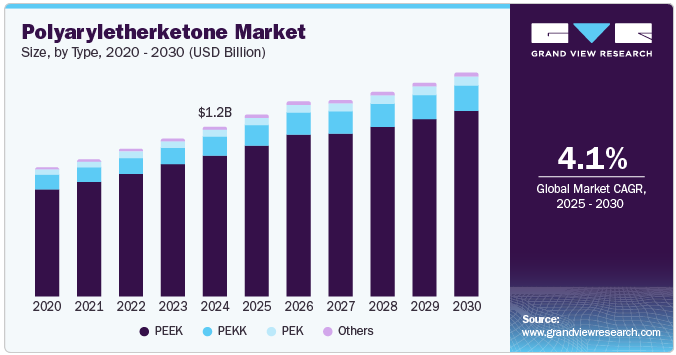

The global polyaryletherketone market is gaining importance as industries increasingly adopt high-performance polymers for applications that require strength, wear resistance, thermal stability, and chemical resistance. Polyaryletherketone (PAEK) materials are used in automotive components, aerospace systems, medical implants, industrial equipment, and other demanding applications where conventional materials may not provide the required performance. Their ability to withstand high temperatures and harsh operating conditions is encouraging manufacturers to incorporate these polymers into specialized components. The global Polyaryletherketone Market was valued at USD 1.2 billion in 2024 and is projected to grow from USD 1.4 billion in 2026 to USD 1.6 billion by 2030, registering a CAGR of 4.1% from 2025 to 2030.
Market Overview: Why High-Performance Polymers Matter
PAEK materials are preferred for their combination of mechanical strength, wear resistance, temperature tolerance, and chemical stability. Certain variants also offer biocompatibility, making them suitable for medical applications such as implants, dental treatments, surgical instruments, and drug delivery devices.
Their ability to perform under demanding conditions has expanded their use across multiple industries. In aerospace, PAEK is utilized in seals, bearings, aircraft structural components, thermal acoustic blankets, and pipes designed to protect high-voltage cables. Lightweight characteristics and resistance to elevated temperatures make these materials valuable for applications where component performance and weight are important considerations.
Automotive manufacturers also use PAEK in engine and transmission components exposed to continuous friction, heat, pressure, and mechanical stress. The material's dimensional stability and wear resistance support its use in bushings, bearings, gears, seals, braking systems, and suspension components.
Three Major Demand Areas Supporting Market Development
- Automotive and mobility manufacturing
PAEK materials help manufacturers produce durable components that can withstand demanding operating environments. Their use in engine systems, transmissions, braking systems, and other vehicle components supports demand from automotive manufacturing.
- Aerospace applications
Aircraft manufacturers utilize PAEK for lightweight structural parts, seals, bearings, and other components. Its temperature tolerance and mechanical properties make it suitable for applications involving heat, friction, and demanding operating conditions.
Want to Understand What’s Driving Market Growth? Ask Prism AI for research-backed insights into market size, evolving opportunities
- Medical and biomedical applications
Biocompatible PAEK variants are used in medical implants, dental treatments, surgical instruments, bone implants, and drug delivery devices. Growing utilization across medical applications contributes to the market's demand base.
The adoption of PAEK in mobility manufacturing is also extending into additive manufacturing. In July 2024, Hitachi Rail Limited collaborated with Roboze to implement 3D printing technology using materials such as Carbon Polyetheretherketone (PEEK) for producing train spare parts. This development highlights the material's growing relevance in specialized manufacturing applications.
Type Analysis: PEEK Dominates, While PEKK Offers Growth Potential
The market's product landscape includes different PAEK variants with distinct performance characteristics and application requirements.
PEEK holds the largest market share. The segment accounted for 83.5% of global revenue in 2024. Its widespread use across medical implants, drug delivery, dental medicine, chemical processing, aerospace, automotive, and food processing supports its dominant position. PEEK offers high strength, wear resistance, and thermal stability, with the source identifying its ability to withstand temperatures ranging from 300°C to 400°C. Oil and gas applications also include pump components, pipeline fittings, and valve seals.
PEKK is projected to record the highest CAGR during the forecast period. Polyetherketoneketone is gaining attention across industrial and medical applications, supported by its compatibility with 3D printing technology. Its high-performance characteristics make it suitable for industrial components exposed to extreme temperatures, high pressure, and corrosive chemicals.
Download a free sample report or claim your copy of this full market intelligence report
Application Insights: Automotive Leads the Market
The automotive industry accounted for the largest revenue share of the polyaryletherketone market in 2024. Vehicle components experience continuous exposure to heat, pressure, friction, and stress, creating demand for materials with strong mechanical and chemical properties.
PAEK is used in several automotive applications, including:
- Engine components requiring heat resistance and dimensional stability.
- Transmission components such as bushings, bearings, gears, and seals.
- Braking systems and suspension components.
- Under-hood components exposed to demanding operating conditions.
Industrial and general engineering applications are anticipated to experience significant growth during the forecast period. PAEK is used in seals, compressor rings, valve parts, gears, wire coatings, oil drilling systems, and chemical pumps. Increasing utilization across industrial manufacturing, transportation, and aerospace applications is expected to support this segment.
Competitive Landscape and Key Companies
Competition in the polyaryletherketone market is influenced by product portfolio development, capacity expansion, geographical reach, and the ability to serve specialized industrial applications. Rising demand from automotive and aerospace manufacturers is encouraging companies to strengthen their high-performance polymer offerings.
Key companies operating in the market include:
- Victrex plc
- Solvay
- Evonik
- Arkema
- Ensinger
- SABIC
Victrex plc specializes in PEEK and other high-performance polymer solutions for aerospace, automotive, energy, and medical applications. Evonik operates across specialty chemicals and provides solutions for additive manufacturing, aerospace, automotive, and other industries, while also focusing on sustainability and next-generation solutions.
Regional Outlook: Europe Leads, Asia Pacific Records Strong Growth Potential
Europe: Europe dominated the global market with a revenue share of 41.8% in 2024. The region benefits from the presence of manufacturers and industrial participants operating in medical implants, surgical implants, automotive, aerospace, and chemical processing. The use of PAEK as a lightweight alternative to metal components is supporting adoption across these industries. Electric vehicle industry growth and the presence of multiple PAEK manufacturers are also contributing to regional development.
Germany held the largest country-level revenue share within the European market in 2024. Its established industrial manufacturing base and automotive production facilities support demand for PAEK in engine, transmission, and other industrial components.
North America: North America held a significant revenue share in 2024. Demand is supported by automotive manufacturers seeking lightweight materials, aerospace production activities, and the presence of medical implant and surgical instrument manufacturers. The U.S. dominated the regional market, supported by vehicle manufacturing, medical manufacturing facilities, oil and gas activity, and aerospace industry participants.
Asia Pacific: Asia Pacific is anticipated to register the highest CAGR from 2025 to 2030. A strong chemical industry, manufacturing expansion, cost-effective material availability, and favorable regulatory conditions are supporting regional development. China held the largest country-level revenue share in the region in 2024, driven by its chemical processing industry, electric vehicle manufacturing, and industrial engineering activities.
In March 2024, Autoneum announced the expansion of its production capacities through two new plants in India and China. The company supplies lightweight vehicle components and heat protection components, reflecting the growing manufacturing activity across the region.
Future Market Direction
The polyaryletherketone market is positioned for continued development as manufacturers seek materials that combine lightweight construction with durability and resistance to demanding operating environments. Automotive, aerospace, medical, and industrial applications will remain important sources of demand.
PEEK is expected to retain its leading position because of its established applications, while PEKK offers additional growth opportunities through industrial, medical, and additive manufacturing uses. Regional manufacturing expansion and the increasing adoption of PAEK in specialized components are likely to influence the industry's development through 2030.
Explore Our Research & Intelligence Solutions
Grand View Signal: Understand the Factors Shaping Commodity Prices – Explore the Platform


