


Choosing Managed SOC SIEM for ICT Operations in India
For ICT companies, managed SOC SIEM combines centralized security event monitoring with specialist security operations, helping teams identify suspicious activity across networks, cloud platforms, endpoints, applications, and communications infrastructure while supporting structured investigation and incident response.
The decision facing ICT security leaders
ICT organizations operate environments where connectivity itself is part of the business. Telecom platforms, managed networks, customer portals, cloud infrastructure, remote administration tools, and internal systems can all generate security events that need attention.
Operational pressure: Network and infrastructure teams are expected to maintain availability while also responding to security alerts.
Distributed environments: Security visibility can become fragmented when infrastructure spans data centers, cloud services, branch locations, customer environments, and remote users.
Specialist requirements: Security monitoring requires different skills from network administration or service desk operations, particularly when analysts must investigate correlated events.
For these reasons, ICT companies often consider whether to maintain a fully internal security operation, outsource monitoring, or combine external expertise with an existing internal team.
Managed versus internal security operations
An internal SOC gives an organization direct control over staffing, processes, technology configuration, and escalation. However, the organization also takes responsibility for maintaining the operating model, security tooling, analyst coverage, knowledge management, and continuous monitoring.
A managed model shifts defined security operations to an external provider. The internal team retains governance and business context while the provider handles agreed monitoring and response functions.
Internal ownership: An in-house SOC can provide close alignment with internal processes but requires the organization to sustain the complete operating environment.
External expertise: A managed service can provide access to security analysts and established monitoring processes without requiring every security function to be developed internally.
Shared responsibility: ICT organizations can retain architectural and governance decisions while outsourcing selected operational security activities.
What to look for in a service provider
The phrase managed SOC as a service solution provider for ICT companies in India should describe more than a technology platform. An ICT buyer needs to understand exactly which people, processes, technologies, and responsibilities are included in the service.
A useful evaluation should cover monitoring scope, escalation procedures, SIEM capabilities, response responsibilities, reporting, integration, and service governance.
Coverage boundaries: Establish which networks, endpoints, applications, cloud environments, identities, and security devices will be monitored.
Human analysis: Determine how automated alerts are reviewed and when security analysts become involved.
Response authority: Document what the provider can investigate, contain, isolate, or escalate and what requires approval from the ICT organization.
Service visibility: Confirm how incidents, recurring alerts, unresolved risks, and security trends will be reported to technical and executive stakeholders.
Why traditional monitoring can fall short
Network monitoring and security monitoring are related but different disciplines. A network operations team may identify service degradation or abnormal traffic without having the security context needed to investigate a potential compromise.
For example, an administrator account connecting from an unusual location may initially look like a routine remote-access event. If the same identity then accesses sensitive systems and generates unusual endpoint activity, the combined pattern deserves security investigation.
A SIEM can help centralize these signals. Managed SOC analysts can then review correlated events and determine whether escalation is appropriate.
Signal correlation: Separate events can be examined together instead of being treated as unrelated technical tickets.
Security context: Analysts can assess whether activity resembles an attack pattern, credential misuse, malware behavior, or another security concern.
Escalation discipline: Defined procedures help ensure that significant incidents reach the appropriate ICT and business stakeholders.
How the operating model works
A practical managed SOC SIEM arrangement usually begins with onboarding relevant data sources. The provider and ICT organization establish the systems to monitor, access requirements, alert priorities, escalation contacts, and response procedures.
Security events then move through a monitoring workflow in which relevant activity is collected, analyzed, correlated, investigated, and reported.
|
Area |
In-house SOC |
Managed SOC SIEM |
|
Staffing |
Organization recruits and manages analysts |
Provider supplies agreed security operations resources |
|
Technology |
Organization owns operational responsibility |
Provider manages agreed service components |
|
Monitoring |
Internal team operates coverage |
Provider delivers contracted monitoring |
|
Response |
Internal procedures and personnel |
Shared or provider-led according to agreement |
|
Governance |
Fully internal |
Shared according to defined responsibilities |
|
Scaling |
Requires internal capacity planning |
Service can be expanded according to requirements |
When a hybrid model makes sense
Not every ICT organization needs to choose between complete outsourcing and complete internal ownership. A hybrid approach can divide responsibilities according to operational maturity and risk.
Internal governance: The ICT security team can retain ownership of policies, architecture, risk acceptance, and major incident decisions.
External monitoring: A provider can monitor security events and escalate cases requiring internal action.
Specialist support: External analysts can assist with investigations when internal teams encounter complex or unfamiliar activity.
Existing investments: Organizations can continue using established security technologies while adding managed monitoring around them.
This model can be particularly relevant for ICT companies that already have network operations or security personnel but do not want those teams responsible for every aspect of continuous security monitoring.
India-specific considerations for ICT companies
ICT companies operating in India should establish how their security operations align with applicable contractual, regulatory, and organizational requirements. The exact obligations depend on the company's services, data, customers, and operating model.
Regulatory awareness: Security teams should understand relevant CERT-In requirements and other obligations applicable to their organization.
Customer commitments: Managed ICT providers may have contractual security requirements imposed by enterprise customers, making clear monitoring and escalation responsibilities important.
Data governance: Security logs can contain information about users, devices, applications, and network activity. Access and retention should therefore be governed appropriately.
Incident coordination: Escalation paths should identify who can authorize containment, communicate with customers, preserve evidence, and coordinate recovery.
Questions to ask before selecting a provider
What should an Indian ICT company ask a managed SOC as a service solution provider?
The buyer should ask what will actually be monitored, who investigates alerts, how incidents are escalated, and what response actions are included. The organization should also understand onboarding requirements, reporting arrangements, integrations, and responsibilities that remain internal.
A practical discussion should cover:
- Supported security data sources.
- Monitoring and escalation coverage.
- SIEM integration requirements.
- Incident response responsibilities.
- Service-level expectations.
- Reporting and governance meetings.
Can managed SOC SIEM support complex ICT environments?
Yes, provided the service is designed around the organization's actual infrastructure and operational boundaries. The provider should understand network architecture, cloud services, identity systems, endpoints, applications, and the security tools already deployed.
Is outsourcing suitable when an ICT company already has security staff?
Outsourcing does not necessarily replace an internal security function. It can supplement internal teams by taking responsibility for defined monitoring activities while internal personnel retain governance, business context, and decisions that require organizational authority.
FAQs
What is the difference between managed SOC SIEM and an in-house SOC?
Managed SOC SIEM uses an external security operations capability to monitor and investigate agreed security events, while an in-house SOC is operated directly by the organization. Responsibility can also be divided through a hybrid model.
Does a managed SOC replace an ICT company's network operations team?
No. Network operations and security operations have different objectives. A managed SOC can complement network teams by providing dedicated security monitoring and investigation.
What should be included in a managed SOC agreement?
The agreement should clearly define monitoring scope, response responsibilities, escalation procedures, reporting, service expectations, integrations, access requirements, and ownership of incident decisions.
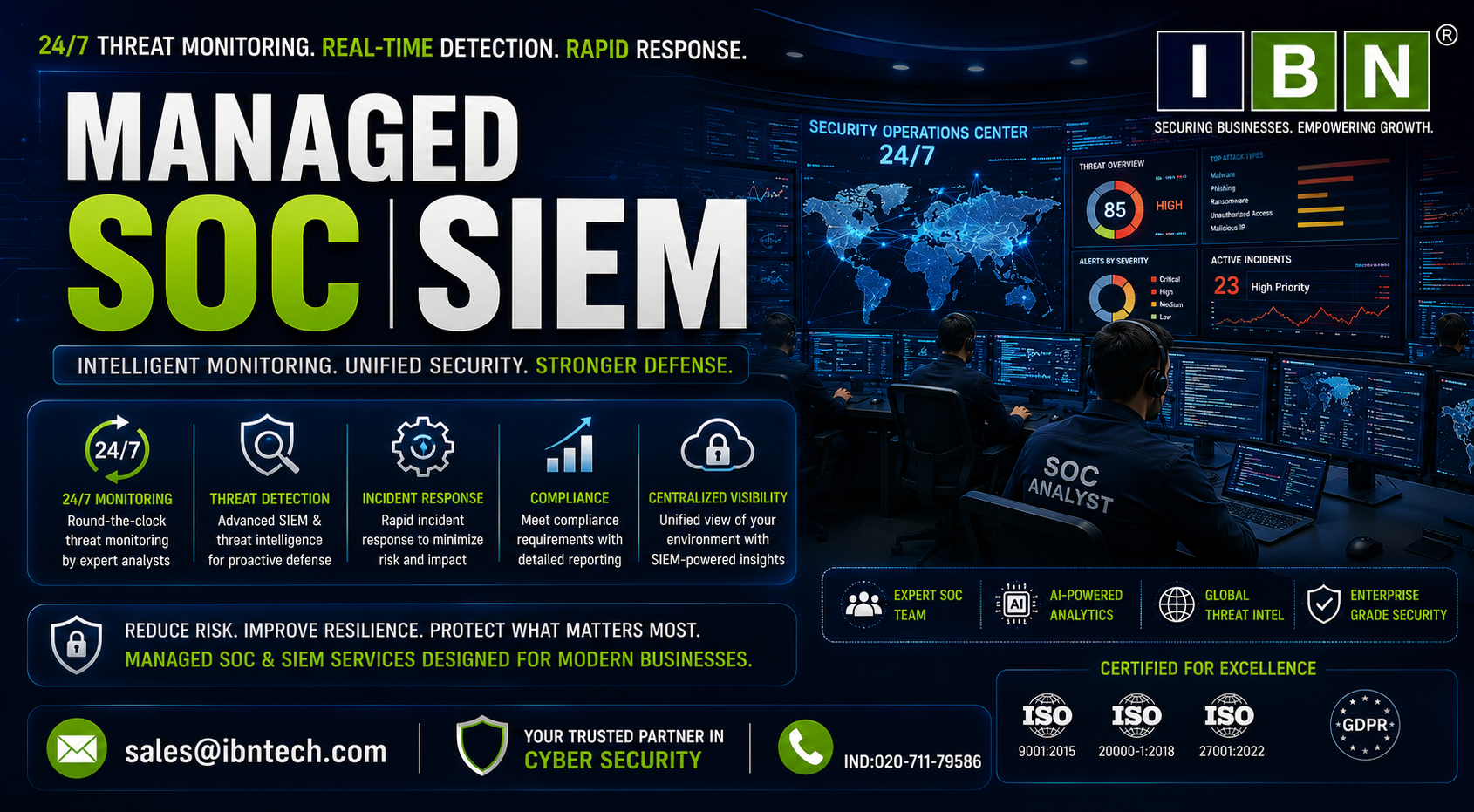
IBN Technologies offers managed SOC and SIEM services that can support organizations seeking continuous security monitoring, investigation, response, and compliance-oriented reporting.
Contact Us
IBN Technologies
Phone: +91 20 6768 0404
Email: sales@ibntech.com


