

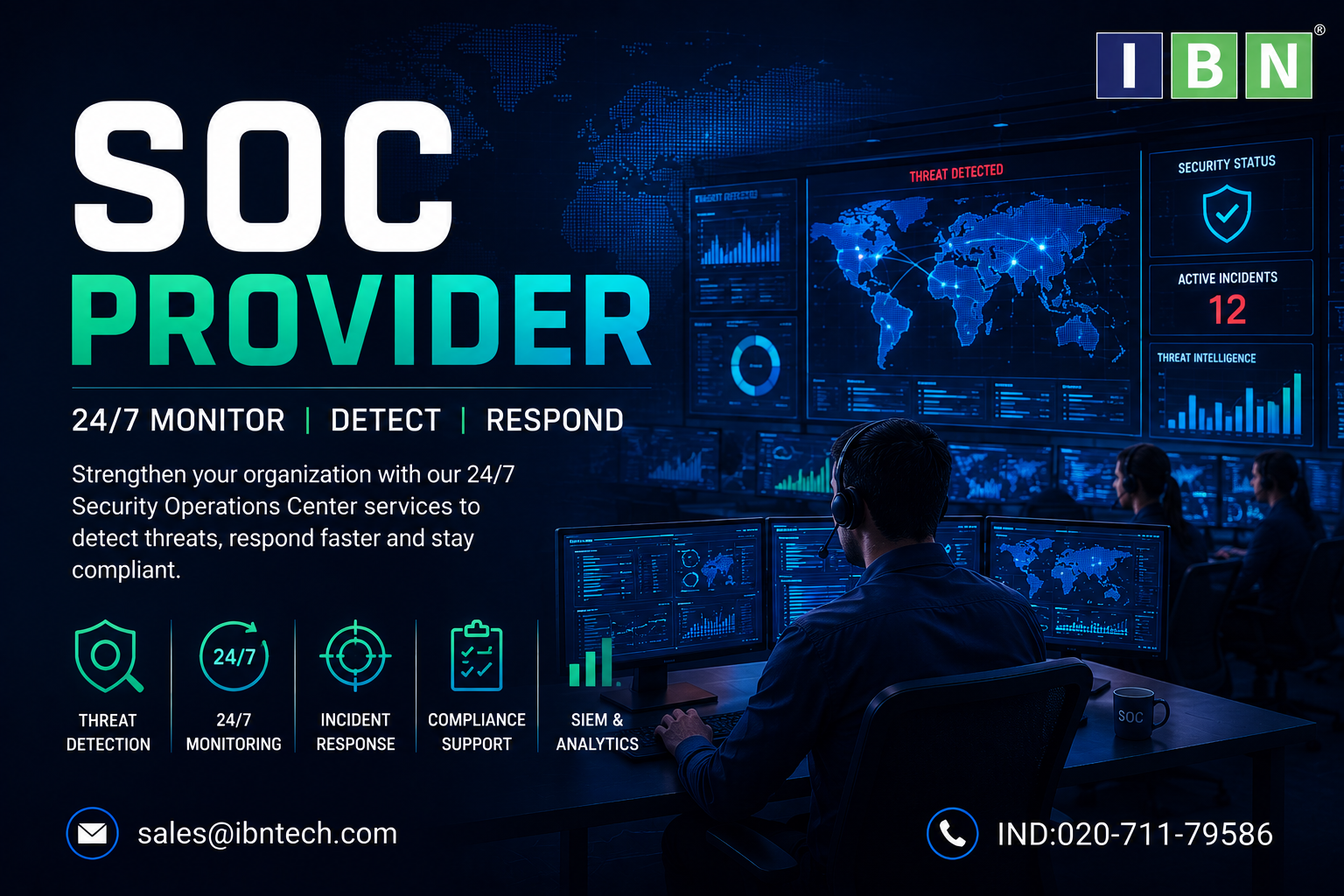
SOC Providers for Indian IT Businesses: Critical Security Support for Growing Teams

Why Indian IT Teams Are Rethinking SOC Providers for Everyday Security Operations
As Indian IT businesses scale digital operations, security monitoring becomes harder to manage through tools and internal teams alone. Cloud workloads, endpoints, applications, identity systems, and network devices continuously generate security events that need context and timely attention.
For many organizations, soc providers offer a way to extend security operations without building every monitoring capability internally.
The real question is not whether an IT business needs more security alerts. It is whether the organization has a dependable way to identify meaningful threats, investigate them, and coordinate a response.
What are SOC providers and how do they support IT businesses?
SOC providers deliver security operations capabilities that help organizations continuously monitor, analyze, and respond to potential threats. Depending on the service model, capabilities can include SIEM monitoring, threat detection, incident response, threat intelligence, security-device monitoring, vulnerability management, and security reporting.
A SOC provider essentially extends an organization's security operations through people, technology, processes, and defined escalation procedures. The provider monitors agreed environments and investigates relevant security events while the customer retains responsibility for business decisions, remediation, governance, and other agreed activities.
Why might an IT business consider a managed SOC service provider in Mumbai?
Mumbai is an important technology and business hub, and IT organizations operating there may manage distributed infrastructure, remote employees, cloud workloads, and customer-facing applications.
A managed soc service provider in mumbai can be relevant for an organization that wants access to managed security operations while maintaining a service relationship aligned with its Indian business environment. The important consideration is not simply the provider's location, but whether the service can cover the organization's technology stack, operating requirements, escalation model, and security objectives.
For an IT company, this distinction matters. A local presence can be useful, but monitoring capability, analyst expertise, integration, reporting, and response procedures still need to be evaluated.
Why can internal security monitoring become difficult?
An IT business may already employ network engineers, cloud administrators, infrastructure specialists, and application teams. These professionals understand the company's systems deeply, but continuous security operations require a different operating rhythm.
Security teams must review alerts, investigate suspicious behavior, correlate events, maintain detection logic, document incidents, and communicate with stakeholders.
That work can compete with infrastructure projects, application releases, cloud migrations, vulnerability remediation, and everyday IT support.
Building a dedicated internal SOC also requires security analysts, management, technology platforms, processes, training, coverage, and ongoing maintenance.
This does not mean an internal SOC is unsuitable for every organization. It means IT leaders should compare the operational requirements of an internal model with the capabilities they can obtain through an external provider.
What should an IT business evaluate before choosing a SOC provider?
The strongest evaluation begins with the organization's actual environment rather than a provider's marketing checklist.
Does the provider cover the right technology?
Start by identifying critical assets.
These may include:
- Cloud workloads
- Servers
- Endpoints
- Firewalls
- Network devices
- Business applications
- Identity systems
- Security appliances
- Other critical infrastructure
The provider should explain how each relevant environment can be monitored and what integrations are required.
How are alerts investigated?
Security monitoring becomes useful when alerts are given context.
An organization should understand whether analysts review suspicious events, how alerts are prioritized, and what information is supplied during escalation.
A dashboard containing thousands of events does not necessarily provide useful security visibility.
The operational process behind those events matters.
How does SIEM fit into the SOC operating model?
SIEM technology helps collect and correlate security information from multiple sources. Logs and events from endpoints, applications, firewalls, authentication systems, cloud environments, and other technologies can be brought together for analysis.
Imagine an employee account generating several failed authentication attempts. Later, the same account successfully logs in from an unusual environment and triggers an endpoint security event.
Looking at each event independently may provide limited context.
A SIEM can correlate the activity, while SOC analysts can investigate whether the combined behavior warrants escalation.
This is why IT organizations should evaluate both the technology layer and the human analysis supporting it.
What happens when a genuine security incident is detected?
A useful SOC engagement should have a clearly defined path from detection to response.
An event is detected through configured monitoring and detection mechanisms. The event is then assessed and, where appropriate, investigated by security analysts.
If the activity meets agreed escalation criteria, the internal stakeholders are notified with relevant information.
The organization can then take the appropriate response or remediation action according to the established incident-response process.
Some SOC and MDR models may also include response or containment capabilities. These should be explicitly defined in the service agreement so both parties understand what actions the provider is authorized to take.
What business benefits can managed SOC operations provide?
The value of an external SOC is primarily operational.
Extended monitoring capability can help organizations maintain security visibility beyond the availability of individual internal employees.
Specialist analysis can supplement internal teams when dedicated security operations expertise is limited.
Centralized visibility can help security teams examine activity across multiple technology sources.
Structured escalation can create a consistent path for communicating important incidents.
Scalable monitoring can help organizations accommodate additional systems as their technology environment grows.
These benefits depend on the quality and scope of the service. Organizations should therefore assess them against measurable requirements rather than assume that every SOC offering provides the same capabilities.
A practical IT security scenario
Consider an Indian software company operating cloud applications, employee endpoints, and internal business systems.
An administrator account suddenly shows repeated authentication failures followed by a successful login. Shortly afterward, the associated endpoint generates a suspicious security event.
The first login event alone may not justify escalation.
When the authentication activity and endpoint event are correlated, however, the sequence may provide enough context for further investigation.
A SOC analyst can review the available information, determine the appropriate severity, and escalate the event according to the agreed process.
The internal IT team can then focus on containment, account validation, remediation, and business decisions.
The example illustrates an important principle: security monitoring is most useful when technology, analysis, and response processes work together.
What should companies include in a SOC provider evaluation checklist?
Before entering an engagement, IT leaders should document:
- Critical systems requiring continuous monitoring
- Required log sources and integrations
- SIEM platform requirements
- Alert prioritization and investigation procedures
- Incident severity definitions
- Escalation contacts and communication channels
- Response responsibilities
- Reporting requirements
- Data retention expectations
- Service availability requirements
- Internal and provider responsibilities
- Scalability requirements
- Security and compliance expectations
A documented checklist makes it easier to compare providers against business requirements instead of comparing only feature lists.
How can SOC operations support compliance?
Security monitoring can contribute to broader governance and compliance programs by providing security-event records, monitoring information, incident documentation, and audit-oriented reporting.
IBN Technologies' published SOC and SIEM services include continuous monitoring, threat intelligence, incident response, and audit-ready reporting. Its published compliance coverage references frameworks and requirements including ISO 27001, PCI-DSS, HIPAA, GDPR, and Indian requirements such as CERT-In, RBI, and SEBI, depending on the applicable environment.
Compliance should not be treated as an automatic outcome of purchasing a SOC service. Organizations still need appropriate policies, controls, risk management, access governance, vulnerability management, and evidence processes.
Frequently Asked Questions
What do SOC providers actually do?
SOC providers deliver managed security operations such as continuous monitoring, threat detection, alert investigation, SIEM management, incident escalation, and security reporting. The exact scope depends on the service agreement.
Is a managed SOC suitable for a growing IT company?
A managed SOC can be useful when an IT company needs continuous security monitoring but does not want to build every SOC capability internally. The organization should evaluate monitoring coverage, integration, analyst expertise, escalation, and scalability before selecting a provider.
Can a SOC provider work with an internal IT team?
Yes. An external SOC can complement internal IT and security teams by handling defined monitoring and investigation activities. Responsibilities for remediation, governance, infrastructure, and business decisions should be clearly assigned.
Does SIEM alone provide SOC capabilities?
No. SIEM technology can collect and correlate security information, but effective SOC operations also require detection processes, security analysis, investigation, escalation, and response procedures.
Contact Us:
IND- 02067680404
IBN Technologies Ltd.
E-mail: - sales@ibntech.com


