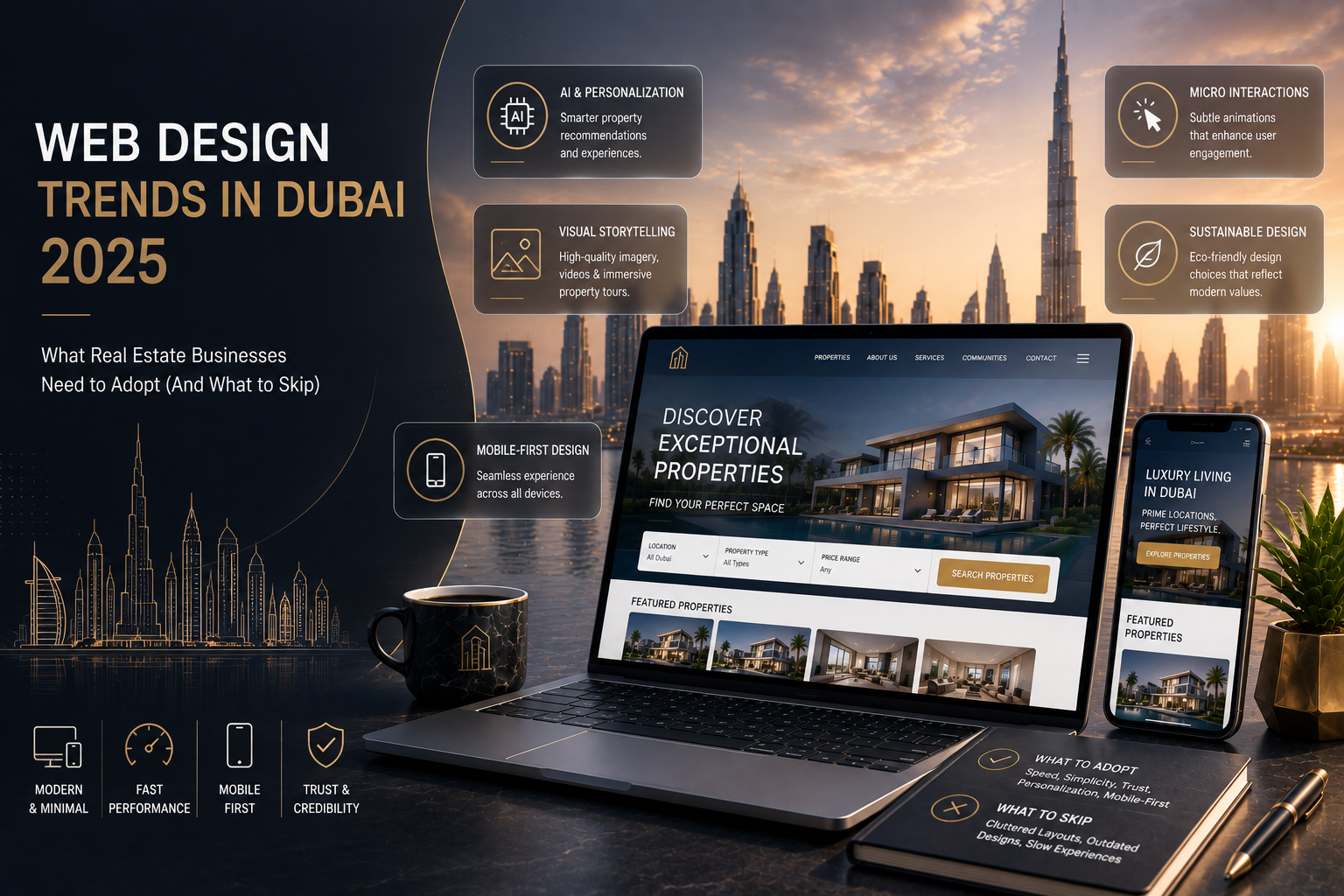
Dubai's real estate market has always been image-driven; the right visual presentation sells properties before a buyer even visits. In 2025, the web development cost in Dubai conversation for property businesses has shifted beyond aesthetics. The trends shaping real estate websites this year are about buyer experience, AI-powered search, and building digital trust with an increasingly sophisticated international investor audience. Here's what's actually worth adopting, and what's just noise.
Dubai's property market attracted AED 411 billion in real estate transactions in 2023 alone, and a growing share of that journey starts online, often from a different country. Buyers from Russia, India, the UK, China, and Europe research Dubai properties digitally for weeks before stepping on a plane. Your website is your first showing, your broker, and your brand ambassador all at once.
In 2025, the real estate websites winning buyer attention aren't just beautiful; they're fast, intelligent, and built around how today's property buyer actually behaves. Here are the 8 trends worth knowing, with a clear view of what's genuinely valuable for Dubai's market and what's trend-for-trend's-sake.
The 8 web design trends shaping Dubai real estate in 2025
1
AI-powered property search and personalisation
The days of a static dropdown filter for "bedrooms" and "price range" are giving way to intelligent search. In 2025, leading Dubai property portals let buyers type natural language queries like "3-bedroom villa in a quiet community near a good school under AED 4M" — and receive curated results. AI also personalises the browse experience: returning visitors see listings based on their previous search behaviour rather than a generic homepage. This is no longer a luxury feature; Bayut and Property Finder have already moved in this direction, and independent agency sites that don't adapt feel dated by comparison.
2
Immersive virtual tours and 3D walkthroughs
Matterport-style 3D walkthroughs and 360° virtual tours have moved from premium differentiators to buyer expectations — especially for off-plan developments targeting overseas investors. A buyer in London deciding between three Dubai Marina apartments will spend significantly more time on a listing that offers a virtual walkthrough than one with 10 static photos. In 2025, the integration of these tours directly into property listing pages (not just linked as external iframes) is the standard buyers expect.
3
Ultra-minimal, content-first design
Dubai real estate websites have historically leaned heavily on gold colour palettes, dark luxury aesthetics, and high-drama hero visuals. In 2025, the design direction is shifting toward restraint: clean white space, single-weight typography, and letting property photography carry the visual weight. This trend reflects a broader shift in luxury positioning; the most premium brands globally are moving toward understatement. In the Dubai property market, ultra-minimal design also loads significantly faster, directly improving Core Web Vitals scores.
4
Interactive ROI and mortgage calculator
Dubai's Golden Visa programme has brought a new category of property investor: international buyers who are evaluating real estate as a financial decision, not just a lifestyle one. In 2025, property websites that include dynamic ROI calculators (showing expected rental yield, projected appreciation, and net annual return) and UAE mortgage calculators (including DEWA, service charge, and agent fee breakdowns) convert this buyer segment at measurably higher rates. These tools keep buyers on the site longer and position the agency as a knowledgeable partner rather than a listing aggregator.
5
Neighbourhood storytelling pages
Buyers new to Dubai don't know the difference between Arabian Ranches, Damac Hills, and Al Barari. In 2025, the most effective real estate websites have moved beyond listing pages to include rich neighbourhood guide content, schools nearby, commute times, community lifestyle, amenities, historical price trends, and who the community is best suited for. These pages rank well on Google for "living in [community]" searches and capture buyers in the research phase, before they've even decided on a community, let alone a property.
6
WhatsApp-first lead capture
Contact forms are dying in Dubai's real estate market. In 2025, the dominant lead capture mechanism for UAE property sites is WhatsApp, either a floating button, a "Chat with an agent" prompt triggered after 30 seconds on a listing page, or WhatsApp Business API integration that assigns enquiries to agents automatically. Buyers in the Gulf region and from South Asia (one of Dubai's largest buyer segments) instinctively communicate through WhatsApp rather than email, and response speed matters enormously in a market where motivated buyers are comparing multiple agencies simultaneously.
7
Bilingual Arabic-English by default
This is no longer a trend; it's a baseline requirement for any Dubai real estate business serious about capturing the full market. In 2025, Emirati buyers, GCC investors, and Arabic-speaking expatriate communities expect a seamless Arabic RTL experience, not a poorly machine-translated version of the English site. Proper bilingual implementation includes RTL layout, Arabic typography optimised for property descriptions, and Arabic-language lead capture forms. Agencies that provide this serve a market segment that competitors without Arabic sites can't reach.
8
Social proof integration - video testimonials and verified reviews
Text-based testimonials have low credibility in 2025; buyers have seen too many clearly fabricated ones. The trend in Dubai's property market is toward video testimonials embedded directly on listing and agent pages, and verified review widgets pulling from Google or Trustpilot that show real, unedited buyer experiences. For an agency where a single transaction represents AED 500,000–5,000,000, third-party verified social proof directly reduces buyer hesitation at the most critical decision point.
Trends to skip - or approach with caution
These are either over-hyped or wrong for Dubai's market in 2025:
Metaverse property tours: The technology exists, but buyer adoption in Dubai is negligible. The ROI doesn't justify the cost unless you're a major developer with a specific overseas campaign.
NFT-based property ownership features: Regulatory clarity in the UAE is still evolving. Avoid building this into your primary website until RERA provides clearer framework guidance.
Chatbots replacing human agents: Dubai property buyers, especially at the AED 1M+ level, want human conversation, not a scripted bot. Use AI to qualify leads, not to replace agent interaction.
Dark mode as default: Looks impressive on design portfolios. Performs poorly for property photography, which is the core content of any real estate site. Offer it as an option, never as default.
What these trends mean for your budget in 2025
WhatsApp integration (essential)AED 0–800 - must-have now
Arabic RTL bilingual (essential)AED 1,500–4,000 - non-negotiable
ROI & mortgage calculatorsAED 2,000–5,000 - strong ROI
Virtual tour integrationAED 1,500–3,500 + photography cost
Neighbourhood guide contentAED 3,000–8,000 - long-term SEO asset
AI-powered searchAED 8,000–25,000 - for portals and large agencies
A real Dubai agency staying ahead of the curve
A mid-size real estate agency operating across JVC, Business Bay, and Dubai Hills consulted BootesNull for a 2025 website overhaul. Rather than a full rebuild, BootesNull prioritised the three highest-impact additions for their specific buyer profile: WhatsApp Business API integration, Arabic RTL implementation, and a neighbourhood guide section for their top three communities. Total additional investment: AED 9,500. Within 60 days, Arabic-language enquiries, previously zero, accounted for 22% of all inbound leads, and average time-on-site increased by 2 minutes as buyers explored the neighbourhood content.
Q1. Which 2025 web design trend has the fastest ROI for a Dubai real estate agency?
WhatsApp Business API integration: it costs the least, takes the shortest time to implement, and produces measurable results within days. If you have one thing to do this month, this is it.
Q2. Are virtual property tours worth the investment for smaller Dubai agencies?
For luxury listings above AED 3M - yes, absolutely. For mid-market listings, high-quality photography with a video walkthrough (not a full Matterport scan) is a more cost-effective option that still differentiates you from static-photo-only competitors.
Q3. How much does a fully trend-compliant Dubai real estate website cost in 2025?
For a mid-size agency implementing the essential features (Arabic RTL, WhatsApp, calculators, neighbourhood guides, virtual tour integration): AED 18,000–35,000 for a new build. Adding features to an existing site: AED 6,000–15,000 depending on current platform and scope.
Q4. How do I know which trends my specific buyer audience actually cares about?
Look at your enquiry data. If most enquiries come via phone, WhatsApp is your top priority. If you get a lot of international buyers, virtual tours and ROI calculators matter most. If your bounce rate is high, neighbourhood content and speed optimisation should come first. The data tells you which trend pays off first for your specific situation.
Q5. How often should a Dubai real estate website be updated to stay current with design trends?
A full redesign every 3–4 years. Functional updates (new features, content additions, performance improvements) should happen continuously. In a market as fast-moving as Dubai property, a website that looked current in 2022 already feels dated in 2025 - especially to international buyers comparing you against global property platforms.
The most successful Dubai real estate businesses in 2025 are treating their website as a living sales tool, one that evolves with buyer expectations, market shifts, and technology advances. The web development cost in Dubai for property businesses is no longer just about building something that looks impressive. It's about building something that earns buyer trust, loads fast on a phone, speaks Arabic and English equally well, and makes it effortless for an investor in another country to take the next step. That's what separates the agencies winning the digital market in 2025 from the ones still relying on referrals alone.