

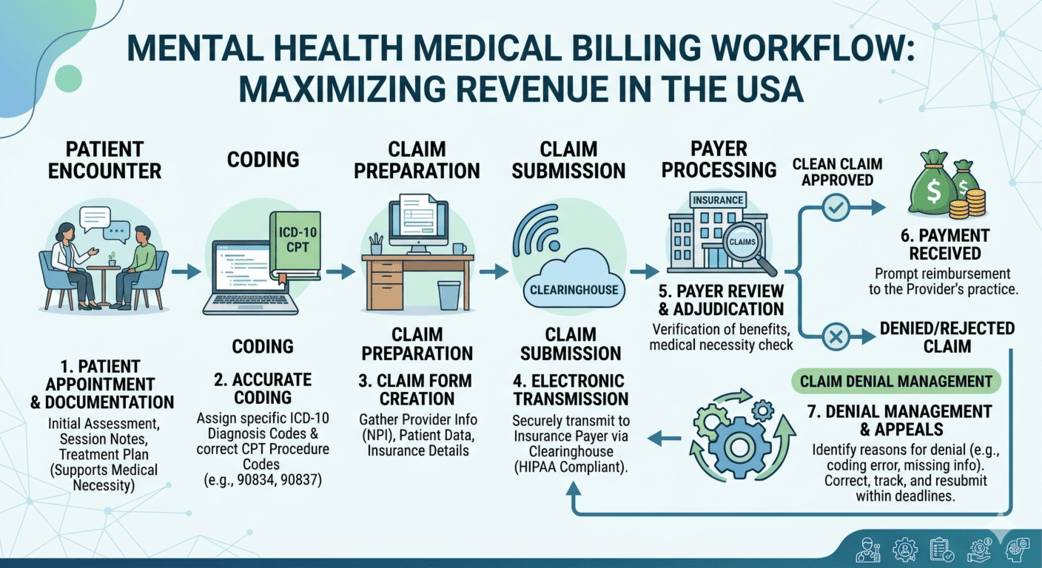
Billing for Mental Health Services in the USA: Strategies to Improve Revenue, Compliance, and Patient Care

Mental health practices across the USA are experiencing unprecedented demand. From private counseling clinics and psychiatric practices to telehealth providers and behavioral health centers, more patients are seeking professional mental health support than ever before. While this growth creates opportunities for providers, it also introduces complex administrative challenges, especially when it comes to billing for mental health services.
Unlike many other specialties, behavioral health billing involves unique coding requirements, payer-specific rules, authorization processes, and documentation standards. Even minor errors can result in claim denials, delayed reimbursements, and lost revenue.
Understanding the fundamentals of mental health billing is essential for providers who want to maintain financial stability while delivering high-quality patient care. This article explores the challenges, best practices, and solutions that help practices optimize mental health medical billing and improve revenue performance.
Understanding Mental Health Billing
Mental health billing refers to the process of submitting claims and obtaining reimbursement for behavioral health and psychiatric services. These services may include:
- Individual psychotherapy
- Group therapy sessions
- Family counseling
- Psychiatric evaluations
- Medication management
- Telepsychiatry visits
- Behavioral health assessments
- Substance abuse counseling
Because insurance carriers often apply different reimbursement policies for behavioral health services, providers must ensure that claims are submitted accurately and supported by proper documentation.
Effective mental health billing requires a combination of clinical knowledge, coding expertise, and payer-specific understanding.
Why Billing for Mental Health Services Is More Complex
Many healthcare providers assume that billing is similar across specialties. However, billing for mental health services presents several unique challenges.
Frequent Authorization Requirements
Many insurance plans require prior authorization before approving behavioral health treatment. Failure to obtain authorization can result in denied claims regardless of the quality of care provided.
Session-Based Billing Rules
Mental health claims are often reimbursed based on session length and service type. Providers must accurately document session duration and select the correct CPT codes.
Evolving Telehealth Regulations
Telehealth has become a major component of behavioral healthcare. However, reimbursement rules continue to evolve, requiring providers to stay updated on payer requirements.
Documentation Scrutiny
Behavioral health claims often undergo detailed audits. Missing documentation or incomplete progress notes may lead to payment delays or recoupments.
Coordination of Benefits
Patients receiving treatment from multiple providers may have complex insurance situations that require careful claim management.
These factors make mental health billing services increasingly valuable for providers seeking efficient reimbursement processes.
Common Challenges in Mental Health Medical Billing
Even experienced practices encounter billing obstacles that affect revenue performance.
Claim Denials
Claim denials commonly occur because of:
- Incorrect diagnosis codes
- Missing modifiers
- Invalid patient information
- Lack of authorization
- Documentation deficiencies
Delayed Payments
Slow reimbursements can negatively impact cash flow and operational stability.
Underpayments
Many providers focus on denied claims but overlook underpaid claims, which can significantly reduce annual revenue.
Coding Errors
Behavioral health coding requires careful attention to CPT and ICD-10 guidelines. Small mistakes can trigger claim rejections.
Insurance Verification Issues
Failure to verify benefits before treatment often results in unexpected patient balances and reimbursement complications.
Professional mental health billing solutions help address these issues before they become costly problems.
Best Practices for Successful Mental Health Billing
Providers can improve reimbursement rates and reduce claim denials by implementing proven billing strategies.
Verify Insurance Eligibility Before Every Visit
Insurance benefits can change frequently. Verifying coverage before appointments helps identify:
- Active coverage
- Copay responsibilities
- Deductible status
- Authorization requirements
- Visit limitations
This simple step reduces billing surprises and improves collections.
Maintain Detailed Clinical Documentation
Accurate documentation supports medical necessity and strengthens claims.
Documentation should include:
- Treatment goals
- Session duration
- Patient progress
- Clinical assessments
- Follow-up plans
Strong records not only support reimbursement but also improve compliance.
Use Accurate Coding
Behavioral health coding requires precision.
Commonly used services include:
- Psychiatric diagnostic evaluations
- Individual psychotherapy
- Family therapy
- Group counseling
- Medication management
Regular coding reviews help prevent avoidable errors.
Monitor Denial Trends
Tracking denial patterns helps identify recurring issues and allows corrective action before revenue is affected.
Stay Current With Payer Policies
Insurance requirements change frequently. Providers should regularly review payer updates to maintain compliance.
The Growing Importance of Mental Health Billing Services
As behavioral healthcare becomes more complex, many providers are turning to specialized mental health billing services.
Dedicated billing teams understand the nuances of behavioral health reimbursement and can help practices achieve:
- Faster claim processing
- Higher first-pass claim acceptance
- Reduced denial rates
- Improved collections
- Better compliance management
By outsourcing billing functions, providers can spend more time focusing on patient care rather than administrative tasks.
How a Mental Health Billing Company Supports Providers
A specialized mental health billing company offers expertise that general billing teams may not possess.
Insurance Verification
Billing specialists verify coverage and identify potential reimbursement issues before treatment begins.
Claims Submission
Claims are prepared, reviewed, and submitted according to payer requirements.
Denial Management
Denied claims are investigated, corrected, and resubmitted promptly.
Payment Posting
Accurate payment reconciliation ensures that providers receive appropriate reimbursement.
Reporting and Analytics
Financial reports provide insight into claim performance, revenue trends, and operational efficiency.
These services help practices improve financial outcomes while reducing administrative burdens.
Choosing Among Mental Health Billing Companies
Not all billing partners deliver the same level of service.
When evaluating mental health billing companies, providers should consider:
Behavioral Health Expertise
The company should have extensive experience with psychiatric and counseling claims.
Technology Integration
Seamless integration with practice management and electronic health record systems improves efficiency.
Compliance Knowledge
The billing team should stay current with regulatory changes and payer requirements.
Transparent Reporting
Providers need access to real-time performance data and revenue metrics.
Scalability
The billing partner should be able to support future growth without disrupting operations.
Selecting the right partner can significantly improve revenue cycle performance.
The Role of Medical Billing Services in Behavioral Healthcare
Comprehensive medical billing services extend beyond claim submission.
They support the entire reimbursement process, including:
- Eligibility verification
- Charge entry
- Claims management
- Denial resolution
- Accounts receivable follow-up
- Financial reporting
These functions contribute to stronger financial performance and improved operational efficiency.
For behavioral health providers, specialized expertise often produces better results than generic billing approaches.
Why Medical Coding Services Matter
Accurate coding is the foundation of successful reimbursement.
Professional medical coding services help ensure that:
- Services are coded correctly
- Documentation supports billed procedures
- Claims meet payer requirements
- Compliance risks are minimized
Behavioral health coding guidelines continue to evolve, making coding expertise increasingly important.
When coding errors occur, providers may experience denied claims, delayed payments, and compliance concerns.
Benefits of Medical Billing and Coding Services
Many practices benefit from combining medical billing and coding services under one coordinated process.
Advantages include:
- Improved claim accuracy
- Reduced administrative workload
- Faster reimbursements
- Lower denial rates
- Enhanced compliance oversight
When coding and billing teams work together, revenue cycle performance often improves significantly.
This integrated approach allows providers to focus on patient outcomes rather than administrative challenges.
Revenue Cycle Management Services for Mental Health Practices
Revenue cycle management services encompass every financial process from patient scheduling to final reimbursement.
A strong revenue cycle strategy includes:
Patient Registration
Accurate demographic information reduces claim errors.
Insurance Verification
Coverage verification prevents reimbursement delays.
Coding Accuracy
Proper coding supports clean claim submission.
Claims Management
Timely claim submission improves cash flow.
Denial Resolution
Rapid denial management accelerates reimbursement.
Patient Collections
Clear communication helps improve patient payment collection rates.
Effective revenue cycle management services create a healthier financial foundation for mental health practices.
The Value of Credentialing Services
Many reimbursement challenges begin before claims are ever submitted.
Credentialing services help ensure that providers are properly enrolled and recognized by insurance networks.
Benefits include:
- Faster payer enrollment
- Reduced reimbursement delays
- Improved network participation
- Fewer claim rejections
- Enhanced compliance
Without proper credentialing, even valid claims may be denied or delayed.
For growing behavioral health organizations, credentialing remains a critical component of long-term success.
Real-World Example: Improving Behavioral Health Revenue
Consider a growing counseling practice serving patients across multiple states.
The practice experienced:
- Frequent claim denials
- Slow reimbursements
- Authorization issues
- Inconsistent coding practices
After implementing specialized billing services for mental health providers, the organization streamlined workflows, improved documentation standards, and strengthened claim quality.
Within months, claim acceptance rates improved, accounts receivable decreased, and cash flow became more predictable.
This example highlights how strategic billing improvements can directly impact organizational success.
Preparing for the Future of Mental Health Billing
The behavioral healthcare industry continues to evolve rapidly.
Providers should prepare for:
- Expanded telehealth services
- Increased payer oversight
- Greater compliance requirements
- Advanced analytics adoption
- Automation and AI-assisted workflows
- Value-based care reimbursement models
Practices that invest in efficient billing systems today will be better positioned for future growth.
Supporting Practice Growth Through Smarter Billing
Financial stability is essential for delivering consistent, high-quality mental healthcare. Efficient billing processes reduce administrative burdens, improve reimbursement rates, and allow providers to focus on patient outcomes.
Many successful behavioral health organizations rely on specialized mental health billing solutions to manage complex reimbursement requirements while maintaining compliance and operational efficiency.
Organizations seeking additional support often explore experienced partners such as 247 Medical Billing Services for guidance on billing workflows, coding accuracy, revenue optimization, and operational improvements.
Conclusion
Billing for mental health services requires far more than claim submission. It demands accurate coding, detailed documentation, payer-specific expertise, and continuous compliance monitoring. As behavioral healthcare continues to grow throughout the USA, providers must adopt efficient billing strategies to maintain financial health and support quality patient care.
By leveraging specialized mental health billing services, medical billing services, medical coding services, medical billing and coding services, revenue cycle management services, and credentialing services, practices can improve reimbursement outcomes while creating a stronger foundation for long-term success.
Frequently Asked Questions (FAQs)
1. What is billing for mental health services?
Billing for mental health services is the process of submitting insurance claims and obtaining reimbursement for behavioral health treatments such as therapy, psychiatric evaluations, counseling, and medication management.
2. Why is mental health billing different from other medical specialties?
Mental health billing often involves session-based coding, authorization requirements, extensive documentation standards, and payer-specific reimbursement policies that differ from many other specialties.
3. What are the benefits of using mental health billing services?
Mental health billing services help reduce claim denials, improve reimbursement rates, streamline administrative tasks, and ensure compliance with changing payer regulations.
4. How can providers reduce claim denials in behavioral health?
Providers can reduce denials by verifying insurance eligibility, maintaining accurate documentation, obtaining required authorizations, and using proper coding practices.
5. What do revenue cycle management services include?
Revenue cycle management services typically include patient registration, insurance verification, coding, claims submission, denial management, payment posting, and patient collections.
6. Why are credentialing services important for mental health providers?
Credentialing services ensure providers are properly enrolled with insurance networks, helping prevent reimbursement delays, claim rejections, and compliance issues.


