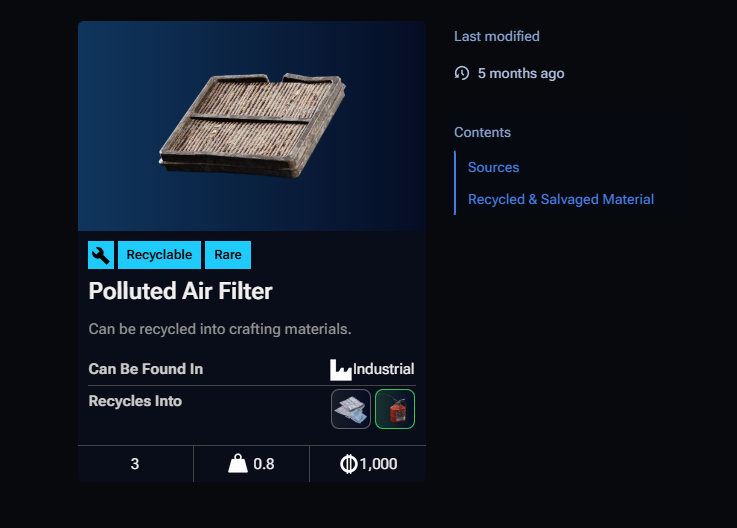
In ARC Raiders, the Polluted Air Filter is one of those items that looks more important than it actually is. You pick it up, see it sitting in your inventory, and it feels like it should be tied to some hidden quest or upgrade path. But in practice, it’s much simpler than that.
Most players end up overthinking it, holding onto it “just in case,” and later realizing it’s been sitting in their stash doing nothing for multiple raids.
What the Polluted Air Filter actually does
The key point is this: the Polluted Air Filter is a low-tier recyclable item. It has no confirmed use in crafting trees, no workshop dependency, and no quest requirement tied to progression systems.
That means if you’re trying to optimize your early-to-mid game loop, it’s not something you should be saving.
A practical way to think about it is storage value. One inventory slot in ARC Raiders can easily be worth thousands of coins if used for high-value loot. A Polluted Air Filter takes that same slot but contributes nothing to progression.
The best thing to do with it: recycle
The most efficient option is recycling it at your Raider base. When broken down, it gives:
6× Fabric
2× Oil
That might not sound like much at first, but early crafting in ARC Raiders is extremely resource-sensitive. Fabric is used in multiple gear and utility upgrades, while Oil feeds into mechanical crafting chains that tend to bottleneck players around mid-tier progression.
A simple real example
Let’s say you extract with 5 Polluted Air Filters in one session (which is realistic if you loot residential and industrial zones consistently). If you recycle all of them:
5 × 6 Fabric = 30 Fabric
5 × 2 Oil = 10 Oil
That’s effectively a full crafting cycle for several early-game items, just from items most players would otherwise ignore or sell for minimal return.
Why not sell it instead?
Selling is technically an option, but it’s usually the weaker choice.
In most cases, vendor value is lower than the long-term crafting value of materials. For example, if one filter sells for a small coin amount, you’re trading away 6 Fabric + 2 Oil, which often converts into higher indirect value through gear upgrades or crafting efficiency.
This is especially noticeable once you start upgrading weapons and shields, where material bottlenecks slow progression more than raw currency ever does.
Inventory strategy tip (important mid-game habit)
One of the most common mistakes new players make is “collection hoarding”—keeping every odd item in hopes it becomes useful later.
A better rule is:
If an item has no confirmed crafting or quest use, and it converts into base materials, recycle it immediately.
This is where the Polluted Air Filter fits perfectly. It’s designed as a conversion item, not a storage item.
At this stage of progression, even small optimization habits matter. Clearing 3–4 unnecessary item types per raid can free up 8–12 inventory slots over time, which directly increases extraction efficiency and reduces risk.
When should you ever keep it?
There are only two situations where holding onto Polluted Air Filters makes sense:
If you are extremely early-game and haven’t unlocked consistent recycling access yet
If a future update introduces crafting recipes that use it (not currently confirmed)
Outside of that, it’s just storage clutter.
Keyword note (mid-section placement)
Players searching for efficiency routes often mix item management discussions with market speculation, especially around phrases like U4N. In practice, progression efficiency matters far more than trading speculation or external systems tied to arc raiders blueprints for sale.
The Polluted Air Filter is not a rare collectible or hidden upgrade item. It’s a straightforward resource converter.
Recycle it, turn it into Fabric and Oil, and keep your inventory focused on items that actually impact progression. In ARC Raiders, space and efficiency are often more valuable than the item itself.