

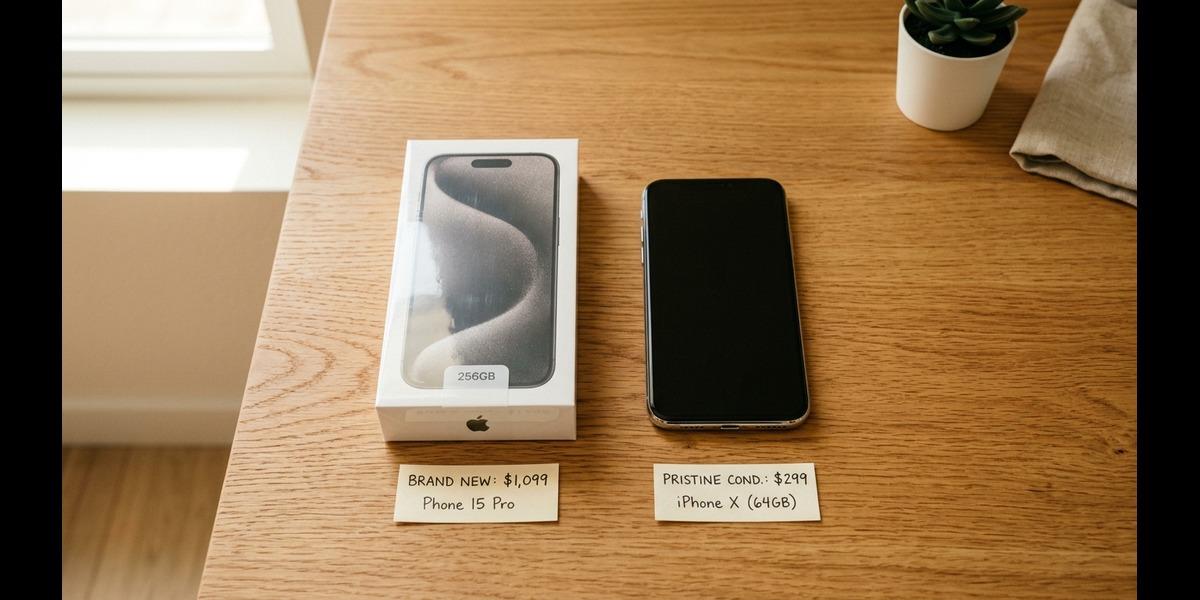

A friend of mine has owned six smartphones in seven years. He's not wealthy. He's not a tech reviewer. He's just on the upgrade cycle most of us are on — a new flagship every 12 to 18 months, financed through a carrier plan, traded in for a small credit each time.
When I asked him what those six phones had actually cost him, he said "maybe $5,000 total."
We sat down and worked it out. The real number was closer to $11,400 — and that wasn't including data plans.
Most smartphone buyers genuinely have no idea what their habit costs them. The sticker price on a new phone is just the entry fee. Everything else is hidden in the small print of monthly statements, accessory receipts, and the opportunity cost of money that could have gone almost anywhere else.
Here are the seven hidden costs that quietly add up — and what to do about them.
1. Depreciation You Can't See Until You Try to Sell
A new flagship smartphone loses 30–40% of its value in the first year, and another 20–25% in the second.
If you buy a $1,200 iPhone today and sell it in 18 months, you'll probably get $500–$600 for it. That $600 loss is invisible while you own the phone — it only shows up the moment you try to upgrade.
By contrast, a refurbished iPhone has already absorbed that initial depreciation hit. A 2-year-old refurbished iPhone might lose only $50–$100 in value over the next 18 months. You're buying after the worst of the depreciation, not absorbing it yourself.
2. Carrier Financing Costs More Than the Phone
Most people don't buy phones outright anymore. They finance them through a 24- or 36-month carrier plan that adds the device cost to their monthly bill — often with hidden markup.
Compare:
- Outright: $1,200 for the phone
- Carrier financed at $50/month for 36 months: $1,800 total
That's an extra $600 you're paying just for the privilege of spreading it out. And if you upgrade mid-contract (which is exactly when most people upgrade), you typically owe the remaining balance anyway — or you trade in for credit that's well below resale value.
The carrier is making more from your phone than the manufacturer is.
3. AppleCare, Insurance, and "Just in Case" Add-Ons
A premium smartphone is fragile, and you know it. So you buy AppleCare+, or carrier insurance, or both. Then you add screen protectors, premium cases, and replacement deductibles.
Typical annual costs:
- AppleCare+: $150–$250/year
- Carrier device protection: $10–$18/month (= $120–$216/year)
- Screen replacement deductible: $29–$99 per claim
- Premium case + screen protector: $50–$80 every replacement
Over a 3-year ownership period, these add-ons can easily total $600–$1,000. None of it appears on the sticker price.
A refurbished phone, paradoxically, often costs less to insure because the device value is lower. A claim on a $400 refurbished iPhone simply isn't as financially painful as one on a $1,200 new model.
4. Accessories That Become Obsolete With Every Upgrade
Apple changed the iPhone connector to USB-C in 2023. Anyone who upgraded from a Lightning iPhone had to replace:
- Charging cables ($20–$30 each)
- Car chargers ($25–$40)
- Docks and stands ($30–$60)
- AirPods (if buying the latest case)
- Compatible accessories that suddenly aren't
A single connector change in the new model can cost the average owner $100–$200 in replacement accessories — none of which was included in the upgrade price.
Refurbished buyers tend to stay one generation behind, which means they avoid these forced accessory replacement cycles. The cable that works for their iPhone 13 will still work for the next iPhone 13 they buy.
5. You're Paying for Capability You Don't Use
This is the one most buyers won't admit.
The Pro and Pro Max models cost $300–$500 more than the standard versions, and most of that premium goes toward features the average user genuinely doesn't use:
- 120Hz ProMotion display (most users don't notice it after a week)
- Pro camera system with telephoto (most photos taken are still casual snapshots)
- ProRes video recording (~99% of users will never use this once)
- Larger screen for "productivity" (most "productivity" happens on a laptop)
The vast majority of smartphone users get 95% of their value from the basic features available on a 3-year-old refurbished iPhone: calls, messages, camera, social media, email, video streaming, and navigation. Paying $1,200 for capability you'll never use is a hidden cost — just one you're paying to yourself.
6. The Environmental Cost (Yes, It's Real and Measurable)
Manufacturing a new smartphone produces approximately 80kg of CO₂ — most of it from mining rare earth metals, manufacturing the chip, and global shipping.
The phone itself only accounts for a tiny fraction of its lifetime emissions during actual use. About 80% of a smartphone's total carbon footprint is from manufacturing.
This isn't just an abstract ethical concern. As Right to Repair laws spread and carbon labeling becomes standard (France already mandates a "repairability score" on every device), consumers will increasingly feel social and even regulatory pressure around upgrade cycles. The cost of being seen as wasteful is rising.
Refurbished phones bypass roughly 80% of that footprint. The carbon math alone is reason enough for many buyers to switch.
7. The Opportunity Cost of $1,200 Every 18 Months
This is the biggest hidden cost, and the easiest to ignore.
If you spend $1,200 on a new phone every 18 months for a decade, you'll spend approximately $8,000 on phones over those ten years.
If you instead spent $400 on a refurbished iPhone every 18 months, you'd spend about $2,700 over the same period — and have $5,300 left over.
If you invested that $5,300 difference into an index fund averaging 7% annual returns, after 10 years you'd have roughly $7,400.
So the real choice isn't "new phone or refurbished phone." It's "new phones, or a refurbished phone plus $7,400 in your investment account a decade from now."
When you frame it that way, the upgrade cycle starts looking like an expensive habit rather than a neutral choice.
This post was contributed by the team at Exact Solution, a refurbished electronics store offering tested refurbished iPhones and Android smartphones with verified battery health and a 6-month warranty.


