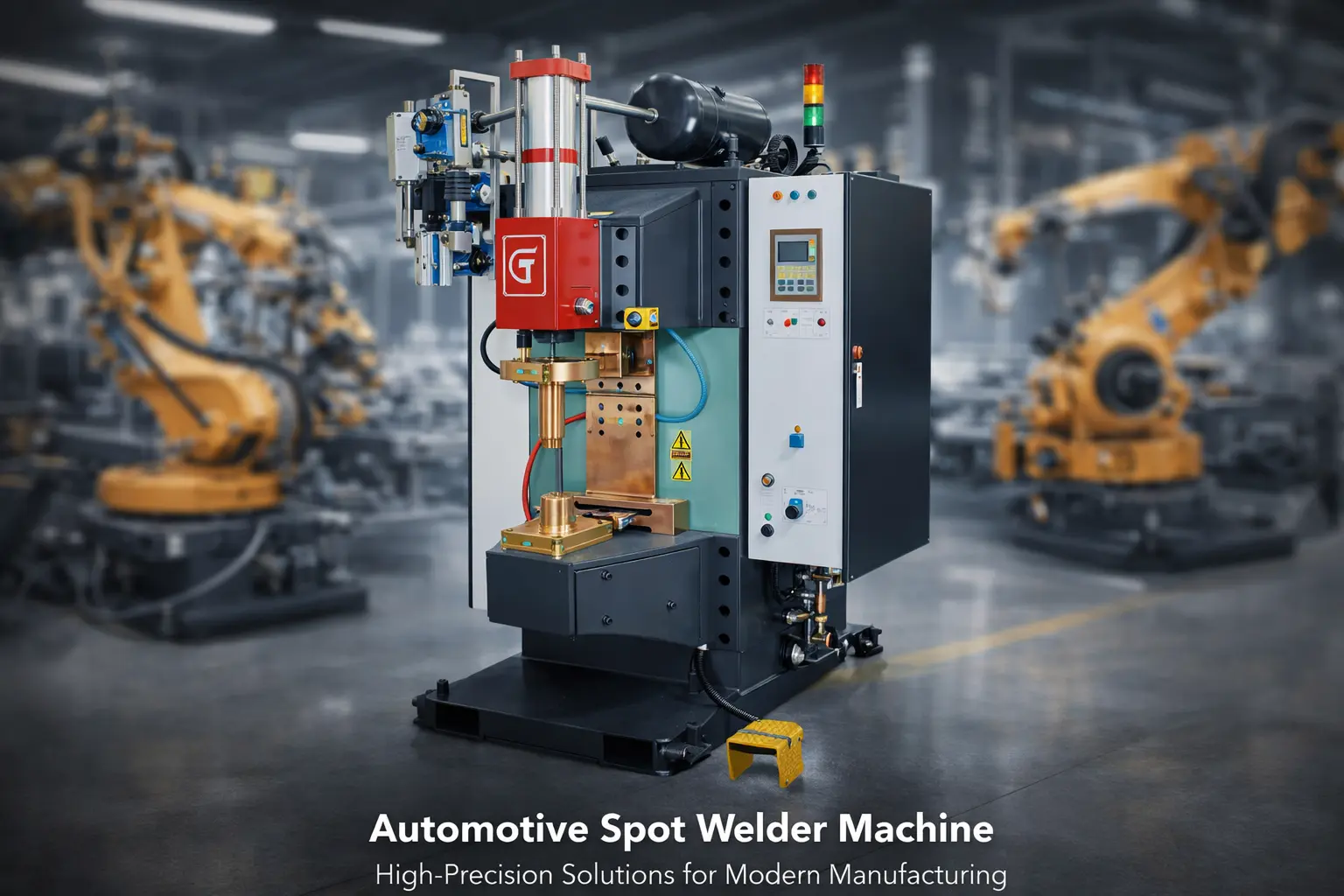
In today’s automotive manufacturing environment, precision, speed, and repeatability are not optional they are critical. The automotive spot welder has become one of the most essential tools in vehicle body assembly, enabling OEMs and Tier-1 suppliers to achieve high-strength joints in sheet metal structures with efficiency and consistency.
As global vehicle production shifts toward lightweight materials, automation, and electric mobility, resistance spot welding remains the backbone of body-in-white assembly lines.
Heron Welder ,a global manufacturer of advanced resistance welding systems, delivers intelligent spot welding solutions designed for demanding automotive production environments.
What Is an Automotive Spot Welder?
An automotive spot welder is a type of resistance welding machine used to join overlapping metal sheets using localized heat and pressure. Electrodes apply force while a high electrical current passes through the joint, forming a weld nugget without the need for filler material.
This process is widely used in automotive body manufacturing because it is:
- Fast (cycle times often under a second)
- Highly repeatable
- Easy to automate with robotic systems
- Suitable for thin sheet metals used in vehicle structures
Modern systems, especially MFDC-based solutions, provide superior control and energy efficiency compared to traditional AC welders.
How Automotive Spot Welding Works (Principle)
The working principle of resistance spot welding is based on Joule heating (I²R loss):
- Electrodes clamp the metal sheets together
- Electrical current passes through the contact point
- Heat is generated due to electrical resistance
- A molten “nugget” forms and solidifies under pressure
Q=I2RtQ = I^2 R tQ=I2Rt
Where:
- Q = heat generated
- I = current
- R = electrical resistance
- t = welding time
This controlled heat input ensures a strong metallurgical bond with minimal distortion, which is critical for automotive-grade quality standards.
Why Spot Welding Is Essential in Automotive Manufacturing
Automotive production lines rely heavily on spot welding because it supports high-speed, automated, and scalable assembly.
Key advantages include:
1. High Production Speed
Robotic spot welding systems can perform hundreds of welds per vehicle body with extremely short cycle times.
2. Consistent Weld Quality
Modern MFDC systems provide stable current control, improving weld consistency across thousands of joints.
3. Low Distortion
Because heat is localized, surrounding material is minimally affected—important for precision automotive panels.
4. Easy Automation
Spot welders integrate seamlessly with robotic arms, fixtures, and production lines.
Types of Automotive Spot Welding Technologies
Modern automotive manufacturing does not rely on a single welding method. Instead, different spot welding technologies are used depending on material and design requirements.
MFDC Spot Welding (Most Advanced)
MFDC (Medium Frequency Direct Current) systems are widely used in automotive OEMs due to:
- Faster current rise
- Higher energy efficiency
- Better weld penetration
- Reduced power consumption
AC Spot Welding
Traditional but still used in cost-sensitive applications. Suitable for basic sheet metal welding.
Capacitor Discharge Spot Welding
Used for specialized applications requiring extremely fast energy delivery.
Automotive Applications of Spot Welding
The automotive spot welder is used across nearly every structural segment of a vehicle:
Body-in-White (BIW)
- Car frames
- Door panels
- Roof structures
- Floor assemblies
Powertrain Components
- Battery enclosures (EVs)
- Motor housings
- Cooling plates
Interior & Structural Parts
- Brackets
- Reinforcement components
- Seat structures
As electric vehicles expand globally, spot welding is increasingly used for aluminum and high-strength steel assemblies.
Spot Welding vs Other Joining Methods
In modern automotive engineering, spot welding competes with several alternative technologies:
| Method |
Strength |
Speed |
Automation |
Best Use Case |
| Spot Welding |
High |
Very High |
Excellent |
Sheet metal body assembly |
| MIG Welding |
Very High |
Medium |
Moderate |
Thick structures |
| Laser Welding |
Very High |
High |
Excellent |
Precision joints |
| Riveting (FSPR) |
High |
Medium |
High |
Multi-material joining |
Heron also provides advanced alternatives such as clinching and self-pierce riveting systems for hybrid material structures.
Key Challenges in Automotive Spot Welding
Even though spot welding is highly effective, manufacturers face several challenges:
1. Electrode Wear
High-volume production leads to electrode degradation, affecting weld consistency.
2. Material Variability
High-strength steels and aluminum alloys require precise parameter control.
3. Energy Efficiency Demands
Automotive OEMs now demand lower energy consumption per weld.
4. Process Monitoring
Modern factories require real-time data tracking for quality assurance.
Heron’s Automotive Spot Welding Solutions
Heron Welder specializes in industrial-grade automotive spot welding systems designed for high-volume production environments.
Our solutions include:
- MFDC spot welding machines
- Robotic welding guns
- Projection welding systems
- Fully automated welding production lines
- Integrated control systems and monitoring
With advanced control technologies and stable current output, Heron systems ensure:
- High weld consistency
- Reduced operating cost
- Long electrode life
- Seamless integration with automation lines
Best Practices for Automotive Spot Welding
To achieve optimal weld quality in automotive applications, engineers should follow these guidelines:
- Maintain correct electrode force and alignment
- Optimize welding current and time parameters
- Use proper cooling systems for electrodes
- Implement regular electrode dressing
- Integrate real-time monitoring systems
Proper parameter control is essential to ensure structural integrity and production reliability.
The Future of Automotive Spot Welding
The automotive industry is evolving toward:
- Electric vehicles (EVs)
- Lightweight multi-material structures
- Smart factories (Industry 4.0)
- AI-based quality monitoring
Future automotive spot welders will increasingly include:
- AI-driven process optimization
- Predictive maintenance systems
- Digital twin simulation
- Fully autonomous welding cells
Heron continues to develop intelligent welding technologies that align with these future manufacturing trends.
FAQs
1. What is an automotive spot welder used for?
It is used to join sheet metal components in vehicle body manufacturing using resistance heat and pressure.
2. Which materials can be welded?
Steel, stainless steel, high-strength steel, and aluminum alloys are commonly used.
3. What is the difference between MFDC and AC spot welding?
MFDC offers better energy efficiency, faster response, and higher weld consistency compared to AC systems.
4. Can spot welding be automated?
Yes, it is widely integrated into robotic automotive production lines for high-speed manufacturing.
5. Is spot welding suitable for electric vehicles?
Yes, especially for battery enclosures, aluminum structures, and lightweight EV frames.
Conclusion & CTA
The automotive spot welder remains a core technology in modern vehicle manufacturing, offering unmatched speed, consistency, and automation compatibility. As automotive designs become more complex, manufacturers require smarter, more efficient welding systems.
Heron Welder delivers advanced resistance spot welding solutions tailored for OEMs, Tier-1 suppliers, and automated production lines worldwide.
If you are looking for a customized automotive spot welding solution, contact Heron Welder today to request a quote or consultation and optimize your welding production performance.