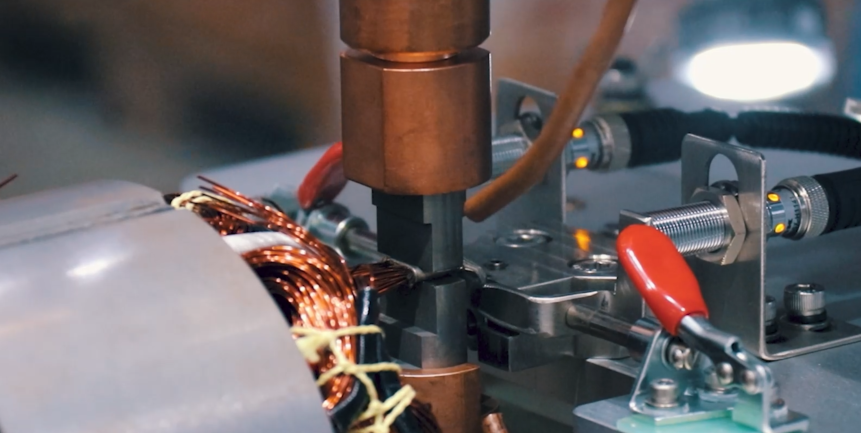
In today’s high-speed manufacturing environments, fastening reliability and production efficiency are critical. A nut welder plays a vital role in achieving both by enabling strong, repeatable, and automated attachment of threaded nuts onto metal components. For industries like automotive, appliances, HVAC, and sheet metal fabrication, nut welding has become a core joining process that replaces traditional mechanical fastening methods.
As a global manufacturer of resistance welding and automation systems, Heron Welder focuses on delivering advanced nut welding solutions designed for precision, consistency, and scalable production performance.
What Is a Nut Welder?
A nut welder machine is a specialized resistance welding system used to permanently attach a nut to a metal workpiece through controlled heat, pressure, and electrical current. Unlike mechanical fastening or riveting, nut welding creates a metallurgical bond, ensuring high strength and vibration resistance.
The process typically relies on projection welding, where small raised points (projections) on the nut concentrate heat at the contact interface. When current passes through, these projections melt and fuse with the base metal, forming a strong joint.
As described in industrial welding principles, nut welding is widely used because it offers a fast, clean, and repeatable joining process suitable for mass production lines.
Working Principle of Nut Welding
A nut welder operates on the core concept of resistance heating:
- The nut is accurately positioned on the sheet metal surface
- Electrodes apply controlled pressure
- A high electric current passes through the contact point
- Heat is generated due to electrical resistance
- The nut projections melt and fuse with the base material
This creates a localized weld nugget with minimal distortion and high structural integrity.
Modern nut welding machines are engineered for precision control of current, force, and timing, which is essential for achieving consistent weld quality in automated manufacturing environments.
Types of Nut Welding Machines
Different production requirements demand different machine configurations. The most common types include:
1. Manual and Semi-Automatic Nut Welders
These systems are used in small-scale fabrication or repair work. Operators manually position the nut, while the machine handles the welding cycle.
2. Automatic Nut Welding Systems
Designed for high-volume production lines, these machines integrate nut feeding, positioning, welding, and quality control into a single automated workflow. They are widely used in automotive body-in-white production.
3. MFDC Nut Welding Machines
Medium Frequency Direct Current (MFDC) systems are preferred in modern factories due to their stability, energy efficiency, and precise heat control. These systems ensure consistent weld quality even under high-speed production conditions.
4. Capacitor Discharge (CD) Nut Welders
CD welders deliver short, high-energy pulses, making them ideal for thin sheet metals where heat distortion must be minimized.
Industrial Applications of Nut Welders
Nut welders are widely used across industries where threaded fastening is required without drilling or mechanical insertion.
Automotive Manufacturing
Nut welding is heavily used in:
- Car body frames
- Door panels
- Engine compartments
- Chassis assemblies
It ensures high durability and crash-resistant fastening points.
Electrical Enclosures and Cabinets
Control panels and metal enclosures use welded nuts for secure mounting of components, ensuring long-term stability under vibration.
HVAC and Appliance Industry
Air conditioners, refrigerators, and industrial HVAC systems rely on nut welds for assembling sheet metal structures and support brackets.
Industrial Equipment and Machinery
Heavy machinery frames and structural assemblies use nut welding for strong load-bearing connections.
Nut Welding vs Other Welding Methods
Understanding the difference between nut welding and other resistance welding processes helps engineers select the right solution.
| Feature |
Nut Welding |
Spot Welding |
Stud Welding |
| Purpose |
Attach threaded nut |
Join two sheets |
Attach studs/fasteners |
| Method |
Projection welding |
Point resistance welding |
Arc or resistance welding |
| Output |
Threaded connection |
Flat joint |
External threaded stud |
| Application |
Fastening assemblies |
Sheet joining |
Structural fastening |
Unlike spot welding, which joins two sheets together, nut welding creates a functional threaded point, enabling assembly with bolts or screws.
Key Advantages of Nut Welding
A well-designed nut welding system delivers significant manufacturing benefits:
- High production speed for mass manufacturing
- Strong and durable joints with vibration resistance
- No need for drilling or secondary operations
- Reduced material damage and distortion
- High repeatability and automation compatibility
- Cost efficiency in large-scale production
These advantages make nut welding an essential process in modern automated factories.
Best Practices for Nut Welding in Production
To ensure consistent weld quality, engineers should focus on the following:
1. Proper Surface Preparation
Clean metal surfaces improve electrical contact and reduce weld defects.
2. Correct Electrode Force
Insufficient or excessive pressure can weaken weld strength or damage components.
3. Optimized Welding Parameters
Current, time, and pressure must be precisely calibrated for different materials and nut sizes.
4. Tooling and Electrode Maintenance
Regular maintenance prevents wear-related inconsistencies in weld quality.
5. Automation Integration
Using robotic feeding and positioning systems increases accuracy and reduces human error in high-volume production.
Heron Welder’s Nut Welding Solutions
At Heron Welder, we design and manufacture advanced resistance welding systems, including nut welders, tailored for industrial-scale production. Our solutions are built to meet the demands of OEMs, Tier-1 suppliers, and automation integrators.
Key strengths include:
- MFDC and capacitor discharge welding technologies
- Fully automated nut feeding and welding systems
- High-precision control for consistent weld quality
- Integration-ready designs for smart manufacturing lines
- Custom engineering for complex production requirements
By combining engineering expertise with automation innovation, Heron helps manufacturers achieve higher productivity, lower defect rates, and improved assembly efficiency.
FAQs About Nut Welder
1. What materials can a nut welder work with?
Nut welders are commonly used with mild steel, stainless steel, and coated sheet metals depending on machine configuration and welding parameters.
2. Is nut welding stronger than mechanical fastening?
Yes. Nut welding creates a permanent metallurgical bond, offering higher vibration resistance and strength compared to mechanical fasteners.
3. What industries use nut welding machines the most?
Automotive, HVAC, electrical enclosure manufacturing, and heavy machinery industries are the largest users of nut welding systems.
4. Can nut welding be automated?
Yes. Modern nut welding systems are often fully automated with robotic feeding, positioning, and welding integration for high-speed production lines.
5. What is the difference between MFDC and capacitor discharge nut welders?
MFDC systems provide stable, continuous control ideal for high-volume production, while capacitor discharge systems are best for thin materials requiring low heat input.
Final Thoughts
A nut welder is more than just a welding machine—it is a precision engineering solution that ensures structural strength, production efficiency, and manufacturing reliability. As industries move toward automation and smart factories, demand for advanced nut welding systems continues to grow.
With deep expertise in resistance welding technology, Heron Welder delivers high-performance nut welding solutions designed for modern industrial challenges.
If you are looking to improve production efficiency, reduce defects, or integrate automated nut welding into your manufacturing line, *
contact Heron Welder for a customized solution or quotation today*.