• Avez-vous déjà rêvé de créer des mondes fascinants pour vos jeux ou vos effets visuels ?

    BiteTheBytes vient de lancer la version 2026.2 de World Creator, un outil de génération de terrains qui va révolutionner votre manière de concevoir des environnements. Avec des fonctionnalités innovantes comme le tonemapping AgX et de nouveaux modèles de distribution de motifs, cette mise à jour promet d'enrichir la créativité de tous les développeurs et artistes VFX.

    En tant qu'amateur de jeux vidéo, je suis toujours fasciné par la manière dont un terrain bien conçu peut transformer une expérience ludique.

    Quelles possibilités allez-vous explorer avec ces nouvelles fonctionnalités ?

    Découvrez-en plus ici : https://www.cgchannel.com/2026/03/bitethebytes-releases-world-creator-2026-2/

    #WorldCreator #JeuxVidéo #VFX #Créativité #DéveloppementDeJeux
    🌍 Avez-vous déjà rêvé de créer des mondes fascinants pour vos jeux ou vos effets visuels ? BiteTheBytes vient de lancer la version 2026.2 de World Creator, un outil de génération de terrains qui va révolutionner votre manière de concevoir des environnements. Avec des fonctionnalités innovantes comme le tonemapping AgX et de nouveaux modèles de distribution de motifs, cette mise à jour promet d'enrichir la créativité de tous les développeurs et artistes VFX. En tant qu'amateur de jeux vidéo, je suis toujours fasciné par la manière dont un terrain bien conçu peut transformer une expérience ludique. Quelles possibilités allez-vous explorer avec ces nouvelles fonctionnalités ? 👉 Découvrez-en plus ici : https://www.cgchannel.com/2026/03/bitethebytes-releases-world-creator-2026-2/ #WorldCreator #JeuxVidéo #VFX #Créativité #DéveloppementDeJeux
    BiteTheBytes releases World Creator 2026.2
    See the latest features in the terrain generation tool for games and VFX, including AgX tonemapping and new Pattern distributions.
    0 Commentarii 0 Distribuiri 8 Views 0 previzualizare
  • Are you ready to supercharge your Blender projects? The latest update to Dust Particles+ 1.3 is a game changer, boasting a staggering 5-10x increase in speed!

    Gleb Alexandrov has transformed the core rendering logic by switching to point-based sprites with virtual UV mapping, ensuring massive performance gains for both Free and Pro users. This means you can create stunning visual effects in a fraction of the time!

    As a creative, I know how frustrating slow rendering can be. With these improvements, we can spend more time crafting and less time waiting. It’s time to elevate your workflow!

    Check out the full article to learn how to take advantage of this impressive update and enhance your Blender experience!

    https://www.blendernation.com/2026/03/06/dust-particles-1-3-is-a-game-changer-5-10x-faster/

    #Blender #GameChanger #DustParticles #3DArt #RenderingSpeed
    🚀 Are you ready to supercharge your Blender projects? The latest update to Dust Particles+ 1.3 is a game changer, boasting a staggering 5-10x increase in speed! 🎨 Gleb Alexandrov has transformed the core rendering logic by switching to point-based sprites with virtual UV mapping, ensuring massive performance gains for both Free and Pro users. This means you can create stunning visual effects in a fraction of the time! As a creative, I know how frustrating slow rendering can be. With these improvements, we can spend more time crafting and less time waiting. It’s time to elevate your workflow! Check out the full article to learn how to take advantage of this impressive update and enhance your Blender experience! https://www.blendernation.com/2026/03/06/dust-particles-1-3-is-a-game-changer-5-10x-faster/ #Blender #GameChanger #DustParticles #3DArt #RenderingSpeed
    Dust Particles+ 1.3 is a Game Changer (5-10x FASTER) [$]
    Gleb Alexandrov writes: Dust Particles+ 1.3 for Blender is here – and it’s 5-10x faster than before. We completely rewrote the core rendering logic of Dust Particles+, switching to point-based sprites with virtual UV mapping. Expect massive performan
    0 Commentarii 0 Distribuiri 24 Views 0 previzualizare
  • https://www.datalibraryresearch.com/market-analysis/optical-genome-mapping-market-4983
    https://www.datalibraryresearch.com/market-analysis/optical-genome-mapping-market-4983
    WWW.DATALIBRARYRESEARCH.COM
    Optical Genome Mapping Market Size, Demand & Report By 2030
    The Optical Genome Mapping Market was valued at USD 88.2 million and is projected to undergo substantial expansion, showing a strong compound annual growth rate (CAGR) of 28.9% by 2030.
    0 Commentarii 0 Distribuiri 17 Views 0 previzualizare
  • Path of Exile Currency: How to Level and Evolve Mercenaries

    Path of exile currency has always been a game defined by complex systems, evolving mechanics, and ever-deepening customization. With Secrets of the Atlas, Grinding Gear Games once again raised the bar by introducing one of the most exciting features in years — Mercenaries. These powerful companions fundamentally change how Exiles approach combat, mapping, and even boss encounters. Whether you’re a veteran min-maxer or a returning player curious about this new addition, this guide will cover everything you need to know about Mercenaries in Secrets of the Atlas — from how to recruit them, to gearing, synergy, and advanced strategies for endgame use.

    Understanding Mercenaries

    Mercenaries are AI-controlled allies that accompany your character through the world of Wraeclast and beyond the Atlas. Think of them as an evolution of the Spectre or Animate Guardian concepts, but far more flexible and interactive. Each Mercenary comes with their own attribute profile, skills, AI behavior, and gear slots, allowing you to customize and develop them like a mini character of their own.

    While minions in Path of Exile are extensions of your skill gems, Mercenaries are independent companions with their own identity. They level alongside you, can equip specific gear types, and their progression often feels like managing a second adventurer. This system bridges the gap between traditional ARPG follower mechanics and Path of Exile’s deep itemization.

    How to Recruit a Mercenary

    Mercenaries are first introduced during the Acts as part of the Secrets of the Atlas questline. The initial encounter acts as a tutorial, teaching players the recruitment and command system. After this, Mercenaries can be found in special encounters across Wraeclast and the Atlas. These encounters often appear as Mercenary Contracts — missions where you duel or assist a wandering warrior. Upon completion, you earn the right to recruit them.

    Recruitment sometimes requires a cost, such as a Mercenary Sigil, a new currency introduced in the league. These Sigils can drop from league events, bosses, and map chests. Once hired, your Mercenary becomes available in your hideout, allowing you to summon or swap them out before entering maps.

    The system encourages experimentation — you’re not locked into one companion forever. You can hire multiple Mercenaries, each with unique skills, and choose which one best fits your current build or challenge.

    Mercenary Archetypes and Attributes

    Every Mercenary is built upon one of three core attribute archetypes — Strength, Dexterity, or Intelligence — with some hybrid variants combining two stats. These attributes determine what items your Mercenary can equip and influence their natural stats like health, damage scaling, and energy shield.

    Strength Mercenaries are typically tanks or melee bruisers. They specialize in physical damage, heavy armour, and life regeneration.

    Dexterity Mercenaries excel at ranged attacks, mobility, and evasion. They’re perfect for kiting enemies and clearing maps efficiently.

    Intelligence Mercenaries are spellcasters and support types. They rely on energy shield, elemental damage, and crowd control.

    Hybrid Mercenaries (such as Str/Dex or Dex/Int) blend roles, allowing for flexible builds. Choosing the right Mercenary depends on your own playstyle — for example, glass-cannon builds benefit from tank mercs, while melee builds may prefer ranged or support types for coverage.

    Gear and Equipment for Mercenaries

    One of the defining features of the Mercenary system is the ability to equip them with real gear. They have their own inventory slots for weapons, armour, and accessories. While some restrictions apply (they can’t use flasks or active skill gems directly), the rest of their gear follows standard PoE rules — stats, affixes, and uniques all apply.

    Several Mercenary-specific uniques were introduced in Secrets of the Atlas. These items grant powerful bonuses exclusive to NPC allies. Examples include helms that grant taunt immunity, chestpieces that share aura effects, or weapons that scale off both your and your Mercenary’s damage.

    Because Mercenaries cannot be manually micromanaged mid-fight, durability is key. Prioritize gear with high life, resistances, and damage reduction. Items that grant minion life or minion damage can sometimes affect Mercenaries, depending on how the modifiers are worded — though unique Mercenary affixes are usually better suited.

    Pro Tip: Crafting gear for Mercenaries is worthwhile. Because they do not require high attribute thresholds like players, you can focus entirely on functional modifiers without worrying about socket color requirements.

    Leveling and Scaling

    Mercenaries gain experience alongside you as you clear areas, but their level caps are tied to your character’s progression. In early Acts, they’ll scale automatically with your zone level. Once you reach mapping, Mercenaries level slower and require Mercenary Contracts or Atlas Memories to keep them up to par.

    Their stats scale with their level, but their effectiveness truly shines through equipment and synergy. Investing in their gear early on pays huge dividends in the endgame. Some passive nodes, Atlas notables, and even new unique jewels offer bonuses to Mercenaries — such as increased life regeneration, faster action speed, or enhanced skill cooldowns.

    Combat Behavior and Commands

    Mercenaries are semi-autonomous. They act according to their AI personality — aggressive, balanced, or cautious — and prioritize different enemies depending on the encounter. However, Secrets of the Atlas introduced a Command Wheel, letting players issue simple orders such as:

    Attack – Directs the Mercenary to focus on a specific target.

    Hold Position – Keeps them in place, ideal for setting up defensive lines.

    Retreat – Useful in boss fights when heavy AoE mechanics appear.

    The command system allows strategic micromanagement without overwhelming complexity. Experienced players can time these orders to maximize survivability and DPS output.

    Synergy With Your Build

    Choosing a Mercenary isn’t just about filling a slot — it’s about complementing your weaknesses. A good Mercenary feels like an extension of your build rather than a passive tagalong.

    For example:

    A glass-cannon spellcaster benefits from a Strength merc that tanks and taunts.

    A melee juggernaut may enjoy a Dexterity merc who deals with ranged threats.

    A summoner can amplify their army’s effectiveness by bringing an Intelligence support merc that grants aura synergy.

    Mercenaries can also trigger certain item effects that benefit you, like aura-sharing equipment or conditional buffs on kill. This opens the door to creative combinations — a Mercenary wielding a debuff weapon can amplify your own damage significantly.

    Mercenaries in Endgame and Boss Fights

    Mercenaries hold up surprisingly well in the endgame, but they’re not immortal. High-tier bosses can still wipe them out quickly if they’re not properly geared. To keep them alive, focus on mitigation rather than pure damage. Items that grant damage reduction, block chance, and life regeneration make a huge difference.

    During Pinnacle Bosses or Uber fights, Mercenaries serve best as utility tools — they distract, apply debuffs, or offer aura support while you handle mechanics. In some cases, you may choose to disable their aggressive behavior and use them purely for passive benefits, like aura sharing or taunt immunity.

    One particularly advanced technique involves “burst summoning.” You summon your Mercenary mid-battle to apply a buff or taunt, then dismiss them before a dangerous phase. This micro-optimization is especially valuable in Hardcore leagues where safety is paramount.

    Common Mistakes to Avoid

    Many new players make similar missteps when experimenting with Mercenaries:

    Overreliance on their damage. Mercenaries enhance your power, but they are not meant to replace it. You still need to pull your weight in every fight.

    Ignoring survivability. Without adequate defenses, Mercenaries melt in high-tier maps. Treat their gear with the same care you give your own.

    Mismatched roles. Pairing a glass-cannon Mercenary with a squishy caster build is a recipe for disaster. Choose synergy over style.

    Neglecting updates. Mercenaries need constant gear and level updates as you progress. A level 60 Merc in a level 90 map will be useless.

    Understanding these pitfalls early ensures that your Mercenary remains a powerful ally throughout your journey.

    Advanced Strategies

    Veteran players have already begun finding ingenious uses for Mercenaries. Some support-oriented builds focus entirely on amplifying the Mercenary’s damage — essentially turning them into the main damage dealer while the player stacks auras and buffs. Others use Mercenaries as “trigger carriers,” equipping them with items that activate effects when they hit or get hit.

    Another creative strategy involves dual-synergy scaling, where both you and your Mercenary benefit from overlapping stats, such as shared auras or curses. When optimized, this can rival some of the strongest solo builds in the current meta.

    Final Thoughts

    The Mercenary system in Path of Exile: Secrets of the Atlas is a masterstroke of design — a perfect blend of depth, experimentation, and accessibility. It empowers players to explore new playstyles, bridge build weaknesses, and inject fresh strategy into an already rich endgame. Mercenaries aren’t just followers; they’re true partners in battle.

    As the league evolves, the community will undoubtedly uncover even more hidden synergies and optimal setups to buy POE divine orbs. But one truth is already clear — with the right Mercenary by your side, even the most daunting challenges in Wraeclast become a little more survivable, and a lot more fun.

    Every player needs a lot of Path of exile currency, I suggest you go to a third-party website like MMOexp.com to buy some currency.
    Path of Exile Currency: How to Level and Evolve Mercenaries Path of exile currency has always been a game defined by complex systems, evolving mechanics, and ever-deepening customization. With Secrets of the Atlas, Grinding Gear Games once again raised the bar by introducing one of the most exciting features in years — Mercenaries. These powerful companions fundamentally change how Exiles approach combat, mapping, and even boss encounters. Whether you’re a veteran min-maxer or a returning player curious about this new addition, this guide will cover everything you need to know about Mercenaries in Secrets of the Atlas — from how to recruit them, to gearing, synergy, and advanced strategies for endgame use. Understanding Mercenaries Mercenaries are AI-controlled allies that accompany your character through the world of Wraeclast and beyond the Atlas. Think of them as an evolution of the Spectre or Animate Guardian concepts, but far more flexible and interactive. Each Mercenary comes with their own attribute profile, skills, AI behavior, and gear slots, allowing you to customize and develop them like a mini character of their own. While minions in Path of Exile are extensions of your skill gems, Mercenaries are independent companions with their own identity. They level alongside you, can equip specific gear types, and their progression often feels like managing a second adventurer. This system bridges the gap between traditional ARPG follower mechanics and Path of Exile’s deep itemization. How to Recruit a Mercenary Mercenaries are first introduced during the Acts as part of the Secrets of the Atlas questline. The initial encounter acts as a tutorial, teaching players the recruitment and command system. After this, Mercenaries can be found in special encounters across Wraeclast and the Atlas. These encounters often appear as Mercenary Contracts — missions where you duel or assist a wandering warrior. Upon completion, you earn the right to recruit them. Recruitment sometimes requires a cost, such as a Mercenary Sigil, a new currency introduced in the league. These Sigils can drop from league events, bosses, and map chests. Once hired, your Mercenary becomes available in your hideout, allowing you to summon or swap them out before entering maps. The system encourages experimentation — you’re not locked into one companion forever. You can hire multiple Mercenaries, each with unique skills, and choose which one best fits your current build or challenge. Mercenary Archetypes and Attributes Every Mercenary is built upon one of three core attribute archetypes — Strength, Dexterity, or Intelligence — with some hybrid variants combining two stats. These attributes determine what items your Mercenary can equip and influence their natural stats like health, damage scaling, and energy shield. Strength Mercenaries are typically tanks or melee bruisers. They specialize in physical damage, heavy armour, and life regeneration. Dexterity Mercenaries excel at ranged attacks, mobility, and evasion. They’re perfect for kiting enemies and clearing maps efficiently. Intelligence Mercenaries are spellcasters and support types. They rely on energy shield, elemental damage, and crowd control. Hybrid Mercenaries (such as Str/Dex or Dex/Int) blend roles, allowing for flexible builds. Choosing the right Mercenary depends on your own playstyle — for example, glass-cannon builds benefit from tank mercs, while melee builds may prefer ranged or support types for coverage. Gear and Equipment for Mercenaries One of the defining features of the Mercenary system is the ability to equip them with real gear. They have their own inventory slots for weapons, armour, and accessories. While some restrictions apply (they can’t use flasks or active skill gems directly), the rest of their gear follows standard PoE rules — stats, affixes, and uniques all apply. Several Mercenary-specific uniques were introduced in Secrets of the Atlas. These items grant powerful bonuses exclusive to NPC allies. Examples include helms that grant taunt immunity, chestpieces that share aura effects, or weapons that scale off both your and your Mercenary’s damage. Because Mercenaries cannot be manually micromanaged mid-fight, durability is key. Prioritize gear with high life, resistances, and damage reduction. Items that grant minion life or minion damage can sometimes affect Mercenaries, depending on how the modifiers are worded — though unique Mercenary affixes are usually better suited. Pro Tip: Crafting gear for Mercenaries is worthwhile. Because they do not require high attribute thresholds like players, you can focus entirely on functional modifiers without worrying about socket color requirements. Leveling and Scaling Mercenaries gain experience alongside you as you clear areas, but their level caps are tied to your character’s progression. In early Acts, they’ll scale automatically with your zone level. Once you reach mapping, Mercenaries level slower and require Mercenary Contracts or Atlas Memories to keep them up to par. Their stats scale with their level, but their effectiveness truly shines through equipment and synergy. Investing in their gear early on pays huge dividends in the endgame. Some passive nodes, Atlas notables, and even new unique jewels offer bonuses to Mercenaries — such as increased life regeneration, faster action speed, or enhanced skill cooldowns. Combat Behavior and Commands Mercenaries are semi-autonomous. They act according to their AI personality — aggressive, balanced, or cautious — and prioritize different enemies depending on the encounter. However, Secrets of the Atlas introduced a Command Wheel, letting players issue simple orders such as: Attack – Directs the Mercenary to focus on a specific target. Hold Position – Keeps them in place, ideal for setting up defensive lines. Retreat – Useful in boss fights when heavy AoE mechanics appear. The command system allows strategic micromanagement without overwhelming complexity. Experienced players can time these orders to maximize survivability and DPS output. Synergy With Your Build Choosing a Mercenary isn’t just about filling a slot — it’s about complementing your weaknesses. A good Mercenary feels like an extension of your build rather than a passive tagalong. For example: A glass-cannon spellcaster benefits from a Strength merc that tanks and taunts. A melee juggernaut may enjoy a Dexterity merc who deals with ranged threats. A summoner can amplify their army’s effectiveness by bringing an Intelligence support merc that grants aura synergy. Mercenaries can also trigger certain item effects that benefit you, like aura-sharing equipment or conditional buffs on kill. This opens the door to creative combinations — a Mercenary wielding a debuff weapon can amplify your own damage significantly. Mercenaries in Endgame and Boss Fights Mercenaries hold up surprisingly well in the endgame, but they’re not immortal. High-tier bosses can still wipe them out quickly if they’re not properly geared. To keep them alive, focus on mitigation rather than pure damage. Items that grant damage reduction, block chance, and life regeneration make a huge difference. During Pinnacle Bosses or Uber fights, Mercenaries serve best as utility tools — they distract, apply debuffs, or offer aura support while you handle mechanics. In some cases, you may choose to disable their aggressive behavior and use them purely for passive benefits, like aura sharing or taunt immunity. One particularly advanced technique involves “burst summoning.” You summon your Mercenary mid-battle to apply a buff or taunt, then dismiss them before a dangerous phase. This micro-optimization is especially valuable in Hardcore leagues where safety is paramount. Common Mistakes to Avoid Many new players make similar missteps when experimenting with Mercenaries: Overreliance on their damage. Mercenaries enhance your power, but they are not meant to replace it. You still need to pull your weight in every fight. Ignoring survivability. Without adequate defenses, Mercenaries melt in high-tier maps. Treat their gear with the same care you give your own. Mismatched roles. Pairing a glass-cannon Mercenary with a squishy caster build is a recipe for disaster. Choose synergy over style. Neglecting updates. Mercenaries need constant gear and level updates as you progress. A level 60 Merc in a level 90 map will be useless. Understanding these pitfalls early ensures that your Mercenary remains a powerful ally throughout your journey. Advanced Strategies Veteran players have already begun finding ingenious uses for Mercenaries. Some support-oriented builds focus entirely on amplifying the Mercenary’s damage — essentially turning them into the main damage dealer while the player stacks auras and buffs. Others use Mercenaries as “trigger carriers,” equipping them with items that activate effects when they hit or get hit. Another creative strategy involves dual-synergy scaling, where both you and your Mercenary benefit from overlapping stats, such as shared auras or curses. When optimized, this can rival some of the strongest solo builds in the current meta. Final Thoughts The Mercenary system in Path of Exile: Secrets of the Atlas is a masterstroke of design — a perfect blend of depth, experimentation, and accessibility. It empowers players to explore new playstyles, bridge build weaknesses, and inject fresh strategy into an already rich endgame. Mercenaries aren’t just followers; they’re true partners in battle. As the league evolves, the community will undoubtedly uncover even more hidden synergies and optimal setups to buy POE divine orbs. But one truth is already clear — with the right Mercenary by your side, even the most daunting challenges in Wraeclast become a little more survivable, and a lot more fun. Every player needs a lot of Path of exile currency, I suggest you go to a third-party website like MMOexp.com to buy some currency.
    0 Commentarii 0 Distribuiri 516 Views 0 previzualizare
  • Fingerprint Identification Chip for Mobile Phone Market to Hit USD 4.5 Billion by 2034, Fueled by Ultrasonic Sensor Integration
    global Fingerprint Identification Chip for Mobile Phone Market was valued at USD 2.8 billion in 2025 and is projected to reach USD 4.5 billion by 2034, reflecting a CAGR of 5.4% during 2026-2034. Market analysis indicates steady expansion driven by biometric security demands in smartphones.
    Fingerprint identification chips are integrated semiconductor devices that capture and process fingerprint patterns for authentication in mobile phones using capacitive, optical, or ultrasonic sensing principles. Capacitive sensors detect electrical field changes from fingerprint ridges, optical sensors use light reflection for image capture, and ultrasonic sensors employ sound waves for 3D subsurface mapping, enabling operation through glass or wet conditions. These chips are primarily embedded in smartphones for unlocking, payments, and app access, with under-display variants supporting bezel-less designs.
    Fingerprint Identification Chip for Mobile Phone Market to Hit USD 4.5 Billion by 2034, Fueled by Ultrasonic Sensor Integration global Fingerprint Identification Chip for Mobile Phone Market was valued at USD 2.8 billion in 2025 and is projected to reach USD 4.5 billion by 2034, reflecting a CAGR of 5.4% during 2026-2034. Market analysis indicates steady expansion driven by biometric security demands in smartphones. Fingerprint identification chips are integrated semiconductor devices that capture and process fingerprint patterns for authentication in mobile phones using capacitive, optical, or ultrasonic sensing principles. Capacitive sensors detect electrical field changes from fingerprint ridges, optical sensors use light reflection for image capture, and ultrasonic sensors employ sound waves for 3D subsurface mapping, enabling operation through glass or wet conditions. These chips are primarily embedded in smartphones for unlocking, payments, and app access, with under-display variants supporting bezel-less designs.
    0 Commentarii 0 Distribuiri 199 Views 0 previzualizare
  • Discover the magic of contemporary art at Casa Batlló! This iconic Barcelona monument has just unveiled its new exhibition space, Casa Batlló Contemporary, featuring an incredible façade mapping by United Visual Artists and a thought-provoking site-specific exhibition. As part of the celebration for Gaudí Year 2026, this is an exciting opportunity to immerse yourself in modern creativity while appreciating architectural genius.

    Have you ever felt inspired by art in an unexpected place? Moments like these remind us that innovation can thrive in the most beautiful settings. Embrace the new and step into a world of imagination!

    Let’s celebrate art that transcends time and tradition!

    Read more here: https://graffica.info/casa-batllo-inaugura-un-nuevo-espacio-expositivo/

    #CasaBatlló #ContemporaryArt #ArtInBarcelona #InspireCreativity #Gaudí2026
    🌟 Discover the magic of contemporary art at Casa Batlló! 🎨 This iconic Barcelona monument has just unveiled its new exhibition space, Casa Batlló Contemporary, featuring an incredible façade mapping by United Visual Artists and a thought-provoking site-specific exhibition. As part of the celebration for Gaudí Year 2026, this is an exciting opportunity to immerse yourself in modern creativity while appreciating architectural genius. Have you ever felt inspired by art in an unexpected place? Moments like these remind us that innovation can thrive in the most beautiful settings. Embrace the new and step into a world of imagination! Let’s celebrate art that transcends time and tradition! 👉 Read more here: https://graffica.info/casa-batllo-inaugura-un-nuevo-espacio-expositivo/ #CasaBatlló #ContemporaryArt #ArtInBarcelona #InspireCreativity #Gaudí2026
    GRAFFICA.INFO
    Casa Batlló inaugura un nuevo espacio expositivo con el mapping de United Visual Artists y una exposición site-specific
    El monumento barcelonés estrena Casa Batlló Contemporary con la quinta edición de su mapping en fachada y una exposición interior firmada por United Visual Artists, en el marco del Año Gaudí 2026. Casa Batlló da un nuevo paso en su apuesta por el art
    0 Commentarii 0 Distribuiri 322 Views 0 previzualizare
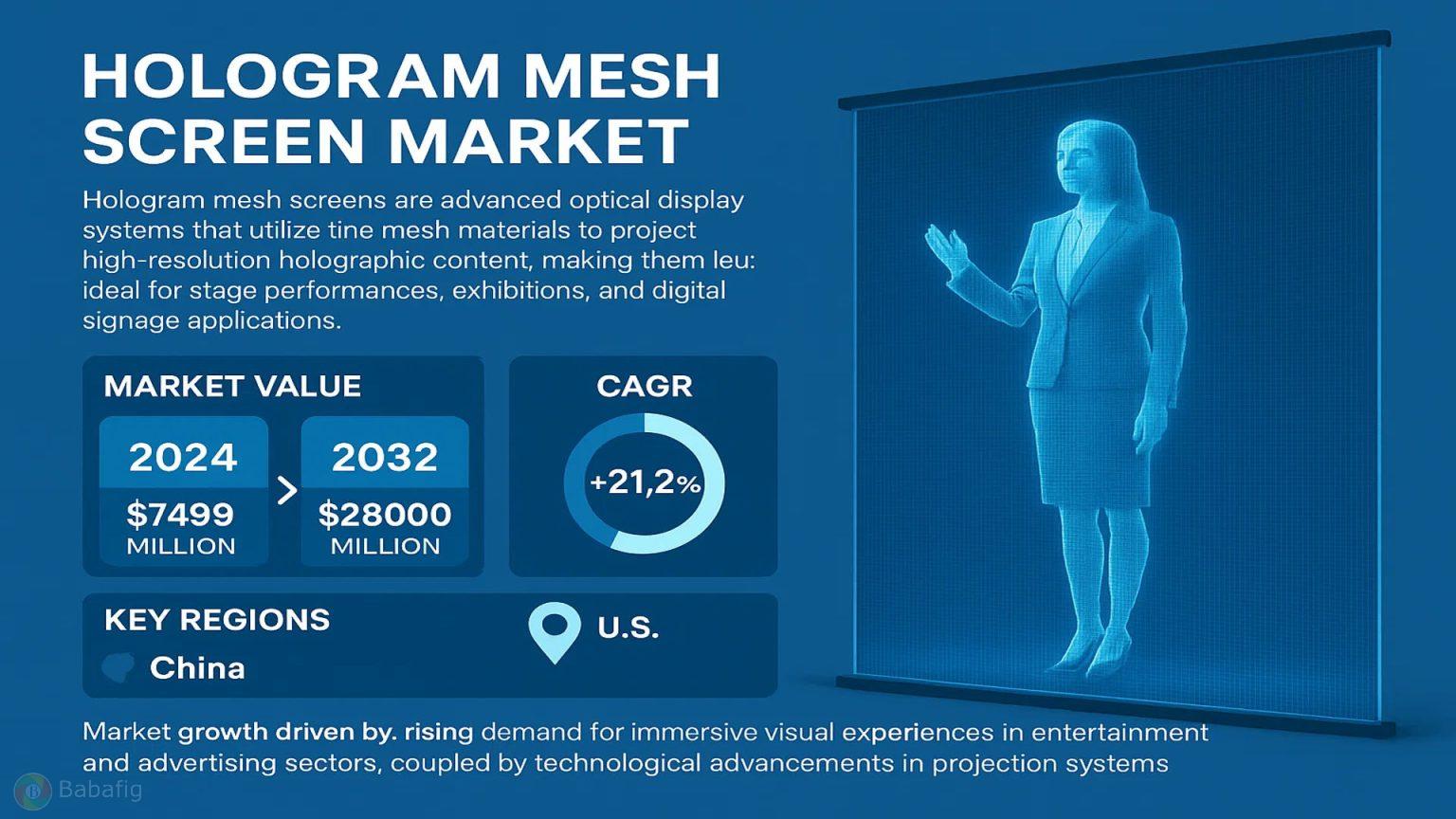
  • Hologram Mesh Screen Market to Surge Through 2034 as Visual Technologies Transform Entertainment

    Global Hologram Mesh Screen Market was valued at USD 7,499 million in 2026 and is projected to reach USD 28,000 million by 2034, expanding at a strong CAGR of 21.2% during the forecast period 2026–2034. Rapid adoption of immersive display formats across stage production, exhibitions, museums, and next-generation digital signage is reshaping how brands and event organizers deliver visual experiences.
    Hologram mesh screens are advanced optical display platforms built using ultra-fine transparent mesh materials that enable projection of high-resolution holographic visuals while maintaining see-through capability. By combining projection mapping with precision mesh substrates, these systems create floating 3D visual effects visible from multiple viewing angles, making them highly effective for live performances and interactive installations.
    Full report details and segment forecasts:
    https://semiconductorinsight.com/report/hologram-mesh-screen-market/
    Hologram Mesh Screen Market to Surge Through 2034 as Visual Technologies Transform Entertainment Global Hologram Mesh Screen Market was valued at USD 7,499 million in 2026 and is projected to reach USD 28,000 million by 2034, expanding at a strong CAGR of 21.2% during the forecast period 2026–2034. Rapid adoption of immersive display formats across stage production, exhibitions, museums, and next-generation digital signage is reshaping how brands and event organizers deliver visual experiences. Hologram mesh screens are advanced optical display platforms built using ultra-fine transparent mesh materials that enable projection of high-resolution holographic visuals while maintaining see-through capability. By combining projection mapping with precision mesh substrates, these systems create floating 3D visual effects visible from multiple viewing angles, making them highly effective for live performances and interactive installations. Full report details and segment forecasts: https://semiconductorinsight.com/report/hologram-mesh-screen-market/
    0 Commentarii 0 Distribuiri 207 Views 0 previzualizare
  • Path of Exile Currency: The Mercenary Scaling System Explained

    Path of exile currency has always been a game defined by complex systems, evolving mechanics, and ever-deepening customization. With Secrets of the Atlas, Grinding Gear Games once again raised the bar by introducing one of the most exciting features in years — Mercenaries. These powerful companions fundamentally change how Exiles approach combat, mapping, and even boss encounters. Whether you’re a veteran min-maxer or a returning player curious about this new addition, this guide will cover everything you need to know about Mercenaries in Secrets of the Atlas — from how to recruit them, to gearing, synergy, and advanced strategies for endgame use.

    Understanding Mercenaries

    Mercenaries are AI-controlled allies that accompany your character through the world of Wraeclast and beyond the Atlas. Think of them as an evolution of the Spectre or Animate Guardian concepts, but far more flexible and interactive. Each Mercenary comes with their own attribute profile, skills, AI behavior, and gear slots, allowing you to customize and develop them like a mini character of their own.

    While minions in Path of Exile are extensions of your skill gems, Mercenaries are independent companions with their own identity. They level alongside you, can equip specific gear types, and their progression often feels like managing a second adventurer. This system bridges the gap between traditional ARPG follower mechanics and Path of Exile’s deep itemization.

    How to Recruit a Mercenary

    Mercenaries are first introduced during the Acts as part of the Secrets of the Atlas questline. The initial encounter acts as a tutorial, teaching players the recruitment and command system. After this, Mercenaries can be found in special encounters across Wraeclast and the Atlas. These encounters often appear as Mercenary Contracts — missions where you duel or assist a wandering warrior. Upon completion, you earn the right to recruit them.

    Recruitment sometimes requires a cost, such as a Mercenary Sigil, a new currency introduced in the league. These Sigils can drop from league events, bosses, and map chests. Once hired, your Mercenary becomes available in your hideout, allowing you to summon or swap them out before entering maps.

    The system encourages experimentation — you’re not locked into one companion forever. You can hire multiple Mercenaries, each with unique skills, and choose which one best fits your current build or challenge.

    Mercenary Archetypes and Attributes

    Every Mercenary is built upon one of three core attribute archetypes — Strength, Dexterity, or Intelligence — with some hybrid variants combining two stats. These attributes determine what items your Mercenary can equip and influence their natural stats like health, damage scaling, and energy shield.

    Strength Mercenaries are typically tanks or melee bruisers. They specialize in physical damage, heavy armour, and life regeneration.

    Dexterity Mercenaries excel at ranged attacks, mobility, and evasion. They’re perfect for kiting enemies and clearing maps efficiently.

    Intelligence Mercenaries are spellcasters and support types. They rely on energy shield, elemental damage, and crowd control.

    Hybrid Mercenaries (such as Str/Dex or Dex/Int) blend roles, allowing for flexible builds. Choosing the right Mercenary depends on your own playstyle — for example, glass-cannon builds benefit from tank mercs, while melee builds may prefer ranged or support types for coverage.

    Gear and Equipment for Mercenaries

    One of the defining features of the Mercenary system is the ability to equip them with real gear. They have their own inventory slots for weapons, armour, and accessories. While some restrictions apply (they can’t use flasks or active skill gems directly), the rest of their gear follows standard PoE rules — stats, affixes, and uniques all apply.

    Several Mercenary-specific uniques were introduced in Secrets of the Atlas. These items grant powerful bonuses exclusive to NPC allies. Examples include helms that grant taunt immunity, chestpieces that share aura effects, or weapons that scale off both your and your Mercenary’s damage.

    Because Mercenaries cannot be manually micromanaged mid-fight, durability is key. Prioritize gear with high life, resistances, and damage reduction. Items that grant minion life or minion damage can sometimes affect Mercenaries, depending on how the modifiers are worded — though unique Mercenary affixes are usually better suited.

    Pro Tip: Crafting gear for Mercenaries is worthwhile. Because they do not require high attribute thresholds like players, you can focus entirely on functional modifiers without worrying about socket color requirements.

    Leveling and Scaling

    Mercenaries gain experience alongside you as you clear areas, but their level caps are tied to your character’s progression. In early Acts, they’ll scale automatically with your zone level. Once you reach mapping, Mercenaries level slower and require Mercenary Contracts or Atlas Memories to keep them up to par.

    Their stats scale with their level, but their effectiveness truly shines through equipment and synergy. Investing in their gear early on pays huge dividends in the endgame. Some passive nodes, Atlas notables, and even new unique jewels offer bonuses to Mercenaries — such as increased life regeneration, faster action speed, or enhanced skill cooldowns.

    Combat Behavior and Commands

    Mercenaries are semi-autonomous. They act according to their AI personality — aggressive, balanced, or cautious — and prioritize different enemies depending on the encounter. However, Secrets of the Atlas introduced a Command Wheel, letting players issue simple orders such as:

    Attack – Directs the Mercenary to focus on a specific target.

    Hold Position – Keeps them in place, ideal for setting up defensive lines.

    Retreat – Useful in boss fights when heavy AoE mechanics appear.

    The command system allows strategic micromanagement without overwhelming complexity. Experienced players can time these orders to maximize survivability and DPS output.

    Synergy With Your Build

    Choosing a Mercenary isn’t just about filling a slot — it’s about complementing your weaknesses. A good Mercenary feels like an extension of your build rather than a passive tagalong.

    For example:

    A glass-cannon spellcaster benefits from a Strength merc that tanks and taunts.

    A melee juggernaut may enjoy a Dexterity merc who deals with ranged threats.

    A summoner can amplify their army’s effectiveness by bringing an Intelligence support merc that grants aura synergy.

    Mercenaries can also trigger certain item effects that benefit you, like aura-sharing equipment or conditional buffs on kill. This opens the door to creative combinations — a Mercenary wielding a debuff weapon can amplify your own damage significantly.

    Mercenaries in Endgame and Boss Fights

    Mercenaries hold up surprisingly well in the endgame, but they’re not immortal. High-tier bosses can still wipe them out quickly if they’re not properly geared. To keep them alive, focus on mitigation rather than pure damage. Items that grant damage reduction, block chance, and life regeneration make a huge difference.

    During Pinnacle Bosses or Uber fights, Mercenaries serve best as utility tools — they distract, apply debuffs, or offer aura support while you handle mechanics. In some cases, you may choose to disable their aggressive behavior and use them purely for passive benefits, like aura sharing or taunt immunity.

    One particularly advanced technique involves “burst summoning.” You summon your Mercenary mid-battle to apply a buff or taunt, then dismiss them before a dangerous phase. This micro-optimization is especially valuable in Hardcore leagues where safety is paramount.

    Common Mistakes to Avoid

    Many new players make similar missteps when experimenting with Mercenaries:

    Overreliance on their damage. Mercenaries enhance your power, but they are not meant to replace it. You still need to pull your weight in every fight.

    Ignoring survivability. Without adequate defenses, Mercenaries melt in high-tier maps. Treat their gear with the same care you give your own.

    Mismatched roles. Pairing a glass-cannon Mercenary with a squishy caster build is a recipe for disaster. Choose synergy over style.

    Neglecting updates. Mercenaries need constant gear and level updates as you progress. A level 60 Merc in a level 90 map will be useless.

    Understanding these pitfalls early ensures that your Mercenary remains a powerful ally throughout your journey.

    Advanced Strategies

    Veteran players have already begun finding ingenious uses for Mercenaries. Some support-oriented builds focus entirely on amplifying the Mercenary’s damage — essentially turning them into the main damage dealer while the player stacks auras and buffs. Others use Mercenaries as “trigger carriers,” equipping them with items that activate effects when they hit or get hit.

    Another creative strategy involves dual-synergy scaling, where both you and your Mercenary benefit from overlapping stats, such as shared auras or curses. When optimized, this can rival some of the strongest solo builds in the current meta.

    Final Thoughts

    The Mercenary system in Path of Exile: Secrets of the Atlas is a masterstroke of design — a perfect blend of depth, experimentation, and accessibility. It empowers players to explore new playstyles, bridge build weaknesses, and inject fresh strategy into an already rich endgame. Mercenaries aren’t just followers; they’re true partners in POE orbs for sale.

    Every player needs a lot of Path of exile currency, I suggest you go to a third-party website like MMOexp.com to buy some currency.
    Path of Exile Currency: The Mercenary Scaling System Explained Path of exile currency has always been a game defined by complex systems, evolving mechanics, and ever-deepening customization. With Secrets of the Atlas, Grinding Gear Games once again raised the bar by introducing one of the most exciting features in years — Mercenaries. These powerful companions fundamentally change how Exiles approach combat, mapping, and even boss encounters. Whether you’re a veteran min-maxer or a returning player curious about this new addition, this guide will cover everything you need to know about Mercenaries in Secrets of the Atlas — from how to recruit them, to gearing, synergy, and advanced strategies for endgame use. Understanding Mercenaries Mercenaries are AI-controlled allies that accompany your character through the world of Wraeclast and beyond the Atlas. Think of them as an evolution of the Spectre or Animate Guardian concepts, but far more flexible and interactive. Each Mercenary comes with their own attribute profile, skills, AI behavior, and gear slots, allowing you to customize and develop them like a mini character of their own. While minions in Path of Exile are extensions of your skill gems, Mercenaries are independent companions with their own identity. They level alongside you, can equip specific gear types, and their progression often feels like managing a second adventurer. This system bridges the gap between traditional ARPG follower mechanics and Path of Exile’s deep itemization. How to Recruit a Mercenary Mercenaries are first introduced during the Acts as part of the Secrets of the Atlas questline. The initial encounter acts as a tutorial, teaching players the recruitment and command system. After this, Mercenaries can be found in special encounters across Wraeclast and the Atlas. These encounters often appear as Mercenary Contracts — missions where you duel or assist a wandering warrior. Upon completion, you earn the right to recruit them. Recruitment sometimes requires a cost, such as a Mercenary Sigil, a new currency introduced in the league. These Sigils can drop from league events, bosses, and map chests. Once hired, your Mercenary becomes available in your hideout, allowing you to summon or swap them out before entering maps. The system encourages experimentation — you’re not locked into one companion forever. You can hire multiple Mercenaries, each with unique skills, and choose which one best fits your current build or challenge. Mercenary Archetypes and Attributes Every Mercenary is built upon one of three core attribute archetypes — Strength, Dexterity, or Intelligence — with some hybrid variants combining two stats. These attributes determine what items your Mercenary can equip and influence their natural stats like health, damage scaling, and energy shield. Strength Mercenaries are typically tanks or melee bruisers. They specialize in physical damage, heavy armour, and life regeneration. Dexterity Mercenaries excel at ranged attacks, mobility, and evasion. They’re perfect for kiting enemies and clearing maps efficiently. Intelligence Mercenaries are spellcasters and support types. They rely on energy shield, elemental damage, and crowd control. Hybrid Mercenaries (such as Str/Dex or Dex/Int) blend roles, allowing for flexible builds. Choosing the right Mercenary depends on your own playstyle — for example, glass-cannon builds benefit from tank mercs, while melee builds may prefer ranged or support types for coverage. Gear and Equipment for Mercenaries One of the defining features of the Mercenary system is the ability to equip them with real gear. They have their own inventory slots for weapons, armour, and accessories. While some restrictions apply (they can’t use flasks or active skill gems directly), the rest of their gear follows standard PoE rules — stats, affixes, and uniques all apply. Several Mercenary-specific uniques were introduced in Secrets of the Atlas. These items grant powerful bonuses exclusive to NPC allies. Examples include helms that grant taunt immunity, chestpieces that share aura effects, or weapons that scale off both your and your Mercenary’s damage. Because Mercenaries cannot be manually micromanaged mid-fight, durability is key. Prioritize gear with high life, resistances, and damage reduction. Items that grant minion life or minion damage can sometimes affect Mercenaries, depending on how the modifiers are worded — though unique Mercenary affixes are usually better suited. Pro Tip: Crafting gear for Mercenaries is worthwhile. Because they do not require high attribute thresholds like players, you can focus entirely on functional modifiers without worrying about socket color requirements. Leveling and Scaling Mercenaries gain experience alongside you as you clear areas, but their level caps are tied to your character’s progression. In early Acts, they’ll scale automatically with your zone level. Once you reach mapping, Mercenaries level slower and require Mercenary Contracts or Atlas Memories to keep them up to par. Their stats scale with their level, but their effectiveness truly shines through equipment and synergy. Investing in their gear early on pays huge dividends in the endgame. Some passive nodes, Atlas notables, and even new unique jewels offer bonuses to Mercenaries — such as increased life regeneration, faster action speed, or enhanced skill cooldowns. Combat Behavior and Commands Mercenaries are semi-autonomous. They act according to their AI personality — aggressive, balanced, or cautious — and prioritize different enemies depending on the encounter. However, Secrets of the Atlas introduced a Command Wheel, letting players issue simple orders such as: Attack – Directs the Mercenary to focus on a specific target. Hold Position – Keeps them in place, ideal for setting up defensive lines. Retreat – Useful in boss fights when heavy AoE mechanics appear. The command system allows strategic micromanagement without overwhelming complexity. Experienced players can time these orders to maximize survivability and DPS output. Synergy With Your Build Choosing a Mercenary isn’t just about filling a slot — it’s about complementing your weaknesses. A good Mercenary feels like an extension of your build rather than a passive tagalong. For example: A glass-cannon spellcaster benefits from a Strength merc that tanks and taunts. A melee juggernaut may enjoy a Dexterity merc who deals with ranged threats. A summoner can amplify their army’s effectiveness by bringing an Intelligence support merc that grants aura synergy. Mercenaries can also trigger certain item effects that benefit you, like aura-sharing equipment or conditional buffs on kill. This opens the door to creative combinations — a Mercenary wielding a debuff weapon can amplify your own damage significantly. Mercenaries in Endgame and Boss Fights Mercenaries hold up surprisingly well in the endgame, but they’re not immortal. High-tier bosses can still wipe them out quickly if they’re not properly geared. To keep them alive, focus on mitigation rather than pure damage. Items that grant damage reduction, block chance, and life regeneration make a huge difference. During Pinnacle Bosses or Uber fights, Mercenaries serve best as utility tools — they distract, apply debuffs, or offer aura support while you handle mechanics. In some cases, you may choose to disable their aggressive behavior and use them purely for passive benefits, like aura sharing or taunt immunity. One particularly advanced technique involves “burst summoning.” You summon your Mercenary mid-battle to apply a buff or taunt, then dismiss them before a dangerous phase. This micro-optimization is especially valuable in Hardcore leagues where safety is paramount. Common Mistakes to Avoid Many new players make similar missteps when experimenting with Mercenaries: Overreliance on their damage. Mercenaries enhance your power, but they are not meant to replace it. You still need to pull your weight in every fight. Ignoring survivability. Without adequate defenses, Mercenaries melt in high-tier maps. Treat their gear with the same care you give your own. Mismatched roles. Pairing a glass-cannon Mercenary with a squishy caster build is a recipe for disaster. Choose synergy over style. Neglecting updates. Mercenaries need constant gear and level updates as you progress. A level 60 Merc in a level 90 map will be useless. Understanding these pitfalls early ensures that your Mercenary remains a powerful ally throughout your journey. Advanced Strategies Veteran players have already begun finding ingenious uses for Mercenaries. Some support-oriented builds focus entirely on amplifying the Mercenary’s damage — essentially turning them into the main damage dealer while the player stacks auras and buffs. Others use Mercenaries as “trigger carriers,” equipping them with items that activate effects when they hit or get hit. Another creative strategy involves dual-synergy scaling, where both you and your Mercenary benefit from overlapping stats, such as shared auras or curses. When optimized, this can rival some of the strongest solo builds in the current meta. Final Thoughts The Mercenary system in Path of Exile: Secrets of the Atlas is a masterstroke of design — a perfect blend of depth, experimentation, and accessibility. It empowers players to explore new playstyles, bridge build weaknesses, and inject fresh strategy into an already rich endgame. Mercenaries aren’t just followers; they’re true partners in POE orbs for sale. Every player needs a lot of Path of exile currency, I suggest you go to a third-party website like MMOexp.com to buy some currency.
    0 Commentarii 0 Distribuiri 3K Views 0 previzualizare
  • Global Sonobuoy Launcher Market Trends, Size & Forecast

    India, Pune -The Insight Partners is proud to announce its newest market report, "Sonobuoy Launcher Market: An In-depth Analysis of the Sonobuoy Launcher Market". The report provides a holistic view of the Sonobuoy Launcher Market and describes the current scenario as well as growth estimates of during the forecast period.

    The Sonobuoy Launcher Market is experiencing a dynamic evolution as defense modernization, maritime security challenges, and technological innovation fuel demand across regions. Sonobuoy launchers critical systems for deploying underwater acoustic sensors that enable anti‑submarine warfare and ocean monitoring remain essential to naval strategies worldwide.

    Market Overview

    The sonobuoy launcher market is driven by a global emphasis on ensuring undersea domain awareness and strengthening naval forces. As underwater threats evolve, so does the demand for sophisticated detection and deployment systems. Sonobuoy launchers play a central role in enabling forces to project situational awareness at extended ranges, helping crews make informed decisions in complex maritime environments.

    Key Market Highlights

    Market Size, Share & Forecast (by 2031)

    Projected Market Growth: The sonobuoy launcher market size is projected to reach US$ 374.07 million by 2031 from US$ 253.93 million in 2023. The market is expected to register a CAGR of 5.0% during 2023–2031. Integration of sonobuoy launchers with combat management system is likely to remain a key trend in the market.
    Regional Share Leaders:
    North America: Maintains a strong leadership position, underpinned by established defense procurement frameworks and innovation in undersea systems.
    Europe: Secures significant market engagement through collaborative naval modernization efforts among EU member states and allied portfolios.
    Asia Pacific: Witnesses rapid adoption due to enhanced maritime strategies and expanding naval fleets.
    Market Trends:
    Integration with combat management and autonomous platforms.
    Prioritization of reliability and deployment precision.
    Diversification of launch platforms including aircraft and ship‑based systems.

    Sonobuoy Launcher Market Segmentation

    By Type

    1. Multiple Rotary Launch System (MRLS)

    The Multiple Rotary Launch System represents a high-capacity, versatile launcher designed for modern naval and maritime patrol missions. This system allows operators to deploy multiple sonobuoys rapidly, significantly increasing the area covered and improving underwater situational awareness. The rotary design enables sequential or simultaneous launches from a single platform, supporting long-duration operations and complex anti-submarine warfare (ASW) scenarios.

    2. Single Launch System (SLS)

    The Single Launch System is optimized for smaller missions or platforms with limited deck or aircraft space. This system is widely used for tactical deployments where precise placement and controlled launch sequences are required. Its simple and reliable design makes it ideal for smaller patrol aircraft or ships with minimal launcher infrastructure.

    By Ejection Platform

    1. Aircraft

    Aircraft-based sonobuoy launchers are critical for maritime patrol, anti-submarine warfare, and rapid reconnaissance missions. Deploying sonobuoys from aircraft provides the advantage of wide-area coverage in minimal time, making it suitable for monitoring extensive oceanic regions or tracking fast-moving underwater targets. These systems are integrated with onboard avionics and mission management software to provide real-time acoustic data processing.

    2. Ships

    Ship-based sonobuoy launchers offer a persistent, platform-stable solution for long-duration maritime operations. These launchers are mounted on frigates, destroyers, and specialized ASW vessels to maintain continuous underwater surveillance while supporting fleet defense operations. Ship-deployed systems are often paired with advanced sonar networks for enhanced target detection and tracking.

    Get Sample Report: https://www.theinsightpartners.com/sample/TIPRE00010252

    Global and Regional Analysis

    North America — Strategic Innovation and Defense Readiness

    North America continues to dominate the global sonobuoy launcher market with robust defense budgets and proactive maritime strategies. This region’s leadership is anchored in ongoing naval modernization programs, advanced sonar integration, and a strong industrial base supported by key technology providers. Government support and cross‑agency investments enhance deployment capabilities and sustain market momentum.

    Regional Focus:

    Strong emphasis on integrating launchers with aircraft and maritime patrol platforms.
    Expansion of anti‑submarine warfare training exercises and fleet upgrades.
    Collaborative research and development with defense partners.

    Europe — Collaborative Defense Transformation

    Europe’s regional market is expanding as defense alliances and coalition programs prioritize maritime security capabilities. Countries are investing in upgraded sonobuoy launcher systems that support multinational operations and align with NATO strategies.

    Regional Focus:

    Shared procurement and interoperability efforts.
    Focus on upgrading naval patrol aircraft and surface vessel deployment systems.
    Harmonization of technological standards across member states.

    Asia Pacific — Fastest Emerging Market

    The Asia Pacific region is experiencing reshaped market dynamics. Rising regional tensions and strategic maritime concerns have prompted increased investment in sonobuoy launcher capabilities. Emerging economies are prioritizing enhanced undersea surveillance and coastal defense mechanisms, resulting in wider adoption of launcher systems across naval fleets.

    Regional Focus:

    Expanding submarine fleets are catalyzing demand for advanced launchers.
    Domestic production initiatives and technology co‑development partnerships.
    Integration of systems with regional command and control architectures.

    Trends and Market Drivers

    The sonobuoy launcher market’s growth is guided by several compelling trends:

    Technological Integration: Manufacturers are embedding automated and digital control interfaces, enabling smoother operation and quicker deployment cycles.
    Autonomous Synergies: Launchers are increasingly paired with unmanned aerial and surface platforms, extending operational reach and reducing risk to personnel.
    Defense Modernization: Global navies are refreshing legacy systems and investing in next‑generation ASW capabilities aligned with contemporary defense strategies.
    Research Applications: Beyond defense, scientific institutions are leveraging sonobuoy launchers for ocean mapping, climate research, and undersea environmental studies.

    Key Players & Recent Developments in the Sonobuoy Launcher Market

    1. Alkan S.A.

    Profile & Role
    Alkan S.A. is recognized in defense supply chains for manufacturing a range of aerospace and naval equipment, including sonobuoy launcher systems and associated hardware such as pylons, ejector release units, and store management systems for aircraft. 

    Market Positioning

    Listed among the core global firms active in the sonobuoy launcher segment. 
    While specific recent news releases on Alkan’s sonobuoy launcher products are limited in the public domain, the company plays a foundational role as an equipment supplier especially for launch integration kits and tactical deployment assemblies. 

    2. GeoSpectrum Technologies Inc.

    Profile & Focus
    GeoSpectrum Technologies Inc. is a specialist in acoustic sensor systems, sonar processing, and underwater detection solutions that are part of broader maritime security implementations. 

    Recent Developments & Capabilities

    GeoSpectrum continues to advance sonar technology platforms that can complement sonobuoy deployment such as its M670 hull‑mounted sonar systems and the tactical RecView processing suite. 
    These technologies integrate acoustic data processing and tactical management, helping naval forces manage and interpret returns from sensors including sonobuoy networks. 

    3. L3Harris Technologies Inc.

    Profile & Leadership
    L3Harris Technologies Inc. is one of the most prominent global suppliers of sonobuoy launchers, offering a range of systems from single‑launch units to rotary multi‑launch systems tailored for maritime patrol aircraft and naval platforms. 

    Recent Market and Product Developments

    Product Portfolio Expansion: L3Harris continues to develop next‑generation sonobuoy launching systems including modular launch tubes (MLT) and extended rotary launch configurations to support a broader range of mission profiles, from fixed‑wing patrol aircraft to helicopter and UAV platforms. 
    Strategic Capacity Growth: The company has been expanding its facilities and capabilities across aerospace and defense domains, including enhanced manufacturing footprints that also support undersea systems. 
    Diversification: L3Harris is strengthening its defense systems portfolio beyond sonobuoy launchers, aligning with wider anti‑submarine warfare and undersea sensor networks reflecting broader investment and integration trends in multi‑domain operations.

    Future Outlook by 2031

    Technological Advancement: Enhanced automation and platform compatibility expected to streamline deployment and data acquisition.
    Regional Growth Patterns: Asia Pacific set to achieve accelerated adoption rates, supported by expanded defense cooperation and fleet expansions.
    Integration with Autonomous Systems: Increased launch from unmanned aerial and maritime vehicles to broaden operational flexibility.
    Strategic Alliances: Cross‑border defense partnerships projected to scale joint procurement, training, and interoperability standards.
    Sustainability Focus: Innovations expected to address environmental concerns related to sonar waveform emissions.

    About The Insight Partners

    The Insight Partners provides comprehensive syndicated and tailored market research services in the healthcare, technology, and industrial domains. Renowned for delivering strategic intelligence and practical insights, the firm empowers businesses to remain competitive in ever-evolving global markets.

    Contact Information

    •              Email: sales@theinsightpartners.com

    •              Website: theinsightpartners.com

    •              Phone: +1-646-491-9876
    Global Sonobuoy Launcher Market Trends, Size & Forecast India, Pune -The Insight Partners is proud to announce its newest market report, "Sonobuoy Launcher Market: An In-depth Analysis of the Sonobuoy Launcher Market". The report provides a holistic view of the Sonobuoy Launcher Market and describes the current scenario as well as growth estimates of during the forecast period. The Sonobuoy Launcher Market is experiencing a dynamic evolution as defense modernization, maritime security challenges, and technological innovation fuel demand across regions. Sonobuoy launchers critical systems for deploying underwater acoustic sensors that enable anti‑submarine warfare and ocean monitoring remain essential to naval strategies worldwide. Market Overview The sonobuoy launcher market is driven by a global emphasis on ensuring undersea domain awareness and strengthening naval forces. As underwater threats evolve, so does the demand for sophisticated detection and deployment systems. Sonobuoy launchers play a central role in enabling forces to project situational awareness at extended ranges, helping crews make informed decisions in complex maritime environments. Key Market Highlights Market Size, Share & Forecast (by 2031) Projected Market Growth: The sonobuoy launcher market size is projected to reach US$ 374.07 million by 2031 from US$ 253.93 million in 2023. The market is expected to register a CAGR of 5.0% during 2023–2031. Integration of sonobuoy launchers with combat management system is likely to remain a key trend in the market. Regional Share Leaders: North America: Maintains a strong leadership position, underpinned by established defense procurement frameworks and innovation in undersea systems. Europe: Secures significant market engagement through collaborative naval modernization efforts among EU member states and allied portfolios. Asia Pacific: Witnesses rapid adoption due to enhanced maritime strategies and expanding naval fleets. Market Trends: Integration with combat management and autonomous platforms. Prioritization of reliability and deployment precision. Diversification of launch platforms including aircraft and ship‑based systems. Sonobuoy Launcher Market Segmentation By Type 1. Multiple Rotary Launch System (MRLS) The Multiple Rotary Launch System represents a high-capacity, versatile launcher designed for modern naval and maritime patrol missions. This system allows operators to deploy multiple sonobuoys rapidly, significantly increasing the area covered and improving underwater situational awareness. The rotary design enables sequential or simultaneous launches from a single platform, supporting long-duration operations and complex anti-submarine warfare (ASW) scenarios. 2. Single Launch System (SLS) The Single Launch System is optimized for smaller missions or platforms with limited deck or aircraft space. This system is widely used for tactical deployments where precise placement and controlled launch sequences are required. Its simple and reliable design makes it ideal for smaller patrol aircraft or ships with minimal launcher infrastructure. By Ejection Platform 1. Aircraft Aircraft-based sonobuoy launchers are critical for maritime patrol, anti-submarine warfare, and rapid reconnaissance missions. Deploying sonobuoys from aircraft provides the advantage of wide-area coverage in minimal time, making it suitable for monitoring extensive oceanic regions or tracking fast-moving underwater targets. These systems are integrated with onboard avionics and mission management software to provide real-time acoustic data processing. 2. Ships Ship-based sonobuoy launchers offer a persistent, platform-stable solution for long-duration maritime operations. These launchers are mounted on frigates, destroyers, and specialized ASW vessels to maintain continuous underwater surveillance while supporting fleet defense operations. Ship-deployed systems are often paired with advanced sonar networks for enhanced target detection and tracking. Get Sample Report: https://www.theinsightpartners.com/sample/TIPRE00010252 Global and Regional Analysis North America — Strategic Innovation and Defense Readiness North America continues to dominate the global sonobuoy launcher market with robust defense budgets and proactive maritime strategies. This region’s leadership is anchored in ongoing naval modernization programs, advanced sonar integration, and a strong industrial base supported by key technology providers. Government support and cross‑agency investments enhance deployment capabilities and sustain market momentum. Regional Focus: Strong emphasis on integrating launchers with aircraft and maritime patrol platforms. Expansion of anti‑submarine warfare training exercises and fleet upgrades. Collaborative research and development with defense partners. Europe — Collaborative Defense Transformation Europe’s regional market is expanding as defense alliances and coalition programs prioritize maritime security capabilities. Countries are investing in upgraded sonobuoy launcher systems that support multinational operations and align with NATO strategies. Regional Focus: Shared procurement and interoperability efforts. Focus on upgrading naval patrol aircraft and surface vessel deployment systems. Harmonization of technological standards across member states. Asia Pacific — Fastest Emerging Market The Asia Pacific region is experiencing reshaped market dynamics. Rising regional tensions and strategic maritime concerns have prompted increased investment in sonobuoy launcher capabilities. Emerging economies are prioritizing enhanced undersea surveillance and coastal defense mechanisms, resulting in wider adoption of launcher systems across naval fleets. Regional Focus: Expanding submarine fleets are catalyzing demand for advanced launchers. Domestic production initiatives and technology co‑development partnerships. Integration of systems with regional command and control architectures. Trends and Market Drivers The sonobuoy launcher market’s growth is guided by several compelling trends: Technological Integration: Manufacturers are embedding automated and digital control interfaces, enabling smoother operation and quicker deployment cycles. Autonomous Synergies: Launchers are increasingly paired with unmanned aerial and surface platforms, extending operational reach and reducing risk to personnel. Defense Modernization: Global navies are refreshing legacy systems and investing in next‑generation ASW capabilities aligned with contemporary defense strategies. Research Applications: Beyond defense, scientific institutions are leveraging sonobuoy launchers for ocean mapping, climate research, and undersea environmental studies. Key Players & Recent Developments in the Sonobuoy Launcher Market 1. Alkan S.A. Profile & Role Alkan S.A. is recognized in defense supply chains for manufacturing a range of aerospace and naval equipment, including sonobuoy launcher systems and associated hardware such as pylons, ejector release units, and store management systems for aircraft.  Market Positioning Listed among the core global firms active in the sonobuoy launcher segment.  While specific recent news releases on Alkan’s sonobuoy launcher products are limited in the public domain, the company plays a foundational role as an equipment supplier especially for launch integration kits and tactical deployment assemblies.  2. GeoSpectrum Technologies Inc. Profile & Focus GeoSpectrum Technologies Inc. is a specialist in acoustic sensor systems, sonar processing, and underwater detection solutions that are part of broader maritime security implementations.  Recent Developments & Capabilities GeoSpectrum continues to advance sonar technology platforms that can complement sonobuoy deployment such as its M670 hull‑mounted sonar systems and the tactical RecView processing suite.  These technologies integrate acoustic data processing and tactical management, helping naval forces manage and interpret returns from sensors including sonobuoy networks.  3. L3Harris Technologies Inc. Profile & Leadership L3Harris Technologies Inc. is one of the most prominent global suppliers of sonobuoy launchers, offering a range of systems from single‑launch units to rotary multi‑launch systems tailored for maritime patrol aircraft and naval platforms.  Recent Market and Product Developments Product Portfolio Expansion: L3Harris continues to develop next‑generation sonobuoy launching systems including modular launch tubes (MLT) and extended rotary launch configurations to support a broader range of mission profiles, from fixed‑wing patrol aircraft to helicopter and UAV platforms.  Strategic Capacity Growth: The company has been expanding its facilities and capabilities across aerospace and defense domains, including enhanced manufacturing footprints that also support undersea systems.  Diversification: L3Harris is strengthening its defense systems portfolio beyond sonobuoy launchers, aligning with wider anti‑submarine warfare and undersea sensor networks reflecting broader investment and integration trends in multi‑domain operations. Future Outlook by 2031 Technological Advancement: Enhanced automation and platform compatibility expected to streamline deployment and data acquisition. Regional Growth Patterns: Asia Pacific set to achieve accelerated adoption rates, supported by expanded defense cooperation and fleet expansions. Integration with Autonomous Systems: Increased launch from unmanned aerial and maritime vehicles to broaden operational flexibility. Strategic Alliances: Cross‑border defense partnerships projected to scale joint procurement, training, and interoperability standards. Sustainability Focus: Innovations expected to address environmental concerns related to sonar waveform emissions. About The Insight Partners The Insight Partners provides comprehensive syndicated and tailored market research services in the healthcare, technology, and industrial domains. Renowned for delivering strategic intelligence and practical insights, the firm empowers businesses to remain competitive in ever-evolving global markets. Contact Information •              Email: sales@theinsightpartners.com •              Website: theinsightpartners.com •              Phone: +1-646-491-9876
    Sonobuoy Launcher Market Strategic Insights by 2031 : The Insight Partners
    Sonobuoy Launcher Market growth trajectory is set to achieve US$ 253.93 Million by 2031, expects a strong CAGR during the forecast period.
    0 Commentarii 1 Distribuiri 8K Views 0 previzualizare
  • How Will the Cycle Computer Market Achieve a 7.6% CAGR by 2032?
    Cycle Computer Market was valued at USD 278 million in 2024 and is projected to grow from USD 299 million in 2025 to USD 458 million by 2032, exhibiting a CAGR of 7.6% during the forecast period. This substantial growth trajectory is detailed in a new comprehensive report published today. The study underscores the pivotal role these advanced electronic devices play in modernizing the cycling experience, transitioning from basic speedometers to sophisticated, data-rich training and navigation systems.
    Modern cycle computers, which track metrics such as speed, distance, cadence, and heart rate, combined with advanced features like GPS navigation and connectivity with other devices, are becoming indispensable for cyclists of all levels. The global push for healthier lifestyles, coupled with the rising integration of smart technology in sports equipment, propels the market forward. Concurrently, the evolution of cycling from a basic mode of transport to a prominent fitness and recreational activity fuels demand for more advanced data-tracking solutions.
    Rising Health Consciousness and Smart Fitness Integration: The Primary Growth Engine
    The report identifies the global surge in health and fitness consciousness as the principal driver for the cycle computer market's expansion. This trend is amplified by the deep integration of technology into personal fitness regimes. The proliferation of smart devices and the Internet of Things (IoT) has created a connected ecosystem where cyclists can seamlessly sync their riding data with popular fitness apps and platforms. This allows for comprehensive performance analysis, social sharing, and structured training plans, making data an integral part of the modern cycling experience.
    Furthermore, the post-pandemic era has solidified a cultural shift towards outdoor and individual recreational sports, with cycling emerging as a frontrunner. "The convergence of fitness tracking and navigation technology has fundamentally reshaped consumer expectations," the report states. "Cyclists are no longer satisfied with just speed and distance; they demand detailed analytics on power output, elevation gain, route mapping, and physiological metrics, which modern cycle computers are uniquely positioned to provide." This demand is further accelerated by the growth of e-bikes, which often come equipped with or are compatible with advanced computer systems to monitor battery life and assist levels.
    Competitive Landscape: Key Players and Strategic Focus
    The report profiles key industry players, including:
    • Garmin (Switzerland)
    • CatEye (Japan)
    • Sigma Sport (Germany)
    • Pioneer Electronics (Japan)
    • Polar (Finland)
    • Bryton Inc. (Taiwan)
    • Giant Bicycles (Taiwan)
    • Raleigh (Accell Group) (Netherlands)
    • Trek Bicycle (U.S.)
    • Wahoo Fitness (U.S.)
    • Topeak Inc. (Taiwan)
    • VDO Cyclecomputers (Germany)
    • o-synce (Germany)
    • BBB Cycling (Netherlands)
    • Bion (Italy)
    • KNOG (Australia)
    These companies are aggressively focusing on technological innovation, particularly in integrating GPS, advanced sensor ecosystems (ANT+ and Bluetooth Smart), and developing seamless connectivity with smartphone applications. Strategic partnerships with cycling teams and event organizers are also common, enhancing brand visibility and product credibility among serious cyclists.
    Emerging Opportunities in Smart Ecosystems and Data Analytics
    Beyond the core growth drivers, the report highlights significant emerging opportunities. The shift towards comprehensive smart fitness ecosystems presents a major avenue for expansion. Advanced computers now act as a central hub, connecting power meters, heart rate monitors, and electronic shifting systems to provide a holistic view of a rider's performance. This integration, powered by sophisticated data analytics, enables personalized training insights, fatigue monitoring, and recovery suggestions.
    Furthermore, the market is seeing a trend towards the creation of subscription-based services. These services offer premium features such as advanced navigation with live traffic and off-course alerts, personalized daily workout suggestions, and detailed performance benchmarking against a global community of riders. This not only creates a recurring revenue stream for manufacturers but also significantly enhances the value proposition of high-end devices, encouraging upgrades and brand loyalty. The rise of virtual cycling platforms, which connect physical bikes to immersive digital worlds, also drives demand for compatible computers that can transmit data in real-time.
    Download FREE Sample Report:
    Cycle Computer Market - View in Detailed Research Report
    Market Segmentation: Wireless Computers and Mountain Bike Applications Dominate
    The report provides a detailed segmentation analysis, offering a clear view of the market structure and key growth segments.
    Segment Analysis:
    By Type
    • Wired Computer
    • Wireless Computer
    • Wireless and GPS Computer
    By Application
    • Mountain Bike
    • Road Bike
    • Others
    By End User
    • Recreational Cyclists
    • Professional Athletes
    • Commuters
    By Distribution Channel
    • Specialty Bicycle Retailers
    • Online E-commerce Platforms
    • Sporting Goods Stores

    Report Scope and Availability
    The market research report offers a comprehensive analysis of the global and regional Cycle Computer markets from 2025–2032. It provides detailed segmentation, market size forecasts, competitive intelligence, technology trends, and an evaluation of key market dynamics.
    For a detailed analysis of market drivers, restraints, opportunities, and the competitive strategies of key players, access the complete report.
    Read Full Report: https://semiconductorinsight.com/report/cycle-computer-market/
    Get Full Report Here:
    Cycle Computer Market, Global Business Strategies 2025-2032 - View in Detailed Research Report
    About Semiconductor Insight
    Semiconductor Insight is a leading provider of market intelligence and strategic consulting for the global semiconductor and high-technology industries. Our in-depth reports and analysis offer actionable insights to help businesses navigate complex market dynamics, identify growth opportunities, and make informed decisions. We are committed to delivering high-quality, data-driven research to our clients worldwide.
    Website: https://semiconductorinsight.com/
    International: +91 8087 99 2013
    LinkedIn: Follow Us

    #CycleComputerMarket
    #CycleComputerGrowth
    #CycleComputerIndustry
    #CycleComputerTrends
    #CycleComputerForecast
    #CycleComputerTechnology
    #CycleComputerInsights
    #CycleComputerMarketAnalysis
    How Will the Cycle Computer Market Achieve a 7.6% CAGR by 2032? Cycle Computer Market was valued at USD 278 million in 2024 and is projected to grow from USD 299 million in 2025 to USD 458 million by 2032, exhibiting a CAGR of 7.6% during the forecast period. This substantial growth trajectory is detailed in a new comprehensive report published today. The study underscores the pivotal role these advanced electronic devices play in modernizing the cycling experience, transitioning from basic speedometers to sophisticated, data-rich training and navigation systems. Modern cycle computers, which track metrics such as speed, distance, cadence, and heart rate, combined with advanced features like GPS navigation and connectivity with other devices, are becoming indispensable for cyclists of all levels. The global push for healthier lifestyles, coupled with the rising integration of smart technology in sports equipment, propels the market forward. Concurrently, the evolution of cycling from a basic mode of transport to a prominent fitness and recreational activity fuels demand for more advanced data-tracking solutions. Rising Health Consciousness and Smart Fitness Integration: The Primary Growth Engine The report identifies the global surge in health and fitness consciousness as the principal driver for the cycle computer market's expansion. This trend is amplified by the deep integration of technology into personal fitness regimes. The proliferation of smart devices and the Internet of Things (IoT) has created a connected ecosystem where cyclists can seamlessly sync their riding data with popular fitness apps and platforms. This allows for comprehensive performance analysis, social sharing, and structured training plans, making data an integral part of the modern cycling experience. Furthermore, the post-pandemic era has solidified a cultural shift towards outdoor and individual recreational sports, with cycling emerging as a frontrunner. "The convergence of fitness tracking and navigation technology has fundamentally reshaped consumer expectations," the report states. "Cyclists are no longer satisfied with just speed and distance; they demand detailed analytics on power output, elevation gain, route mapping, and physiological metrics, which modern cycle computers are uniquely positioned to provide." This demand is further accelerated by the growth of e-bikes, which often come equipped with or are compatible with advanced computer systems to monitor battery life and assist levels. Competitive Landscape: Key Players and Strategic Focus The report profiles key industry players, including: • Garmin (Switzerland) • CatEye (Japan) • Sigma Sport (Germany) • Pioneer Electronics (Japan) • Polar (Finland) • Bryton Inc. (Taiwan) • Giant Bicycles (Taiwan) • Raleigh (Accell Group) (Netherlands) • Trek Bicycle (U.S.) • Wahoo Fitness (U.S.) • Topeak Inc. (Taiwan) • VDO Cyclecomputers (Germany) • o-synce (Germany) • BBB Cycling (Netherlands) • Bion (Italy) • KNOG (Australia) These companies are aggressively focusing on technological innovation, particularly in integrating GPS, advanced sensor ecosystems (ANT+ and Bluetooth Smart), and developing seamless connectivity with smartphone applications. Strategic partnerships with cycling teams and event organizers are also common, enhancing brand visibility and product credibility among serious cyclists. Emerging Opportunities in Smart Ecosystems and Data Analytics Beyond the core growth drivers, the report highlights significant emerging opportunities. The shift towards comprehensive smart fitness ecosystems presents a major avenue for expansion. Advanced computers now act as a central hub, connecting power meters, heart rate monitors, and electronic shifting systems to provide a holistic view of a rider's performance. This integration, powered by sophisticated data analytics, enables personalized training insights, fatigue monitoring, and recovery suggestions. Furthermore, the market is seeing a trend towards the creation of subscription-based services. These services offer premium features such as advanced navigation with live traffic and off-course alerts, personalized daily workout suggestions, and detailed performance benchmarking against a global community of riders. This not only creates a recurring revenue stream for manufacturers but also significantly enhances the value proposition of high-end devices, encouraging upgrades and brand loyalty. The rise of virtual cycling platforms, which connect physical bikes to immersive digital worlds, also drives demand for compatible computers that can transmit data in real-time. Download FREE Sample Report: Cycle Computer Market - View in Detailed Research Report Market Segmentation: Wireless Computers and Mountain Bike Applications Dominate The report provides a detailed segmentation analysis, offering a clear view of the market structure and key growth segments. Segment Analysis: By Type • Wired Computer • Wireless Computer • Wireless and GPS Computer By Application • Mountain Bike • Road Bike • Others By End User • Recreational Cyclists • Professional Athletes • Commuters By Distribution Channel • Specialty Bicycle Retailers • Online E-commerce Platforms • Sporting Goods Stores Report Scope and Availability The market research report offers a comprehensive analysis of the global and regional Cycle Computer markets from 2025–2032. It provides detailed segmentation, market size forecasts, competitive intelligence, technology trends, and an evaluation of key market dynamics. For a detailed analysis of market drivers, restraints, opportunities, and the competitive strategies of key players, access the complete report. Read Full Report: https://semiconductorinsight.com/report/cycle-computer-market/ Get Full Report Here: Cycle Computer Market, Global Business Strategies 2025-2032 - View in Detailed Research Report About Semiconductor Insight Semiconductor Insight is a leading provider of market intelligence and strategic consulting for the global semiconductor and high-technology industries. Our in-depth reports and analysis offer actionable insights to help businesses navigate complex market dynamics, identify growth opportunities, and make informed decisions. We are committed to delivering high-quality, data-driven research to our clients worldwide. 🌐 Website: https://semiconductorinsight.com/ 📞 International: +91 8087 99 2013 🔗 LinkedIn: Follow Us #CycleComputerMarket #CycleComputerGrowth #CycleComputerIndustry #CycleComputerTrends #CycleComputerForecast #CycleComputerTechnology #CycleComputerInsights #CycleComputerMarketAnalysis
    0 Commentarii 0 Distribuiri 7K Views 0 previzualizare
  • RizomUV, UV mapping, 3D modeling, GPU Packing, Rizom-Lab, software update, artist workflow, design efficiency

    ## Introduction

    In the fast-evolving world of 3D modeling and design, staying ahead of the curve is paramount for artists and studios alike. As technology advances, tools must adapt to meet the increasing demands for speed and efficiency. Enter **RizomUV 2025**, the latest version of the highly trusted UV unwrapping solution developed by Rizom-Lab. Officially released on **September 15...
    RizomUV, UV mapping, 3D modeling, GPU Packing, Rizom-Lab, software update, artist workflow, design efficiency ## Introduction In the fast-evolving world of 3D modeling and design, staying ahead of the curve is paramount for artists and studios alike. As technology advances, tools must adapt to meet the increasing demands for speed and efficiency. Enter **RizomUV 2025**, the latest version of the highly trusted UV unwrapping solution developed by Rizom-Lab. Officially released on **September 15...
    RizomUV 2025: A Major Leap Forward in UV Mapping
    RizomUV, UV mapping, 3D modeling, GPU Packing, Rizom-Lab, software update, artist workflow, design efficiency Introduction In the fast-evolving world of 3D modeling and design, staying ahead of the curve is paramount for artists and studios alike. As technology advances, tools must adapt to meet the increasing demands for speed and efficiency. Enter **RizomUV 2025**, the latest version of the...
    0 Commentarii 0 Distribuiri 1K Views 0 previzualizare
Sponsor

Générez jusqu'à 2000 €/mois en créant des vidéos YouTube automatisées grâce à l'IA

Sans montrer votre visage ni créer de site web Découvrez la méthode AffiVideo IA pour transformer des scripts générés par IA en vidéos YouTube...

ADS Jbcois
Babafig https://www.babafig.com