How Is 5G Adoption Boosting Data Center Infrastructure Management Demand?
Data center strategy needs to be planned in such a manner that the systems never malfunction in any circumstance. As a result, data center managers are opting for data center infrastructure management (DCIM) solutions as they offer insights and visibility by monitoring different parameters, such as the performance of data center computers and servers, network operations, and security uptime, and resolving network issues as they arise. Owing to these advantages, DCIM solutions are being increasingly adopted by organizations for improving their decision-making process and by data centers for enhancing their uptime with better energy services.
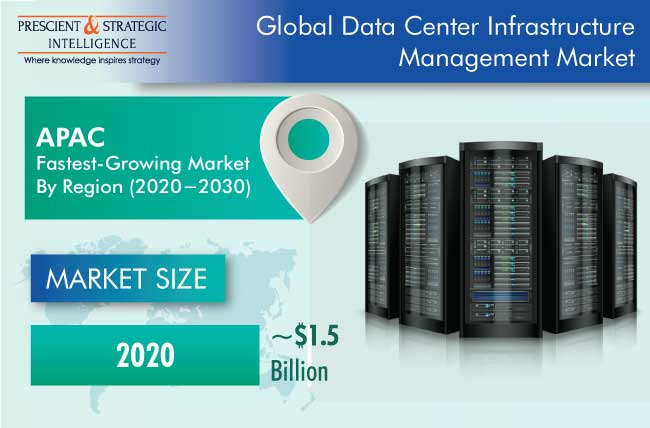
The surging use of such solutions can be credited to the increasing deployment of 5G network, which enables smooth movement of data between locations. This novel communication technology will offer support for extensive machine-to-machine communications, with around 100,000 connections per square kilometer. 5G also plays a significant role in establishing smart cities, which generate a huge volume of data that needs to be managed efficiently. Thus, the rising penetration of the 5G network, will steer the data center infrastructure management market growth during 2021–2030. According to P&S Intelligence, the market reached $1,425.6 million revenue in 2020.
At present, DCIM solutions offered by Panduit Corporation, Infosys Ltd., ABB Ltd., IBM Corporation, Huawei Technologies Co. Ltd., Modius Inc., CommScope Inc., Nlyte Software, Delta Electronics Inc., NTT DATA Corporation, Hewlett-Packard Enterprise, Raritan Inc., and Cisco Systems Inc. are mostly used for asset management application. In recent years, information technology (IT) asset management has become very difficult due to the surging complexities of the systems. Many small organizations use paper and pen and spreadsheet-based solutions to track their IT assets, which cannot deal with the accelerating pace of IT infrastructure development.
Currently, DCIM solution proving companies are mostly focusing on product development and launches to cater to the evolving needs of customers. For instance, in March 2020, ABB Ltd. introduced MegaFlex, a compact and resilient uninterruptible power supply (UPS) system, for continuous data center operations. This system was introduced to meet the burgeoning demand for infrastructure as a service (IaaS) and software as a service (SaaS) applications in business organizations, owing to which, data centers have become extensively crucial.
Such novel products are being utilized by the banking, financial services, and insurance (BFSI), manufacturing, telecommunications, government and public sector, healthcare and life sciences, and IT and information technology-enabled services (ITeS) sectors for managing their data centers. All these sectors prefer on-premises solutions over the cloud-enabled ones, as monitoring data on infrastructure availability, humidity, power consumption, temperature, airflow, and other aspects has become very important, which can be efficiently done through such solutions.
In the coming years, the Asia-Pacific (APAC) data center infrastructure management market will record the fastest sales of DCIM solutions, due to the accelerating adoption rate of advanced digital technologies, such as the internet of things (IoT) and machine learning, in Japan, China, and India. Moreover, the mounting investments being made in infrastructure development in these countries and escalating interest of regional governments on developing data centers will fuel the adoption of DCIM solutions in the region in the foreseeable future.
Thus, the growing penetration of 5G network and soaring need for managing high volumes of data generated by several end-use industries will augment the need for DCIM solutions in the forthcoming years.
Read More:
https://www.psmarketresearch.com/market-analysis/data-center-infrastructure-management-dcim-marketHow Is 5G Adoption Boosting Data Center Infrastructure Management Demand?
Data center strategy needs to be planned in such a manner that the systems never malfunction in any circumstance. As a result, data center managers are opting for data center infrastructure management (DCIM) solutions as they offer insights and visibility by monitoring different parameters, such as the performance of data center computers and servers, network operations, and security uptime, and resolving network issues as they arise. Owing to these advantages, DCIM solutions are being increasingly adopted by organizations for improving their decision-making process and by data centers for enhancing their uptime with better energy services.
The surging use of such solutions can be credited to the increasing deployment of 5G network, which enables smooth movement of data between locations. This novel communication technology will offer support for extensive machine-to-machine communications, with around 100,000 connections per square kilometer. 5G also plays a significant role in establishing smart cities, which generate a huge volume of data that needs to be managed efficiently. Thus, the rising penetration of the 5G network, will steer the data center infrastructure management market growth during 2021–2030. According to P&S Intelligence, the market reached $1,425.6 million revenue in 2020.
At present, DCIM solutions offered by Panduit Corporation, Infosys Ltd., ABB Ltd., IBM Corporation, Huawei Technologies Co. Ltd., Modius Inc., CommScope Inc., Nlyte Software, Delta Electronics Inc., NTT DATA Corporation, Hewlett-Packard Enterprise, Raritan Inc., and Cisco Systems Inc. are mostly used for asset management application. In recent years, information technology (IT) asset management has become very difficult due to the surging complexities of the systems. Many small organizations use paper and pen and spreadsheet-based solutions to track their IT assets, which cannot deal with the accelerating pace of IT infrastructure development.
Currently, DCIM solution proving companies are mostly focusing on product development and launches to cater to the evolving needs of customers. For instance, in March 2020, ABB Ltd. introduced MegaFlex, a compact and resilient uninterruptible power supply (UPS) system, for continuous data center operations. This system was introduced to meet the burgeoning demand for infrastructure as a service (IaaS) and software as a service (SaaS) applications in business organizations, owing to which, data centers have become extensively crucial.
Such novel products are being utilized by the banking, financial services, and insurance (BFSI), manufacturing, telecommunications, government and public sector, healthcare and life sciences, and IT and information technology-enabled services (ITeS) sectors for managing their data centers. All these sectors prefer on-premises solutions over the cloud-enabled ones, as monitoring data on infrastructure availability, humidity, power consumption, temperature, airflow, and other aspects has become very important, which can be efficiently done through such solutions.
In the coming years, the Asia-Pacific (APAC) data center infrastructure management market will record the fastest sales of DCIM solutions, due to the accelerating adoption rate of advanced digital technologies, such as the internet of things (IoT) and machine learning, in Japan, China, and India. Moreover, the mounting investments being made in infrastructure development in these countries and escalating interest of regional governments on developing data centers will fuel the adoption of DCIM solutions in the region in the foreseeable future.
Thus, the growing penetration of 5G network and soaring need for managing high volumes of data generated by several end-use industries will augment the need for DCIM solutions in the forthcoming years.
Read More: https://www.psmarketresearch.com/market-analysis/data-center-infrastructure-management-dcim-market
 English
 Arabic
 Français
 Spanish
 Portuguese
 Deutsch
 Turkish
 Dutch
Dutch
 Italiano
 Russian
 Romaian
 Portuguese (Brazil)
 Greek
Greek
 Réunionnais
 India
India
 Entreprises locales
 Runsound music
 La silver économie
 Affiliation Matrice 3x9
 Récompenses
 Babarun (BBRN)
 Calculez vos calories
 Collab Influenceurs
 Événementiels
 Procaly
 Affiliation
 Prêts Immobiliers