

Search
Discover new people, create new connections and make new friends

-
-
-
-
-
Forecast Polyurethane Market Size, Growth Trends & (2024–2031)
The global polyurethane market reached US$ 82.2 billion in 2023 and is projected to hit US$ 117.5 billion by 2031, growing at a CAGR of 4.5% during 2024–2031 (DataM Intelligence).
Polyurethane is a versatile polymer used across industries such as construction, automotive, furniture, electronics, packaging, and footwear. Its demand is rising due to lightweight durability, superior insulation, and energy efficiency, making it a key material in modern manufacturing.
Market Highlights
• Market Value (2023): US$ 82.2 Billion
• Forecast Value (2031): US$ 117.5 Billion
• CAGR (2024–2031): 4.5%
• Largest Region: Asia-Pacific
• Fastest Growing Region: Asia-Pacific
• Key End-Use Sectors: Construction, Automotive, Packaging, Furniture
Polyurethane Market Drivers
1. Rise of Bio-Based Polyurethane in Construction
• Growing demand for eco-friendly building materials.
• Bio-polyurethane foams & coatings improve thermal insulation in walls, roofs, and floors.
• Nanotechnology & bio-based nanoparticles enhance insulation performance.
Quick Answer (AEO-ready):
Bio-based polyurethane is gaining popularity in construction because it improves energy efficiency, reduces carbon footprint, and offers cost-effective insulation compared to traditional materials.
2. Expanding Use in Packaging Industry
• Flexible and rigid PU foams for protective packaging.
• Lightweight, durable, and shock-absorbing properties safeguard fragile goods.
• Example: Storopack’s FOAM plus 5504RC, a renewable-content PU foam for sustainable packaging.
3. Growing Role in Furniture & Bedding
• PU foams in mattresses and furniture improve comfort, pressure relief, and durability.
• Companies like Evonik are investing in PU recycling technologies to boost circular economy initiatives.
Download Sample : https://www.datamintelligence.com/download-sample/polyurethane-market?praveen
Market Challenges
• Heavy reliance on petrochemicals → environmental concerns.
• VOC emissions and flammability issues in certain PU foams.
• Need for sustainable alternatives like bio-based polyols and safer additives.
Quick Answer (AEO-ready):
The biggest challenge for the polyurethane industry is balancing performance with environmental safety, especially reducing reliance on petrochemicals and VOC emissions.
Regional Insights
Asia-Pacific Dominates the Market
• Largest and fastest-growing region due to construction, automotive, and electronics expansion.
• Example: Walkaroo (India) boosted PU footwear capacity from 30,000 to 50,000 pairs per day in 2022.
• Polyurethane adoption is also increasing in renewable energy, such as wind turbine blades (Covestro & TMT collaboration in China).
Key Polyurethane Companies
• BASF SE
• Covestro AG
• Huntsman Corporation
• Dow Chemical Company
• Wanhua Chemical Group Co., Ltd.
• Mitsui Chemicals Inc.
• Manali Petrochemicals Ltd.
• Woodbridge Foam Corporation
Recent Developments
• Base Materials (2023): Launched high-density PU tooling boards (BP600, BP1200, BP1700).
• Chromatic 3D Materials (2023): Expanded RX-Flow 3D printer range for PU applications.
• Intertronics (2023): Introduced Point-One Structural PU adhesives to meet EU REACH standards.
External Impact Factors
• COVID-19 Impact: Supply chain disruptions, factory closures, and reduced demand in automotive & furniture industries.
• Russia-Ukraine War: Geopolitical instability impacting construction, raw material supply, and investments.
Key Takeaways
• Polyurethane is essential in construction, automotive, packaging, and energy sectors.
• The shift towards bio-based and recyclable PU materials is reshaping the market.
• Asia-Pacific leads global growth, with renewable energy and sustainability driving adoption.
Why This Matters for You
• Manufacturers/Buyers: Identify growth areas in sustainable PU materials.
• Investors: Spot opportunities in renewable energy and bio-based polyurethane.
• Researchers & Startups: Explore nanotechnology applications in PU foams.
Buy Now: https://www.datamintelligence.com/buy-now-page?report=polyurethane- market?praveen
About us:
DataM Intelligence is a Market Research and Consulting firm that provides end-to-end business solutions to organizations from Research to Consulting. We, at DataM Intelligence, leverage our top trademark trends, insights and developments to emancipate swift and astute solutions to clients like you. We encompass a multitude of syndicate reports and customized reports with a robust methodology.
Our research database features countless statistics and in-depth analyses across a wide range of 6300+ reports in 40+ domains creating business solutions for more than 200+ companies across 50+ countries; catering to the key business research needs that influence the growth trajectory of our vast clientele.
Contact Us -
Company Name: DataM Intelligence
Contact Person: Sai Kiran
Email: Sai.k@datamintelligence.com
Phone: +1 877 441 4866
Website: https://www.datamintelligence.com
#Polyurethane Market #Polyurethane Market Size 2024 #Polyurethane Market Growth Forecast #Global Polyurethane Manufacturers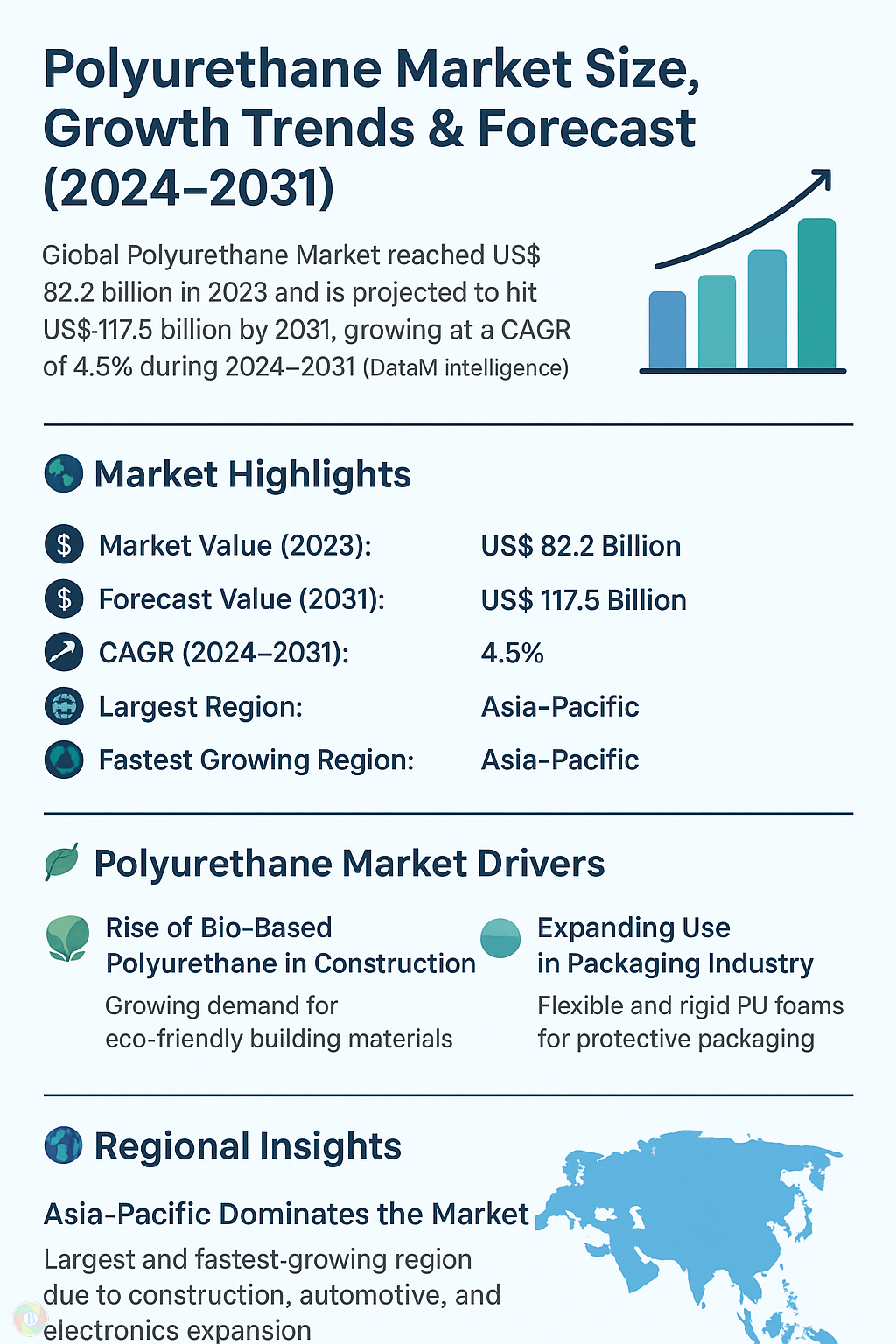 19.6K Views
-
OBC Market Trends: Global Valuation to Reach USD 163.34 Million by 2032 at 5.2% CAGR
The global Olefin Block Copolymer (OBC) Market is poised for significant expansion, with its valuation reaching USD 103.50 million in 2023 and projected to grow at a CAGR of 5.20% to approximately USD 163.34 million by 2032. This growth trajectory is driven by the material’s superior properties, including elasticity, heat resistance, and recyclability, making it indispensable across multiple industries such as footwear, adhesives, and infrastructure development.
Olefin Block Copolymers are engineered polymers with alternating hard and soft segments, offering a unique balance between flexibility and thermal stability. These qualities make OBCs highly sought-after for applications requiring durability and performance under varying conditions. The push toward sustainable material solutions is further accelerating adoption as manufacturers seek alternatives to traditional plastics.
Download FREE Sample Report: https://www.24chemicalresearch.com/download-sample/282692/global-olefin-block-copolymer-market-2025-2032-7641.5K Views -
-
Polyisoprene Market Size, Key Factors Analysis Report to 2034
Polyisoprene Market Overview
Polyisoprene, a synthetic and natural elastomer, plays a vital role in various industries due to its exceptional elasticity, tensile strength, and resistance to wear and tear. It is primarily used in the production of rubber-based products such as tires, footwear, adhesives, and medical devices. The market for polyisoprene is poised for substantial growth, driven by increasing demand in key industries, advancements in production technology, and expanding applications.
Market Dynamics
The polyisoprene market is heavily influenced by demand from the automotive and healthcare sectors. Natural rubber, a form of polyisoprene, is widely used in tire manufacturing, a segment that constitutes a significant portion of the market. As the automotive industry grows, particularly in developing economies, the demand for tires and, consequently, polyisoprene, is expected to rise. Additionally, synthetic polyisoprene is gaining popularity due to its consistent quality, reduced impurities, and controlled production processes.
In the healthcare sector, synthetic polyisoprene is a preferred material for medical gloves, catheters, and other medical devices due to its biocompatibility and hypoallergenic properties. The increasing emphasis on hygiene and the growing prevalence of surgeries globally are boosting the demand for medical-grade polyisoprene.
Natural vs. Synthetic Polyisoprene
Natural polyisoprene, derived from latex of the Hevea brasiliensis tree, dominates the market. However, fluctuations in natural rubber prices and concerns over deforestation have led to increased interest in synthetic alternatives. Synthetic polyisoprene, produced from petrochemicals like isoprene, offers superior properties for specific applications, including medical devices and high-performance tires. While natural rubber remains cost-effective, synthetic polyisoprene is gradually gaining market share due to its consistency and quality control advantages.
Read More @ https://www.marketresearchfuture.com/reports/polyisoprene-market-25579
Regional Insights
The Asia-Pacific region dominates the polyisoprene market, accounting for the largest share in terms of production and consumption. Countries such as Thailand, Indonesia, and Malaysia are major producers of natural rubber, supplying raw materials to both local and international markets. Additionally, the region's booming automotive industry drives demand for synthetic and natural polyisoprene.
North America and Europe are significant markets for synthetic polyisoprene, particularly in the healthcare and automotive sectors. Stringent regulations and a focus on sustainability have encouraged the adoption of synthetic variants in these regions. Meanwhile, Latin America and Africa are emerging markets, benefiting from growing industrial activities and investments in infrastructure.
Challenges and Opportunities
The polyisoprene market faces challenges such as price volatility of raw materials, environmental concerns related to natural rubber production, and competition from alternative materials like styrene-butadiene rubber (SBR) and nitrile rubber. However, these challenges also present opportunities for innovation and growth. For instance, advancements in bio-based synthetic polyisoprene and sustainable cultivation practices for natural rubber are gaining traction.
The increasing demand for electric vehicles (EVs) also offers significant growth potential for the polyisoprene market. EVs require high-performance tires, creating opportunities for synthetic polyisoprene with enhanced properties. Additionally, the rise in disposable medical devices post-pandemic has further emphasized the importance of synthetic polyisoprene in healthcare.9.8K Views -
-
-
-

More Results


